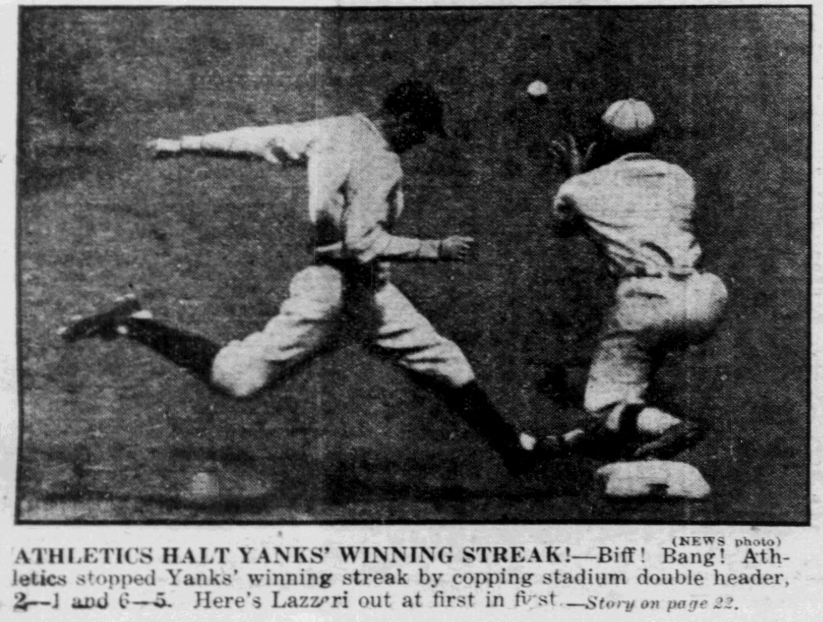
A's Kibosh Yankee Streak as Lefty Grove Plays Executioner
The Yankees' 16-game winning streak came to an abrupt end as Lefty Grove and the Athletics swept a Philadelphia doubleheader. Plus, Paul Gallico reflects on the glory and heartbreak of life on the pitching mound.
Content from the NY Daily News - Saturday, May 29, 1926
In This Edition
A's KIBOSH YANKEE WINNING STREAK
MACKMEN TAKE BOTH GAMES FROM HUGMEN
Lefty Groves Again Stops Pennant Chasers.
By MARSHALL HUNT.
They sharpened up their butcher knives,
Their sabers, long and keen,
And envy filled their evil eyes
At sight of sweet Sixteen!
All gathered 'round with lustful looks,
They whet their guillotine.
Then Robert Grove released the blade—
THERE WAS NO SEVENTEEN!
—Modern Yankee Ballad.
May 28, 1926, was the exact date when the magnificent sixteen-game winning streak of the Yankees became a two-game losing streak as quickly and dramatically as though it had come under some inscrutable occult control; the precise day when the resplendent Yankee pageant, with its tinsel and blaring trumpets, off to surpass the American League consecutive games record of nineteen, halted, then marched to the rear with muffled drums.
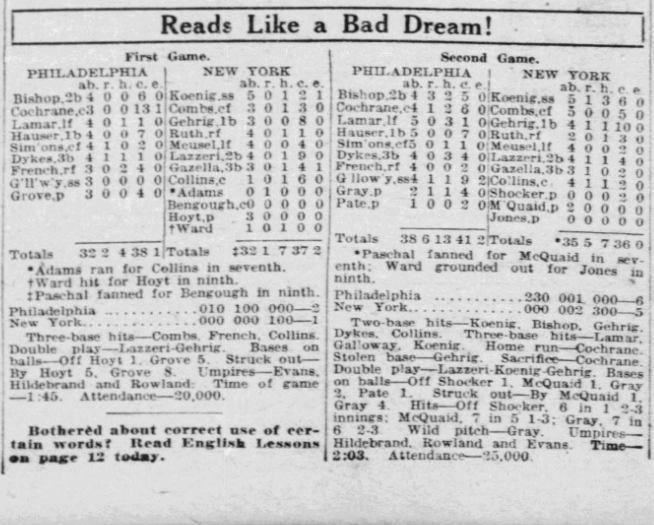
It all came about yesterday because they lost two games to the Philadelphia Athletics here, the contest which guillotined their winning streak by a score of 2 to 1, and the next by 6 to 5.
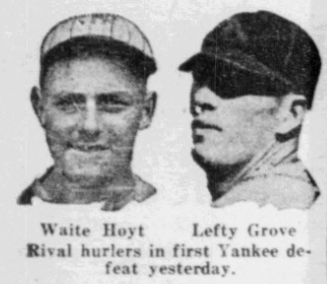
It was Lefty Grove against Waite Hoyt in the game which ended the procession—the same Lefty Grove who stopped the Yanks not long ago after they had won eight straight. Grove against the student mortician, who should have shared a better fate, for he held the A's to only four hits and might have won had not Master Mark Koenig erred in the second inning, a fumble which gave the Pachyderms an opening, which they seized with avidity.
The Athletics started out murderously in the second installment, a homer by Mickey Cochrane in the first round and triples by Chick Galloway and Bing Miller in the second causing the removal of Urban Shocker.
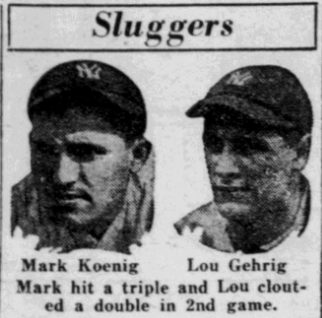
Long distance hits by Koenig and Lou Gehrig in the sixth and other bludgeoning in the seventh caused the end of Sam Gray and the Yankees came within a run of tying the score. They fought on, to get two gents on base in the ninth but, alas, there they remained.
And, all during the march to the rear the weapon of Babe Ruth was all too silent.
As chronicled above, it was a fumble by Mark Koenig in the second inning of the first game which left a gap open for the vengeful Athletics to guillotine the beauteous winning streak of the ambitious Yankees.
Koenig gummed up Al Simmons's roller and Al took third on a single by Walter French. Chick Galloway forced out French, but the football tactics of the latter not only ruined a double play which would have retired the side, but permitted Simmons to score.
A single by Jimmy Dykes in the fourth and a triple by French gave the A's their second and winning run.
Lefty Grove struck out eight, but he yielded seven hits and how they were wasted!
Nine New York gentlemen were left on bases. Opportunity after opportunity to score was piffled away and it was an error in the seventh inning which finally enabled the Yanks to score their solitary run which precluded a shut-out.
Mike Gazella singled and Pat Collins walked. Hoyt fouled out. Koenig's single filled the bases. Spencer Adams ran for Collins. Earle Combs tapped to Grove. Gazella was forced at the plate and a double play at first would have succeeded had not Gordon Cochrane made a wild throw to Joe Hauser which let in Adams. Lou Gehrig fanned for the third time.
Boo! Take Him Out!
By PAUL GALLICO.
You would think that hanging around good ball players would do some good, and I thought it would, because I spent a good part of Wednesday afternoon on the ball field up in Boston watching Walter Beall and Sam Jones warming up, hoping to discover something that would stop an outcurve from breaking the minute it left the hand. Beall and Jones and I are all right handers, but Walt and Sam are much better. I think that stuff about being inspired by watching good performances is the bunk. Mr. Frank Dolan, the redheaded reporter who works up in the front of the paper where we sport people are allowed only on very special occasions, was very soothing about it yesterday morning when I tried out what I had learned, with him as a battery mate, but the bitter truth was only too evident. I’ll never be a pitcher.
Pitcher is the best job on a ball club. He works harder than anybody else, but he gets all the attention in addition to his salary. True, he shares it with the batter, but what a bum he can make out of the eager figure waving a stick at him. True, the batter can make as big a tramp out of him by leaning on one in a crucial moment, but it’s the pitcher that starts things. Nothing can happen until he delivers the ball. In my estimation, make or break is in his hands. When he blows, the game blows with him.
It is a humiliating moment for a pitcher when he gets the eye from the bench and before anywhere from 10,000 to 50,000 citizens he marches off the field. But the ledger is balanced, when some famous batsman strides to the plate before those same thousands, the bases are filled and a hit means a victory, only to prove a toy in the hands of the man on the mound. After the slugging hero has taken his three windies the pitcher can afford to be yanked publicly a few times. He has experienced the sweetest of all sensations, eh?