Lou Gehrig's 12th-Inning Hit Lifts Yankees as Cubs Sweep Dodgers
Lou Gehrig's twelfth-inning single lifted the Yankees over Cleveland, while the Cubs swept a doubleheader from Brooklyn and the Giants pounded Cincinnati for their third straight victory on July 10, 1926.
In This Edition
- Gehrig's Wallop Beats Indians, 4–3
- Dodgers Drop Two to Cubs, 6 to 4; 3 to 1
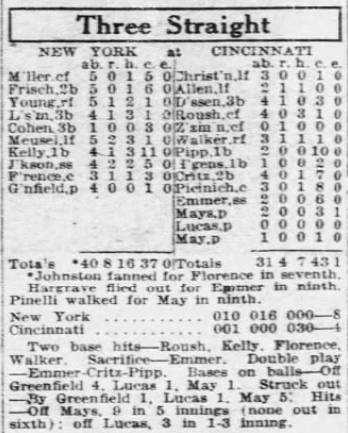
- Giants Take Third Straight from Reds
GEHRIG’S WALLOP BEATS INDIANS, 4-3
PASCHAL SCORES WINNING RUN IN TWELFTH INNING
By C. A. LOVETT.
A venerable Texan inserted himself into a torrid twirling tussle between Joe Shaute and Urban Shocker before some 20,000 swelterers at the Yankee Stadium yesterday afternoon and made for much higher temperatures under such wilted collars as were not earlier shed.
But the Lone Star stater, while he accounted for all three Cleveland runs and sent the game beyond normal limits, was by no means the lone star of the hectic fracas. Nor could Tris Speaker prevail lone handed against the bludgeoning of the league leading Yankees.
The home crowd won 4 to 3 in 3 hours and 20 minutes on Lou Gehrig's solid single to left with the bases full and one out in the twelfth. Ben Paschal made the victory possible by rapping Joe Shaute, who went the full distance for Cleveland, for a long triple to center, after which Joe Dugan and Babe Ruth were purposely passed.
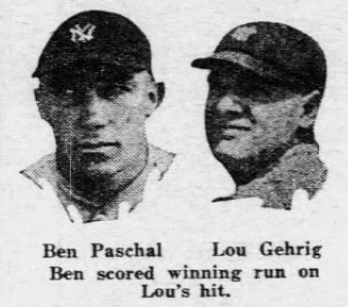
Lou resented the slight by slapping the first ball pitched past Joe Sewell, and Paschal romped over with the deciding tally.
Miller Huggins's men should have won in the eleventh. Tony Lazzeri opened with a single to center, but Speaker nailed him trying to stretch the hit. Aaron Ward followed with a long double to center that was wasted when Bing Miller gathered in Benny Bengough's liner to left and doubled Ward off second.
Tony Lazzeri, with his twelfth big league circuit clout; Joe Jamieson, with a sparkling catch, and the throw to the plate with the bases full and the score tied, and a circus grab by Earle Combs that averted disaster in the first extra inning were other factors in the mad procession of events, a long weird admixture of keen and dumb baseball.
A sandstorm followed by a thunder shower halted proceedings for a half hour midway in the eleventh, but play was resumed shortly before 6 p. m.
Tristram opened the pyrotechnics with a solid slam that rolled to left center field bleacher ramparts in the fourth.
The tribe went out in front again in the eighth when George Uhle laced a slow ball for a double down the left foul line after two were gone, and Spoke lofted down the right marker for a fluke double, counting Spurgeon, and scored on George Burns's single.
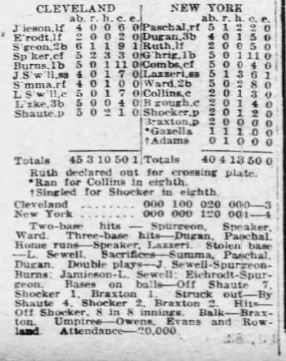
The score:
DODGERS DROP TWO TO CUBS; 6 TO 4; 3 TO 1
By CHARLES HOERTER.
Chicago, July 10.—All is not well in the camp of Wilbert Robinson tonight, the reason being that the Dodgers, who came here with their heads lifted high, dropped a double header to those pesky Cubs today.
The scores were 6 to 4 in eleven innings and 3 to 1 in regulation frames. It was the third straight licking suffered by the Dodgers at the hands of the Cubs.
It would not be an untruth to say the Dodgers were faced with a double jinx in both games.
In the first game, Jess Petty, after pitching a good game, fared his usual fate.
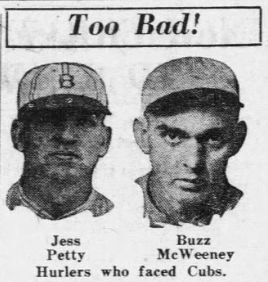
In the second, Douglas McWeeny, formerly of the White Sox, was honored by the fans, but, as is usual in most cases of that sort, McWeeny was forced to leave before the game terminated.
Percy Jones, a pint sized southpaw who is most always effective against the Dodgers, continued the tradition in the second clash. For eight innings he stood them on their heads, allowing a hit here and there, but never really being in danger.
Then in the ninth, with his team three runs to the good, he let up somewhat and gave the Dodgers their only run.
Don't let it be said that McWeeny didn't hurl a good game. After the Cubs had scored twice in the third on successive hits by Sparky Adams, Cliff Heathcote, Freigau and Hack Wilson, there was not a single hit during the next four innings. In the eighth he was taken out for a pinch hitter and replaced by Rube Ehrhardt, who gave the Cubs their last run.
GIANTS TAKE THIRD STRAIGHT FROM REDS
Plaster Three Pitchers for Sixteen Hits.
Cincinnati, July 10.—Despite numerous pinch hitters, extra fielders and the efforts of three Red pitchers, the Giants won the third game of their first road series, 8 to 4.
The small crowd of about five thousand was afforded one of the most pleasing sights to the average fan when Umpire Pete McLaughlin was wounded above his right ear by a vicious foul tip. For five minutes in the sixth inning the efforts of Jamieson, the Giant trainer, were needed to stop the flow of blood.
However, so many of the Giant players crowded around to witness the treatment that the fans could only see the blue cap on Umpire Pete’s head.
Since leaving the Polo Grounds the House of John McGraw seems to have recovered its individual batting eye. Today, for example, they divided sixteen hits impartially to all corners of the field and easily scored their eight runs. At this rate they can bat their way through the west and up into the pennant race.
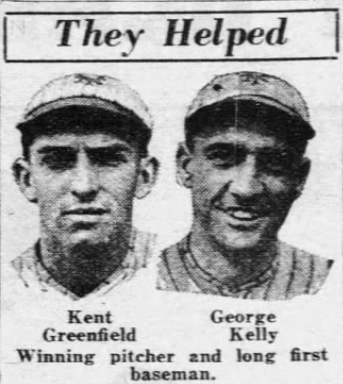
One run ahead up to the fifth inning the Giants batted all the way around in the sixth, scoring six runs on six hits, including a two bagger by Florence, and a base on balls to George Kelly.
After that Greenfield just coasted along, although he allowed three runs on four hits in the eighth.