Old Stars Fade as Yankees Roll On: Baseball Reflections from June 6 1926
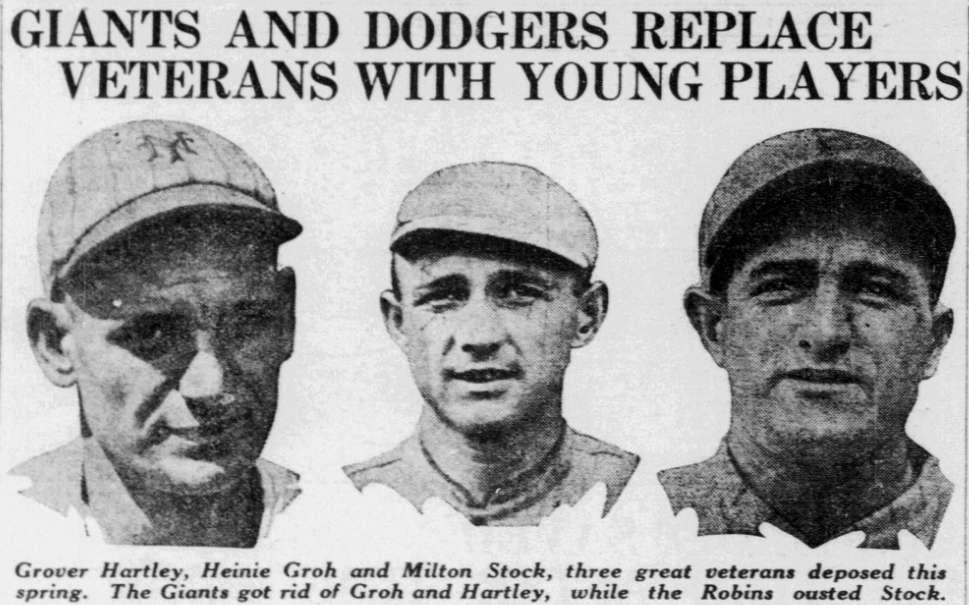
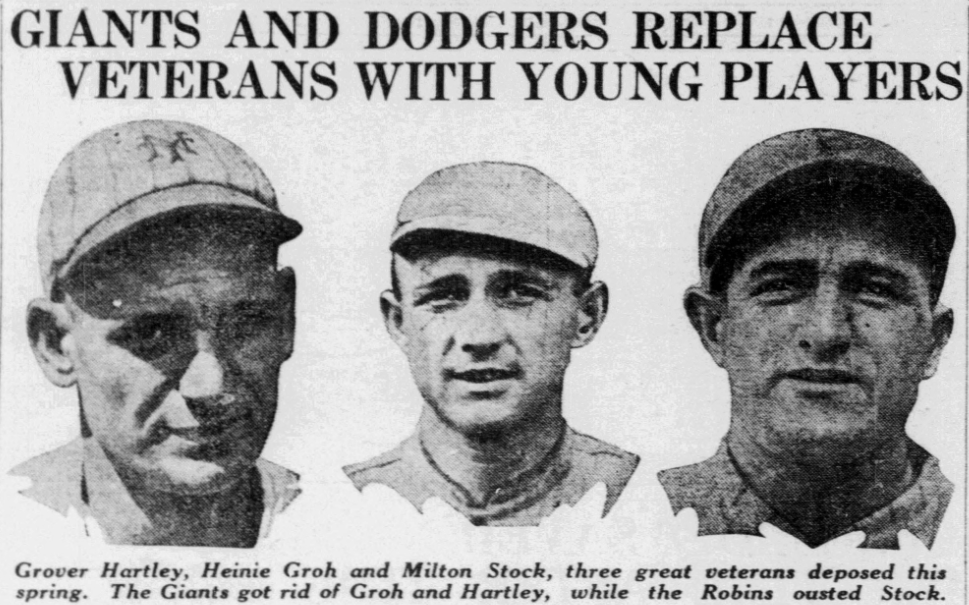
As the Yankees rode a seemingly charmed winning streak, baseball writers also reflected on the passing of an older generation. Heinie Groh, Milton Stock and Grover Hartley were among the veterans leaving center stage as younger stars reshaped the game in 1926.
Content from the NY Daily News, Sunday June 6, 1926
In This Edition
- Old Stars Passing From Majors
- ‘Breaks’ Aided in Yank Winning Streak
- Western Nines to Get Test in Eastern Games
- Advertisements
OLD STARS PASSING FROM MAJORS
GIANTS AND DODGERS REPLACE VETERANS WITH YOUNG PLAYERS
Delayed Departures From Leagues Come in Bunch.
By WILL MURPHY.
They pass a ballplayer when he is young and lusty.
When he is old and the charley-horses trammel his legs, they pass him on.
The eager young batter is sent a-walking, gratis, to first base, lest he drive the ball to the far places and shatter the ball game beyond repair.
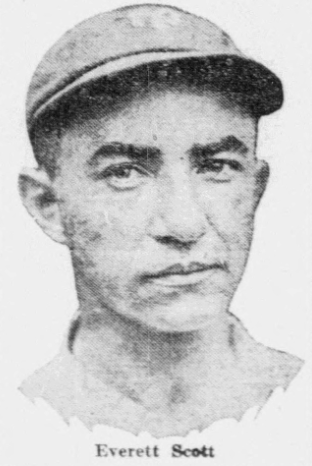
The elderly athlete, his eyes fading and his dogs growing cold, is sent a-riding, by rail, to Toledo or St. Paul, lest he be hit on the head by a fly ball and ruined for all purposes.
Many Have Gone.
These melancholy reflections are induced by the removal, probably final, of certain seasoned performers from the major leagues to the provinces.
In a few days this spring, the New York Giants cut loose Heinie Groh, the Brooklyn Robins set Milton Stock on the doorstep and rang for somebody to take him away, and the Giants again shifted Grover Hartley to the American Association, from whence he came.
And it seems as though more of the familiar props of our national obsession are about to be knocked from under. Last year and last winter saw the severing of an untold number of bald and graying baseball heads, and this summer will see the process continue.
They do say that the rabbit glands grafted onto the official baseball back in 1920 or thereabouts caused many an old-timer to "stay in the league," as the players have it. The postponed departures of these veterans seem to be coming all in a bunch.
Henry Knight Groh, to give his name the way it appears in the realty reports in the Stadthaus at Cincinnati, his home town, was born at Rochester, N. Y., Sept. 18, 1890, according to the record books.
The same diverting volumes have it that Heinie played ball for Oshkosh in the Wisconsin-Illinois League in 1908, when he must have been only 17 years old. Precocious, Heinie was, or else the record books are lying, which has been known to happen.
Anyhow, Heinie had passed the infant prodigy stage when he left the Giants last month. He was just starting his nineteenth season of professional ball. His career is too well known to need any relating here. From about 1919 until time put its leaden grip on his ankles, Heinie was right up with the best third basemen in the business.
Has Wide Fame.
He won't ever need any benefits. Always a saving citizen, Heinie made good money according to the going rate for third basemen. He cut in on four World's Series. At last reports he was playing good ball for the Toledo club and can probably go on for a few seasons more in the American Association before he retires to his comfortable home in the Cincinnati Rhineland.
Groh's squat figure and peculiar stance at the bat made him known throughout the land, but he was good enough not to need his trick bottle bat as a boost toward fame.
Milton Stock, not yet 33 years old, was originally a John McGraw development, but was with the Giants only one full season, in 1914. Later he played with the Philadelphia Phillies and St. Louis Cardinals, winding up in Brooklyn. Strangely enough, his best season was his last, 1925, when he hit .328, the highest average of his career.
This spring he was a Florida realtor and reported late, with a bad arm, perhaps from signing too many checks for commissions. Now he is in the Southern League. Always a good infielder, Stock was never a great one, but he had his moments last year.
Grover Hartley was a kid catcher with the Giants back when Christy Mathewson was still a great pitcher. He played around the big leagues—National, American and Federal—for years and then subsided for a long spell in the American Association.
Needing an experienced catcher last year, McGraw sent for Grover, who did good work and hit .316 for the season. The pace was too fast, however, for Grover's time-tried legs, and the A. A. has him again. He is with Indianapolis.
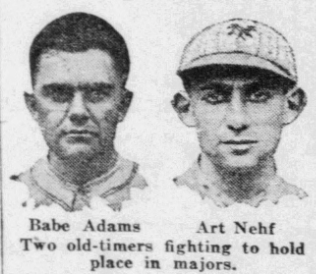
Many another, one guesses, is about to join these three in the minor leagues. There is Babe Adams, who pitched the Pittsburgh Pirates into a World's Championship away back in 1909. Babe is still on the payroll, but Bill McKechnie is using him mostly for decorative purposes.
There is Art Nehf, whose left arm won four successive pennants for McGraw. Art was let go by the Giants early this spring, went to Cincinnati Reds and was promptly knocked out of the box by his former associates. Max Carey, the pride of the Pirates since 1910, is spending a lot of time on the bench.
The old order changeth, yielding place to new, but it's hard to get used to the new names when the old ones meant so much to the baseball obituaries.
‘BREAKS’ AIDED IN YANK WINNING STREAK
OLD MAN HORSESHOES SAVED HUGMEN TIME AFTER TIME
Team Played Real Baseball, Luck Regardless.
By MARSHALL HUNT.
Did you ever stop to consider how hard it is for a baseball team to lose a game when it is in the midst of a healthy winning streak?
Well, even though you are pretty well acquainted with the theories and principles of this uncertain game of baseball and have an analytical mind and dabble in psychology or what have you, the chances are you can’t come up with a convincing answer to that question.
There are too many horseshoes with a winning club to apply any logical method of reasoning to its results. The law of averages should decree that a club can win just so many games in a row and then lose for a while, but yet there are times when this law is suspended and nobody can explain the reason for it.
You know that the New York Yankees , for instance, recently won a whale of a bunch of consecutive games, and if you look back over the way those games were won you are surprised and are given to considerable wonderment. There will be found a dozen places where the Yankees should have lost, but didn’t.
Pretty Breaks.
Old Man Harry Horseshoes was lending them all his physical and moral support and cheering them on like a good fellow.
What the boys call the “breaks of the game” were with the Yankees to the last break.
The New York Giants once won twenty-six consecutive games, a world’s record. That was in 1920. That amazing streak didn’t win a pennant for them, but probably it’s a record that’ll live until the Philadelphia Phillies cop a world’s championship, which makes the mark look comparatively safe for some time to come.
Inspect the remarkable string of Giant victories in 1920 and you will find that they should have lost many contests, but they didn’t because they were on a robust winning streak and every break was in their favor.
Horseshoes and breaks and luck are generous with winning teams and there’s no explaining why. Just one of those peculiar aspects of the ever absorbing game of baseball. A more just law of averages would insist that the breaks be awarded the teams in tough luck. But the law doesn’t work that way.
When the Yankees were plowing through all opposition with the power of a juggernaut, they were creating the longest winning streak in the history of the club. Some of their games were won by large margins and some by only one run. Yet a victory by one run meant as much to them as victory by a dozen.
Errors Aplenty.
Joe Dugan had been taken out of the game because of a split finger, and some of the cry mongers believed his absence would hurt the strength of the team.
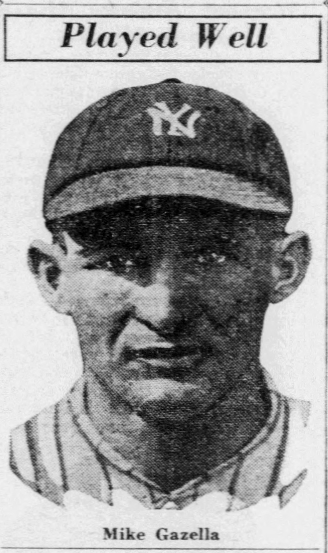
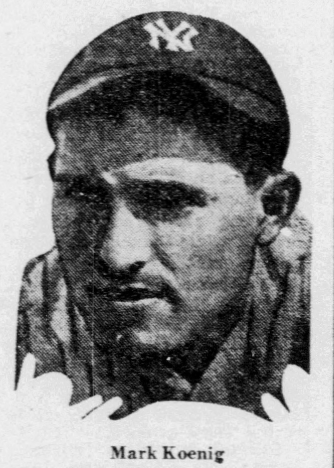
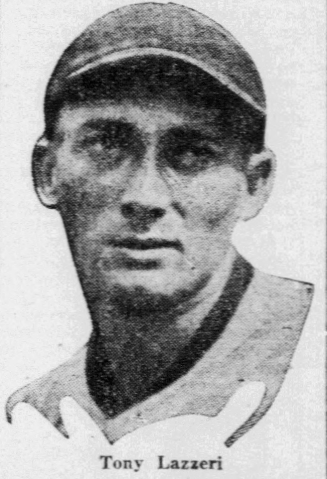
Joseph was relieved by Mike Gazella, who played acceptably enough, but he was guilty of several damaging errors which let in runs. Mark Koenig and Tony Lazzeri, two youngsters, were not faultless fielders during the winning streak. The Yankees once made four errors in one game, all of which were directly involved in the scoring of enemy runs.
None the less, the Yankees won those games they seemed destined to lose because the breaks were with them. The writer is not of the opinion that their own skill in late innings atoned for faulty plays in early innings.
Old Man Harry Horseshoes simply was riding the band wagon and getting a kick out of the big parade. He hadn’t been bribed or coerced or corrupted, because that’s an impossibility. The gentleman might be accused of being partial, but he cannot be approached. He favored the Yankees.
Some of the Yankee pitchers soured at moments during that streak. There were times when the flinging of Sam Jones, Herb Pennock, Bob Shawkey, Walter Beall, Garland Braxton, Urban Shocker and others was nothing to write home about. But they didn’t lose because That Something was with the Yankees and not with the other teams.
At a critical moment in a certain game Master Lou Gehrig took a swipe at a ball above his shoulders and got a double for his trouble which drove in two runs. There had been two strikes on him and two were out.
“Couldn’t Be Beat.”
“Why,” asked a reporter after the game, “did you take a cut at that ball when you could have missed it so easily and perhaps lost for the Yanks?”
“Aw, I dunno,” Lou replied. “Seemed like the Yankees couldn’t lose that day, so I took a chance.”
But above all things don’t let it be understood that this writer is striving to prove the Yankees aren’t entitled to as long a winning streak as they can get, and the American league pennant and the world’s championship, for that matter.
A team that tries as hard to win as the Yankees do and shows as fine a spirit as gents of Miller Huggins have shown is entitled to most everything in sight, even the helping friendship of Old Man Horseshoes.
Confidence and self-assurance indubitably flourish as a team gets farther into a winning streak and help it along, but it hardly can be denied that breaks also favor the winners for some inscrutable reason.
Explain it, if you will
WESTERN NINES TO GET TEST IN EASTERN GAMES
By JACK FARRELL.
Eastern baseball critics who have been contending that the western clubs of the National League will fade out as pennant possibilities soon after they set foot on seaboard territory are about to see their theories either blasted or confirmed. The western clubs open their first invasion of the east today.
Thus far, the west has had all the better of the intersectional clashes with the east. Only the Brooklyn Robins came close to getting an even break when the eastern clubs were in the west last month, and they won only five games while losing seven—six of them in a row—and tying two.
When the Robins started west they were leading their league. When they returned to the east they were lodged in fourth place. The New York Giants also flivvered badly on the trip, while the Boston Braves and Philadelphia Phillies almost dropped out of the league.
With the coming of the invaders, eastern fans will get an opportunity to size up a few new players who have been instrumental in keeping their clubs up in the race. The Pittsburgh Pirates, who open their campaign today at Ebbets Field, will show two valuable pieces of baseball bric-a-brac in Outfielder Paul Waner and Infielder Hal Rhyne.
The Chicago Cubs, who open with the Giants, will show the rejuvenated Hack Wilson, an old Coogan's Bluff favorite. Likewise they will present a pretty fair pitcher in Charlie Root.
The Cincinnati Reds have practically no new youngsters, but Gotham fans will get a chance to look at Red Lucas, who bids fair to be an outstanding twirler this season, and Wally Pipp, ex-Yankee.
ADVERTISEMENTS