Ruth’s Power, Hornsby’s Honor, and the Reds’ Rise - Baseball’s Big Stories of May 1926
Babe Ruth keeps hammering home runs, Rogers Hornsby prepares for “Hornsby Day” in St. Louis, and the Reds, Robins, Yankees, and Athletics all surge in the 1926 pennant races in this packed Sporting News special edition from May 20, 1926.
Content from the Thursday May 20, 1926 Edition of The Sporting News
Today's Sporting News
- Babe Keeps Ahead of Discipline and Right Up With Homer Record
- National to Honor Rogers Hornsby on May 22
- Fans Wait for Bucs to Begin Real Drive
- Macks Find It Can Be Done, and Do It
- Hendricks Getting Results With Reds
- Hack Wilson Feature: Good Enough for the Cubs
- Luckless Browns Still Floundering
- Boston’s Patience Fails to Hold Out
- They Played Yanks, But Met Babe Ruth
- Pitcher Lefty Grove
- Collins’ Pitching Trifle Wayward
- Senatorial Craft Keeps Even Keel
- Anyway, Mr. Ty Cobb Has His Earl Whitehill
- Uncle Robby Could Use Some Base Hits
- Scribbled by Scribes
- Casual Comment
- Baseball By-Plays
BABE KEEPS AHEAD OF DISCIPLINE AND RIGHT UP WITH HOMER RECORD
Heavy Batting Continues to Characterize Play of Yankees; John McGraw Sells Nehf and Lets Groh Go.
NEW YORK, N. Y., May 17.—After breaking even in the recent series with Ty Cobb's Tigers at Colonel Ruppert's Stadium, which drew more than 110,000 paid admissions and yielded $27,000 as the visiting club's rake-off, the Yankees maintained their grip on the leadership by taking three straight from the Cleveland Indians. It was so cold on Tuesday that the first game with Tris Speaker's men was called off. But after that the series, in spite of low temperature, drew a daily average attendance of 10,000.
The Yankees captured Wednesday's battle by a score of 6 to 5. The issue wasn't settled until the tenth inning, when a drive from Earle Combs' bat sent in the winning run. According to the official scorer, Lacey, who was playing third base, was guilty of an error on Combs' sharp grounder, but in the opinion of other observers it was a base hit.
A moment before, the Yankees had the bases filled with nobody out and the crowd was confident of victory. But a smart double play suddenly quelled the excitement, which turned into a mad frenzy of delight when the Yankees won. The Indians had tied the score in the ninth and looked dangerous in the last inning, but Urban Shocker managed to keep his balance to the end. He was touched up for 11 bingles, which were offset by 13 collected by the Yankees off Sherrod Smith and the elephantine Buckeye.
Although Babe Ruth went hitless in five times at bat in the opener, he lined out two home runs on Thursday and another—his eleventh of the season—on Friday. The score of the Yankees' second triumph was 13 to 9. It was an old-fashioned seesaw slugging match in which the Hugmen found Shaute and Karr for 16 drives, including two doubles, a three-bagger and three homers.
Ruth's Bat Scores Six Runs.
Waite Hoyt lasted less than six innings and yielded nine of the Indians' drives, but Sam Jones had enough skill to stop the enemy the rest of the way. Ruth's first homer was made in the opening frame and his second in the ninth. Both were hammered into the right field bleachers. The Great Bambino, who is determined to beat his own record of 59 circuit wallops, batted in six runs. Combs' four-bagger in the last inning, just before Ruth's clout, was a long smash inside the playing field.
The success of the Yankees was marked by an accident that put Joe Dugan, .400 hitter, out of commission, in the fourth inning. A bad grounder split the middle finger of his left hand from the nail, almost to the second joint. The club's sawbones took two stitches in the wound and said that Jumping Joe would have to be idle for at least a week.
In Dugan's absence, Mike Gazella has been playing third base in clever style. But the fans will be glad when Joe returns to action as he has been one of the important factors in keeping the Yankees at the head of the American League procession.
Cold and threatening rain didn't keep the regulars away from the Stadium on Friday. They were rewarded for their support with a battle of pitchers between young Myles Thomas, late of Toronto, and Emil Levsen, of the Indians. Levsen held the Hugmen to two hits, one of which was Ruth's eleventh home run in the first inning with Lou Gehrig on base, while the other was a single by Pat Collins in the second.
The Speakers gathered six safe drives off Thomas, who lost a shut-out when Eddie Lutzke tripled in the seventh and ran home on an infield out. Neither team made a fielding misplay, but Thomas received the more brilliant support, particularly from the kid infielders, Mark Koenig, Tony Lazzeri and Gazella.
Babe Up With His Record.
Ruth's four bagger, by the way, was the 320th of his major league career. As usual, his wallop landed in the right field open stand. Incidentally it was the anniversary of his eleventh home run made during the year that he hung up the world record.
The pitching of Thomas not only was a revelation, but also strengthened the argument that Miller Huggins should give his young boxmen more work. Strange to say, Hoyt, who outclassed the other veteran pitchers of the team early in the campaign, has shown an inclination to go backward in recent games. Thomas has set a fine example to the other colts—Braxton and Beall—who would help the Yankees wonderfully if they should flash winning skill.
After the struggle with the Tigers, on May 9, when the Stadium's turnstiles recorded 52,000 admission, ill feeling between the teams brought about an exchange of punches under the grandstand. It seems that Gehrig, when hit on the hand by a fast curve, was under the impression that Earl Whitehill had tried to bean him.
"I'll meet you right after the game and give you a good beating," yelled Gehrig.
"You're on," retorted Whitehill, ablaze with anger. Sure enough when the last man had been retired, Gehrig and Whitehill hurried off the field, each vowing vengeance. They were about to hook up in combat when the eminent Mr. Cobb suddenly appeared. Gehrig forgot Whitehill instantly and turned on the Georgia Peach, who was ready to go into action.
"You've been riding me for a long time," shouted the Yankees' big first baseman, "and now I'm going to fix you."
Gehrig and Cobb ran into a clinch and fell to the floor. Rules of boxing and wrestling were ignored as they indulged in rough and tumble tactics. Suddenly Gehrig's head collided with the concrete wall and he was "out" to all intents and purposes.
As Cobb jumped up he was confronted by Ruth. Eye witnesses say that they swung harmless blows for a moment before players of both teams jumped between them. Ruth followed Cobb into the Tigers' dressing room, where half a dozen members of the visiting team literally threw him outside. The feud received considerable publicity, but there was no evidence of hostility when the teams met the next day. All of which shows that the Yankees are fighting for everything worth while.
John McGraw, after assuming control of the Giants in Chicago, saw them play several ragged games. Soon he decided to resort to drastic action. After subjecting the New York players to a severe tongue lashing in St. Louis, he exploded a bomb by selling Art Nehf to the Cincinnati Reds, and releasing Heinie Groh unconditionally.
Both Nehf and Groh were drawing large salaries, so that their sudden departure was taken to mean that McGraw was determined to reduce expenses. Nehf had been of little use in the box since 1924. His arm bothered him all last season, but in Florida recently, he said that he felt sure of staging a comeback.
Before Nehf had an opportunity to show that he could pitch as well as ever, he broke one of the fingers on his right hand, which kept him idle for several weeks. Lately he had shown flashes of his former skill, but the axe fell just the same.
If Nehf makes good with the Reds, he will prove his assertion that he was bothered by McGraw's signals from the dugout.
The passing of the popular and gentlemanly Groh, was a foregone conclusion after the permanent assignment of Freddie Lindstrom to third base, yet Groh, no longer bothered with a weak knee, had played smart ball on numerous occasions this Spring, and wielded his bottle bat with excellent results.
Groh was declared a free agent because he was a ten-year man. He is 35, and first was a Giant nearly 15 years ago, when he was a trifle too young to win a regular position in the Giants' infield. But after he had become a star in Cincinnati, McGraw paid $100,000 in real money, and traded George Burns to land him.
Groh and Nehf helped the Giants to win pennants. They were extremely popular here and many fans will miss them. It is needless to add that they leave New York with the best wishes of thousands of sportsmen who realize what they have done for the National game.
Travis Jackson may be lost to the Giants for many weeks. In St. Louis last Thursday, he twisted his weak knee while sliding to the plate and was carried off the field.
McGraw later announced that he had exercised a purchase option on Andy Cohen, the young Jewish shortstop with Waco of the Texas League. He had to recall Novak from the Virginia League and send him to Waco along with $30,000 cash to swing the deal.
JOE VILA.
NATIONAL TO HONOR Rogers Hornsby ON MAY 22
Six-time Batting Leader to Receive Medal and $1,000 Prize as League's Most Valuable Player.
ST. LOUIS, Mo., May 18.—Rogers Hornsby, manager and second baseman of the St. Louis Cardinals, will have his day at Sportsman's Park here next Saturday, May 22, when the honor of being the National League's "most valuable player" in 1925 will be conferred on him. The day has been designated as "Hornsby Day" and President John A. Heydler and other prominent baseball personages will be here for the occasion.
Hornsby will receive a bronze medal emblematic of the high honors he earned last season and also the $1,000 that goes with the title. James M. Gould, president of the National Baseball Writers' Association, will make the presentation prior to the game with the Phillies.
Hornsby, called the greatest natural batsman of modern times, has led the National League hitters six consecutive seasons. He began his leadership in 1920 with an average of .370 and in 1921 had .397; 1922, .401; 1923, .384; 1924, .423, and 1925, .403. The old National League high mark for consecutive batting leadership was five straight years, a record held by Honus Wagner.
What makes Hornsby's record the more remarkable is that in three of his championship years he has batted more than .400. His figure of .423 in 1924 was the highest a major league player had ever batted in so-called modern baseball history.
The record for the majors in consecutive batting leadership is held by Ty Cobb of Detroit. He topped the American League hitters nine years in a row, from 1907 to 1915. Friends of Hornsby believe that he will shatter Ty's record.
Giants Get Indianapolis Catcher.
NEW YORK, N. Y., May 18.—Manager John McGraw of the Giants, continues to make changes on his team. Yesterday he announced that he had obtained Catcher Paul Florence from the Indianapolis Club of the American Association, turning over Grover Hartley, veteran receiver, and Pitcher Wisner in the deal. An option is kept on Wisner. Florence is a 23-year-old Chicago lad, who was with the Giants in 1924, being released last Spring to Indianapolis. He stands six feet, one, weighs 185 pounds and is a turn-around hitter.
Another Record for Ty Cobb.
PHILADELPHIA, Pa., May 18.—When Ty Cobb batted in the fourth inning of yesterday's game with the Athletics, it marked the 10,428th time the Georgia Peach had gone to bat during his career in the American League. That broke the record of 10,427 times at bat held by Honus Wagner, the old Pittsburg star. Cobb has been with the Detroit team since August 28, 1905.
St. Paul Buys Pitcher Foss.
FORT WORTH, Tex., May 18.—Business Manager LaGrave of the Fort Worth Club, has announced the sale of Pitcher Deebie Foss to the St. Paul Club of the American Association. Manager Jake Atz is making a number of changes on his six-time pennant winners, who have not been going well this season.
Jackson Releases Heck As Manager.
JACKSON, Miss., May 18.—The local team of the Cotton States League, is playing under the direction of Catcher Ray Gillenwater for the present. He was placed in charge of the team temporarily when President Brannon gave Manager Fred Heck his release.
Andy Woehr Goes to Shreveport.
SHREVEPORT, La., May 18.—Andy Woehr, star third baseman of the Beaumont team last season, has been purchased by the local club. He will be used as utility man. Woehr managed Beaumont part of the 1925 season.
Wichita Buys Elmer Phillips.
WICHITA, Kans., May 18.—President Frank Isbell, of the local Western League club, has announced the purchase of Pitcher Elmer Phillips, from the San Francisco Seals of the Pacific Coast League. He is a young right-hander.
FANS WAIT FOR BUCS TO BEGIN REAL DRIVE
BATTING SHOWS SIGNS OF COMING INTO OWN WITH BANG.
Paul Waner and Hal Rhyne Continue to Be Numbered as Regulars; Attendance Figures Hand Lie to Crepe Hangers.
PITTSBURG, Pa., May 17.—The calamity howlers, who are forever predicting the downfall of baseball as an American institution, are getting another swift kick in the slats this Spring. Professional grumblers have been trying to force down the throats of baseball followers for some time a belief that the grand old national game is not what it used to be, and that gradually interest in it is decreasing. But they are not getting much satisfaction out of the present baseball season.
Despite the fact that the season has been decidedly backward, so far as weather conditions are concerned, most of the big league teams are rejoicing over the liberality of their patronage. Here in Pittsburg a falling off might have been expected, for no team in either circuit got off to a more disappointing start than the world's champion Pirates. For several weeks they floundered about as if they didn't know in what direction they were headed.
In addition to this, the weather here has been so cold that fans who went to the ball yard braved pneumonia and kindred ills. And yet the attendance here has been fine right along, and is expected to reach the high mark this week in the series with the New York Giants, who arrive Wednesday for four games.
From numerous other cities, similar reports are being received. The recent series between the Giants and the Cubs in Chicago attracted more than 110,000 people, and Secretary Brannick, of the New York Club, stated that the check handed him at the close for the Giants' share was the largest the Giants had ever received for a similar engagement in the Windy City.
All Along the Line.
Cincinnati has been profiting by the Reds' hustling qualities, and the attendance there has been all that Garry Herrmann could ask for. The Brooklyn Robins got off to a great start, and their early season games with the other Eastern clubs drew enormous throngs. The series with the Giants especially was a corker, so far as the size of the audiences was concerned.
From Boston and Philadelphia, reports are satisfactory. Attaches of every club that has appeared here this Spring tell the same story—that the interest and enthusiasm of the fans this Spring has been quite up to the mark, and that no club is complaining.
There is no reason to believe that any decided falling off in the crowds will mark the later stages of the campaign. A few of the clubs, which find the pace a trifle hot, may be deserted by a percentage of their following, but this will not be unusual. It takes a winning combination to draw enormous throngs, but the other teams get their share of the patronage, too.
The long home stay by the Buccaneers will come to a close this week. Some progress has been made by the champions, but they are still far from top form. Recently, however, there has been a marked improvement in the club's hitting, which is most gratifying. The outfit, though, is still far below its normal mark in this respect, and some of the men who were most strongly counted upon, have failed to get into their stride as rapidly as was expected.
Wright Not Yet Right.
Glenn Wright, last year one of the team's most consistent and timely smashers, has not yet gained the .300 circle where he belongs. There is one thing about Wright's hitting, though. It is timely if not heavy, at present. He has won several games by injecting a bingle at the proper moment, probably going hitless throughout the remainder of the struggle. He was handicapped for some time with an injured hand, which prevented him from getting the proper grip on his bat, and also affected his fielding. There is no doubt that this retarded him materially.
The Pirates have had a penchant this Spring for getting their runs and hits in bunches. In one game, they will pound opposing pitchers all over the lot for an inning or two, and then their attack will dwindle. Perhaps the following day, against the same club, they will be utterly helpless throughout the nine innings.
Paul Waner has been holding down the right field job, Kiki Cuyler having been shifted to the center garden, where he has always been just as much at home as in right. Waner is coming through in nice style, and is beginning to make the fans notice him. He looks the part of a finished ball player. A week ago, against the Boston Braves, he replaced Clyde Barnhart in the fifth inning, was at bat twice, and cracked out a double and a home run. He seems to have no fear of any opposing pitching, and his confidence breeds the belief that before long he will rank as one of the most effective clouters on the team.
Carey Taking It Easy.
Waner is a clever, speedy fielder, covering plenty of ground, and there is nothing wrong with his throwing apparatus. His acquisition was certainly a ten-strike, in view of the failure of Captain Max Carey to round into condition after his illness just as the training trip opened. Carey is still resting, but there is hope that he will shortly be his own self, and be able to return to regular duty. His vim and dash are missed, although mechanically his place has been very well filled.
When he returns, it remains to be seen just how the outer garden will be lined up. If Waner continues as he started, the chances are that Clyde Barnhart will again find himself decorating the bench.
It looks as if Hal Rhyne has permanently displaced Eddie Moore at second base. Rhyne looks better every day, and has pulled up a number of plays that have made the fans gasp in astonishment.
Moore is having his full share of hard luck. During the past week he was taken to a hospital, a victim of influenza, a disease that is not easy to shake off, and that often leaves a drag for weeks and months.
The Pirates have released [Joe Cronin](https://www.baseball-reference.com/players/c/cro nijo01.shtml), the sensational young shortstop, to the New Haven, Conn., club of the Eastern League. He is still held by a strong string, however, and can be recalled on five days' notice.
RALPH H. DAVIS.
MACKS FIND IT CAN BE DONE, AND DO IT
'TWAS MERELY MATTER OF GETTING STARTED WITH ATHLETICS.
Good Pitching and Decisive Hitting Quickly Lift Team Out of Mire; Phillies Go to the Bad on Road.
PHILADELPHIA, Pa., May 17.—In little more than ten days, the Athletics transformed a black picture into a bright scene that has excited the emotions of the fans here. By capturing successive series from the Yanks, Browns and White Sox, the Athletics have had an uninterrupted march up the percentage table highway. When this was written the Athletics had won ten out of their last 11 games, and were giving every indication that their wave of prosperity was not soon to end.
When the Athletics lost their final game with the Red Sox May 1, and lost to Washington at the capital the next day, conditions were most gloomy, for their record showed only six victories and twice as many defeats.
Then came the recovery. The much-heralded batting Behemoths of the Yank team moved to Shibe Park the following Monday and the Athletics surprised everybody by taking three straight. They followed this success against the Browns, winning four in a row.
Fine Display of Punch.
Victory in this final game was the kind that made hearts leap. The Athletics looked certain to be beaten, for they couldn't hit Thurston and the Sox had a four-run lead until the seventh inning started. Then they pared the hostile lead to two runs by suddenly finishing Thurston. Connally and the veteran Ray Schalk jumped into action and got the A's out without further damage. When Connally blanked the Macks in the eighth inning that two-run lead looked as good as a mile.
Then came the radiant ninth when the Athletics turned defeat into victory. Bill Wambsganss, who played superbly in all departments after relieving Jackie Galloway late in the game, started the ruin of the Sox by laying down a surprise bunt and beating it out. Frank Welch batted for Pate and shot a single to right that Barrett fumbled. Wamby hesitated, thinking there might be a catch, and had to stop at third, but Welch took second.
Then a bad break threatened to rob the A's of the fruits of their rally. Welch thought Wamby had scored, and on the first windup dashed to third and found Wamby there. Wamby didn't lose his head. While Welch was being pursued he saw Schalk leave the plate uncovered, so he bolted for home and scored, but Welch was finally tagged in a rundown. Still that looked bad with the bases bare and one out.
Bing Miller, however, started a fresh rally when he doubled to deep center, it being his third two-bagger of the game. Jimmie Foxx, who finished behind the bat, drilled a clean single to center and scored Bishop with the tying run. Joe Hauser then ended the game by whaling the ball against the right field wall, giving the Macks a glorious victory. Pate, who stopped the Sox completely after both Heimach and Walberg had caved in the second, received credit for the victory.
Phillies Worry Fletcher.
The Phillies struck obstacles both in Cincinnati and Pittsburg on their Western tour. They dropped three out of four on Redland Field and two out of three on Forbes Field. As a result of these defeats the team sank a bit lower in the percentage table. Manager Art Fletcher is now making every effort toward reconstruction. He has been silent as the Sphynx as to his plans, but in the Steel City the public prints asserted that he talked trade both with Pittsburg and New York. He refused to discuss these rumors, and declared he was not responsible for the guessing of outsiders who have been making trades for the Phils.
Fletcher's urgent needs are acquisitions to the pitching staff and infield. If he can improve these two departments he might sacrifice a player in a department where he is already strong.
The pitching bent badly on the trip and Clarence Mitchell, who had a record of three victories with no defeats, did not last one inning in Cincinnati, always the Black Hole of Calcutta for the Phils, and only three innings in Pittsburg. Mitchell blamed his sudden transformation from efficiency to the fact that his spitter has been misbehaving.
Jack Knight lost a tough one on the second day at Redland Field. He was leading 5 to 3 when Cincinnati came up for its bat in the last half of the ninth. With one out, Wally Pipp and Hughie Critz tripled and Bennie Picinich walked. Pinch Hitter Red Lucas, a pitcher who can hit, drove in the tying run with a single and a minute later Charlie Dressen broke the game up with a long hit over Harper's head.
Eppy Was Too Tough.
The Reds made it three straight when Eppa Rixey shut out the Phils with five hits on Saturday. Rixey was so good that he didn't give a pass, and only 29 Phils faced him in the nine innings. Carlson pitched well enough to win the ordinary game, the Reds scoring twice.
Wayland Dean saved one game for the Phils when he beat the Reds 4 to 1 before 20,000 fans on Sunday. Dean was strong in pinches and always kept his rivals in check.
The first two games in the Pittsburg series were debacles, the Pirates taking the first, 11 to 1, and the second, 14 to 3. The Phils looked bad in these games. In Wednesday's game the famous Kiki Cuyler-Glenn Wright-Pie Traynor combination was a team in itself. Each made three hits, while Traynor scored three runs and Wright and Cuyler two runs each. On the defense each contributed a sensational play. When Williams was at bat, Wright played on the other side of second base, and Traynor at short. Traynor made a one-handed stop of a ball Williams socked about five feet from the bag and stepped on the keystone for a force, ending the inning.
In this same game Wright made a backhanded stop on the grass in back of second and an equally artful backhanded threw to Hal Rhyne for a force. Then later on, Cuyler threw a strike from center field and pinched Huber at the plate.
JAMES C. ISAMINGER.
HENDRICKS GETTING RESULTS WITH REDS
PITCHING, FIELDING AND HITTING ALL WORK FOR SUCCESS.
Art Nehf and George Dumont Added by Cincinnati as Safeguards for Mound Staff; Bill Zitzmann Has Broken Bone Near Ankle.
CINCINNATI, O., May 17.—There's just one club in the National League that was given even mild consideration as a pennant contender which turned into the middle of May as such. Cincinnati has that ball club. The Reds of 1926 have not, so far at least, thrown down those who spoke well of them in the Winter and early Spring. They've been among the front runners ever since opening day and they've remained up there by playing darn good baseball.
The team has not been lucky. It has not fared as badly in the matter of injuries as some of its rivals, but it has not entirely escaped them, either.
But it has fielded better than any other team in the league, not only in the matter of percentage but also in the more important job of covering ground and converting budding hits into outs. It is hitting about as well as any outfit in the circuit, perhaps not as hard in total bases as some, but as consistently as any when hits mean runs. So far, the Reds have averaged better than one run for every four hits they have made and any club that does that and can back it up with good fielding and able pitching is bound to win.
And as for the pitching—Redland fans would like to see a better balanced staff than Jack Hendricks is bossing even though he has been using only six men.
Anyway, Cincy Is Satisfied.
Brooklyn's staff may be better than that of Cincinnati. We hadn't seen the Robins at the time this epistle was written. On paper, Brooklyn's pitchers may have something on the Redleg crew and they also may have something on our slingers on the ball field, too. But Cincy's staff has done well enough to suit the most exacting, and there probably are not more than two managers in the majors who wouldn't be willing to swap entire staffs with Hendricks and throw in something to boot.
So, with good hitting, excellent fielding and expert pitching, it is no wonder that the Reds have been rolling along, winning consistently and living up to the best things said about them before the starting bell rang.
Getting back to the matter of injuries, we'll cite something that should show that Cincy's team has not been entirely free of them. Just before the Reds prepared to get out of Florida this year, Hendricks began figuring on his regular line-up for the season and announced that Bill Zitzmann, in his opinion, was the best man of a quartet of outfielders who were candidates for the left field job. The Reds had been playing a string of vet-colt games and Zitzmann had been working all over the field, playing second, third, short and the various outfield posts.
As the team left Orlando, Hendricks announced he would put Zitzmann in left field and keep him there until he was satisfied he wouldn't do, if that time ever came.
The club's last stop in Florida was at St. Augustine, Easter Sunday, March 4. Zitzmann played third base for the colts. The championship of the training camp depended on this game. Hendricks offered a straw hat to each member of the winning team and the battle became as hot as any league affair.
A Belated Discovery.
Late in the game, in an effort to take an extra base, Babe Pinelli slid hard into third. Zitzmann tried to block him and was spiked in the right instep. The next night Bill was sent North from Atlanta. At first his injury was believed to be a spike wound and a bruised bone. He's been in uniform only a few days since the season opened and last Wednesday, more than two months after he was hurt, it was discovered for the first time that the bone in his instep was fractured. It would appear that carelessness somewhere along the line permitted him to walk around two months on a broken foot. Without any attempt to fix the blame for that, we state that that is what happened.
So, the club has gone along without the man the manager picked to be its regular left fielder and will have to do without him for several more weeks, as Bill has been sent to his home in Nutley, N. J., with orders to stay off the foot until it again is sound.
With Zitzmann out of the competition, Hendricks opened the season with Rube Bressler in left and the handy man has done nobly when able to play. He was leading the league in batting when forced to lay off the other day with a twisted right ankle, and in his place, against a southpaw pitcher, Hendricks had to use Walter Christensen, a left-handed batter who doesn't hit the crooked arms very well. However, the club continued to win and as this is written it looks as strong as any team we have seen this year.
Nehf and Dumont Added.
So far as pitching goes, the Reds now appear to be well fortified for whatever may happen, except, of course, a wholesale string of injuries. A week ago, the staff numbered seven men. It now numbers eight and every one of the eight is a man who has been through the mill.
Brad Springer, the young southpaw, was farmed out to Albany the other day when Hendricks got Art Nehf from the Giants and took on George Dumont from Minneapolis. Both are vets with long careers behind them, but pitchers of that kind usually make the best finishers of games.
For starting pitchers, Skipper Jack now has Eppa Rixey, Red Lucas, Adolfo Luque, Pete Donohue and Carl Mays, whom he plans to work in that order if all goes well. Working every fifth day possibly is not often enough for some of those fellows, but Hendricks now is experimenting with that order though not definitely committed to it.
Jakie May is his first relief man if it is not necessary to use him too often, and he is a whale in that role. Nehf and Dumont also are being primed for rescue work and none of the five regulars is above going in for a few innings now and then if called on.
One of these days a southpaw may beat the Reds, but in the club's first 28 games no left-hander who started against them was able to turn the trick, while several other southpaws who were sent in to stop Cincy's attack got whacked plenty.
At this writing, Emil Yde is the only left-hander to pitch a complete game against the Hendricks crew and he was beaten.
TOM SWOPE.
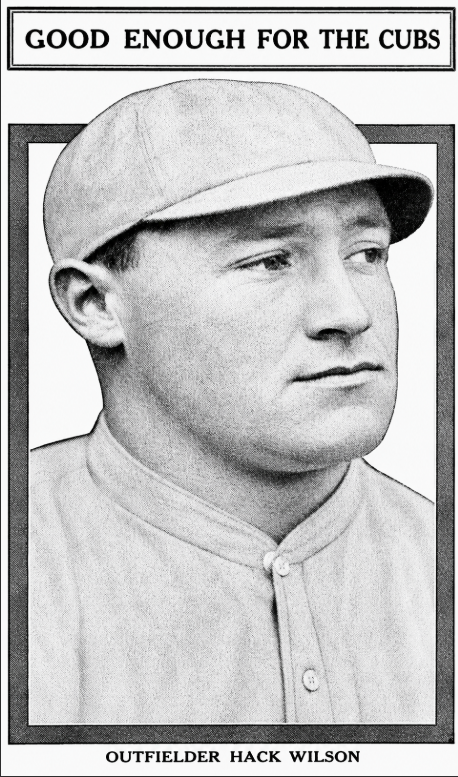
IF THERE is any single reason for the early showing of the Chicago Cubs, aside from the fact that Joe McCarthy has them playing anything but vacant lot baseball, it is due to surprising strength in batting. And if that reason can be condensed to an individual case, Mr. Lewis Robert (Hack) Wilson will please step to the front of the room. It has been Wilson's long distance batting in a number of instances that has represented the margin of victory and his clouts have also had an inspirational effect on the team in general.
Wilson is the underslung young man of balloon tire proportions, who once performed for John McGraw in New York. He didn't hit quite often enough or cleverly enough for the Giants, so was sent to Toledo last season, where he managed to ply his bat for .343 in 55 games. The Cubs drafted him from the American Association Club.
Wilson comes from the mining district of Ellwood City, Pa., and in Pennsylvania around the old Wilson home they will tell you that Hack was a better mining prospect than Stanley Harris ever dreamed of being. Anyway, Hack ducked out of a three-foot vein one Spring day and joined the Martinsburg team of the Blue Ridge League. That was in 1921, and he did so well he popped up with Portsmouth of the Virginia League, in 1923. McGraw grabbed him that Fall and he did good work in stretches in 1924.
Wilson is 26 years old and totes around 185 pounds on a five-foot-eight frame. He bats right-handed and throws from the same side.
LUCKLESS BROWNS STILL FLOUNDERING
CRIPPLES ARE NOW ON MEND, AND BETTER DAYS MAY COME.
George Sisler's Team Wins But Two Games Out of First 11 on Road; Cards Whet Batting Eyes Against Braves.
ST. LOUIS, Mo., May 17.—Have you ever sat in at a little poker, emphasis on the sat, and it just happened that your luck was on a trip to the North Pole? You simply could not get them. When you did fish out something, another guy kicked you higher 'n Ben Franklin's kite. Hand after hand beaten, no matter what you held. Then some wise-cracker chirps up and says: "Well, old-timer, I'll tell you. Luck like yours generally runs along about the same until after 12 o'clock and then—then it gets worse."
That's the way it has been with the St. Louis Browns.
It has got to the point where some of the St. Louis boys who wagered from hats to next Winter's overcoats with Pat Monahan that the Red Sox would finish in the cellar, and for which Pat has been nicknamed the "well-known outfitter," are becoming a bit panicky, lest the Browns beat them out of their hats. The Browns thus far have been giving the Red Sox a real contest for the booby prize.
Since the last epistle there has been no change in the fortunes of George Sisler's team. In their leading up to the final game in Washington they had dropped seven straight games. This consecutive run in reverse was capped with the ignominy of having been beaten by Joe Bush, who partook with the Brownies last season. The run of defeats started in Philadelphia, where four straight were lost, and continued through the first three in the Capitol city.
When Will Things Change?
With crippled infield, one member of the outfield laid up and morale half shot, the Browns were easy for both Washington and Philadelphia. In fact, of the first 11 games played on the present road trip, the team had won but two of them. At Washington, Sisler used Outfielder Harry Rice at second, Second Baseman Marty McManus at third and Wally LaMotte was at short. This switching about was made necessary because Wally Gerber, Gene Robertson and Oscar Melillo were laid up.
Then, in the final game with Washington, Sisler twisted an ankle in making a slide, and upon arrival in Boston he was not fit to play. However, it rained the first day and the next day was Sunday, so Sisler was able to nurse the injury along.
Some of the cripples are about ready to return to the lineup. Gene Robertson was about in shape after his injury, when he received word of the death of his brother and was called home. Gerber's smashed finger is again O. K., and with Robertson back McManus will be able to return to second. Melillo, by the way, has been playing with a side that has pained him for two weeks. He was hurt in the Detroit series, but did not take very much time out, because he just had to be in there.
Joe Giard is one of the new cripples. He was sent back to St. Louis when he confessed to Manager Sisler in Washington that he had had a sore arm all year. He had kept the matter to himself, thinking that it would work out. But it finally gave him so much pain that he told the manager. Melillo's bad arm is being given a rest and it is expected it will come around before long.
In dropping four straight to the Athletics, the Browns were beaten 3 to 4, 5 to 1, 14 to 0 and 3 to 2. In the latter game, General Crowder Gaston pitched well enough to win nine out of ten times, but Al Simmons' home run and double helped toward his undoing. The 14 to 0 rout saw Bill Bayne and Ray Vangilder batted to a fare-thee-well.
Four Hits Off Bush.
In Washington, Walter Johnson was battered in good shape in the first game, but Tom Zachary could not hold his old mates. Joe Bush worked in the next contest and held the Brownies to four hits. It was a big day for Joe because he likes to whip former teammates. Which recalls a little story told by Owner Phil Ball of the Browns.
The local club got Bush from the Yankees a year ago, and he had it in for the New York Club. The Browns, on a visit to Colonel Ruppert's Stadium in a series after mid-season, were a bit used up for pitchers. Bush had been taking it easy because of a purported sore arm. But when he learned he could draw the assignment against the Yanks, if he wanted to, according to Ball, he asked for the opportunity to work, sore arm and all.
"You know what Bush did with that bum whip that day?" asks Ball in telling the story. "He beat the Yankees to a frazzle." It has not been learned if Joe had a sore arm when he worked against the Browns the other day.
While weak pitching is one of the reasons for the flop of the team thus far, a glance at the last batch of averages gives further evidence of the complete breakdown of the team. In the first place, the Brownies are last in fielding. They have made more boots than any other team in the league and there are a lot of other kinds of boots which do not show in the tabulations. Their fielding mark stands at .951.
In batting, the crowd of clubbers who are accustomed to something like .300 for a team average, are resting in seventh place, just above Boston, with a mark of .251. Yea, the bottom has fallen out of everything.
Business Manager Bill Friel last week announced the release on option of two young players. Catcher Tom Porter, the former Oglethorpe athlete, has been sent to the Terre Haute Club of the Three-I League, while Dennis White, California semi-pro pitcher, is with Jeannette of the Middle Atlantic League.
Cards Go Along Even.
The Cardinals have done nothing sensational since hitting the home soil, but neither have they fared so badly. After losing two out of three to the Reds, and three out of four to the Robins, they braced against the faltering Giants and got an even break in four. Then came the Braves and Rogers Hornsby's men gave their batting figures a boost.
The Cardinals have not been hitting up to form. Even Hornsby fell into a slump, but he now appears to be out of it and should carry the rest of the team back to a slugging stride.
Most of the pitching has been carried by two men—Flint Rhem and Jesse Haines. Rhem, including his victory over Boston on Sunday, had six wins and one reverse, giving him a place right at the top of the heap. Haines also beat the Braves, to run his victories up to five, with one defeat. Some of the other fellows have pitched fine ball, but haven't had so much success.
May 22 has been designated as "Hornsby Day" in St. Louis, when the most valuable player to his team in 1925 will receive the medal emblematic of that honor and the $1,000 that goes with it. President John Heydler will be here for the occasion and there will be a dinner for the press the night before.
BOSTON'S PATIENCE FAILS TO HOLD OUT
FANS GET PEEVISH AS RED SOX FAIL TO SHOW THEM MUCH.
Hal Wiltse, Pitcher Who Didn't Figure in Any of Advanced Dope, Gives Some Solace; Braves Stay in Ruck.
BOSTON, Mass., May 17.—Lefty Hal Wiltse seems to be the white-haired boy with the Red Sox these delightful Spring days. And the funny part of it is that when the experts were making their ponderous forecasts on the Hose for 1926, Wiltse hardly was in the picture at all. If he was considered, it was whether or not he'd be returned to Mobile, whence he came, or sent to an American Association team. Yet, as this is written, the only games the Sox have won from their Western foes this season have been the two that Hal has won, first from Cleveland and then from Detroit.
Many of the Indians and the Tigers were heard to proclaim to high heaven that Wiltse had nothing but his glove and a very effective prayer out there on the hill. But he did have something. It was a slow curve ball that he kept in the mean spots, just where the various batters did not want the ball to come. He pitched just to the spots where Catcher Al Gaston ordered him to pitch.
It might be asked why and how Gaston happened to know weaknesses of the American League batters, he having been in the American Association last year. The answer is simple enough. The Sox go over the teams in their skull practice and Lee Fohl tells Gaston the weaknesses of the batters and Al is smart enough to remember them through the series. There's nothing mysterious about this process.
Getting Back at Ty.
One of the gamest things that this baseball writer has seen for some time was the manner in which Freddy Haney strapped up his very bad charley horse and bandaged his very weak ankle and played in the three games against the Detroit Tigers. Haney probably would have stayed out if it had been against any team other than Detroit. But because it was Detroit, with the great Ty Cobb at its head, Freddy just had to be in there giving his all to the effort to beat the pack from Michigan.
In the game which Wiltse pitched successfully against the Tigers the hitting of Haney was a potent factor. In fact, the work of Haney, Topper Rigney and Ira Flagstead was vitally important in that one game. They did not shine so well thereafter, in the two games which the Tigers won. Howard Ehmke, yet another Tiger, now with the Red Sox, did not get into the Detroit series at all. He pitched against the Cleveland Indians and the Tiger pack arrived here the next day.
Ehmke pitched no-hit ball against Cleveland that afternoon until three men should have been out in the eighth inning. But Jack Rothrock, imported into the varsity lineup to play while Rigney was getting over his sore back, made two errors in the eighth. Tris Speaker came up with two mates on base. Spoke had been in a slump, batting for about .200. First base was open. Joe Sewell was the next batter and had been hitting much more potentially than Speaker.
Accordingly, Ehmke decided that it would be the part of wisdom to pitch to Speaker. In the old days Spoke would have been passed, but the law in baseball pitching is to bear down on the under-dog and that certainly was the status of poor old gray Speaker when he came to bat. But he crossed the talent and the wisdom of the game and poor Howard, and smote a double off the left field fence, scoring two runs, and crossing the plate shortly thereafter on a Sewell single.
The Sewell single. George Burns improved every shining moment of pitching let-up and doubled. But three runs and three hits were all that the Indians made off Ehmke, and those three hits and those three runs came after three Indians should have been retired in that eighth inning. If that is not tough luck for a pitcher, where in the world can you find it? No wonder Ehmke feels a little down on his luck.
Nothing Goes Right.
In fact, the Red Sox are having all sorts of bad breaks and an absence of good fortune. Freddy Wingfield has been sick, Ehmke has either been ineffective or unlucky, and Charley Ruffing is just plain rotten, to date, at least. The right field situation has been bothering Manager Lee Fohl. Roy Carlyle, who occasionally gives the ball a tremendous ride off his bat, proved to be an erratic outfielder when placed in right field. Now the same seems to be the case with Sy Rosenthal.
Dud Lee has gone to the Coast League, having been sent along to the Hollywood team last week. Dud certainly was given every chance in the world to make good for the Red Sox. He has been South with them three years and for three Springs has been started off as the first string shortstop. Between injuries and inability to get into condition, he was on the rocks many times. But the position remains a Boston problem. The Sox have been up against it since Everett Scott went to the Yanks.
Rigney, the Topper, has [text obscured]
since he joined the Sox, [text obscured]
bothering him. This may be due to lack of condition—the natural result of passing up the Spring training season. He has been worrying about his playing, too, and that never makes for improvement. He is not helped by the fact that there are so many holes in the Red Sox defense and that the pitching is below par. Everything conspires to make it difficult for him. The fans here have been looking at some pretty bad shortstopping for several years, with only a few bright spots to relieve the pressure, and Topper feels the general dissatisfaction.
They'll Stand So Much.
Up until the last few days the attitude of the fans here towards the Red Sox was patient, but of late there has been an expression of positive dissatisfaction which means that the customers have come to the conclusion that the present lineup will not do. But if some of the pitching comes around, the Sox are quite likely to show an improvement that will have the town wild about them and pulling very strongly for them. President Bob Quinn is old enough in practical baseball to realize that if he can get together a combination that produces 50-50 baseball for Boston, he and his associates in the ownership of the team will make plenty of money regardless of whether or not Sunday baseball comes to this state on the general state-wide referendum vote this Fall.
The Braves have been getting below normal pitching, just as have the Red Sox. Men like Larry Benton, Joe Genewich, Shad Smith and Johnny Cooney have not been showing the stuff that was expected of them. The fans here saw the Braves play some bang-up ball late last season and were primed to cheer for them this Spring and Summer, hoping that they'd continue where they left off last Fall.
But the Tribe seems to have lost that fine something which pushed them so far ahead last Summer and Fall.
BURT WHITMAN.
THEY PLAYED YANKS, BUT MET Babe Ruth
THAT'S THE STORY OF CLEVELAND'S SERIES WITH HUGMEN.
Bambino's Home Runs Topple Indians in Percentage Column; Tris Speaker's Cripples Back in Line.
CLEVELAND, O., May 17.—The gent who made the crack about a good offense must have had the 1926 edition of the New York Yankees foremost in his mind. Those young men get punk pitching and their fielding is not all that it should be. But so long as only one out of five opposing pitchers is able to last a full game against them and they hammer out from ten to 12 runs per game a one-armed guy can win for them. At least that is the story in so far as the Cleveland Indians are concerned. The Indians rode into Bagdad on the Subway tied with the Bronx Burglars for first place. They came to grips with the Bronx Burglars three times and dropped to fifth place.
The Cleveland team opened its Eastern trip in Boston, where it took three out of four, losing the first game to Hal Wiltse by the shutout route. The Indians were blanked early this season, where last year it was August before the Athletics succeeded in doing what the others could not—whitewashing the Tribe. After losing the first Red Sox encounter, the Indians made it three in a row. The final victory was over Howard Ehmke, who did not allow a hit in seven innings. Then three in a row plus two errors gave the Tribe the game, for George Uhle did not allow a run.
When the Indians arrived in New York, Miller Huggins' pitching staff was badly used up and the Indians, in good shape, were hopeful of winning the series. But Mr. Huggins outfoxed them. Although the day was as bright and warm as any the Indians had experienced this Spring, Mr. Huggins called the game off on account of cold.
Huggins, the Weather Man.
Two Summers ago, Mr. Huggins called off a game on account of rain. With a two-inch hose he supplied his own rain. In this instance he must have taken a cake of ice from Col. Ruppert's refrigerator to supply the cold, for it could not be seen nor felt by anyone else.
Sherrod Smith, the left-hander, pitched the first Yankee game and might have won had the boys given him good support, which they did not. The lead swung back and forth and the Indians finally tied it in the ninth, when Smith was taken out for a pinch hitter. George Uhle then went in and Mr. Speaker tried some heavy strategy. Joe Dugan led off with a triple in the Yankee tenth and thereupon Mr. Speaker had Pat Collins and Ben Paschal purposely passed, filling the bases with none out. The plan worked well, for Mark Koenig hit into a double play that took Dugan out of the way. But Earle Combs topped the next ball pitched down the third base line and it was fumbled by Guy Lacey, subbing at that corner, and Collins scored the winning run.
The second game was different. Joe Shaute started for the Indians. Joe always has been hard for New York to beat and Babe Ruth never annoyed him. You may recall that Joe fanned the Babe twice when he made his debut with Cleveland back in 1923. That wove a web of witchery around the Babe's bat and he never troubled Shaute. In fact, Joe used to prefer pitching to Ruth rather than Wally Pipp.
But in this game the spell was broken. In the first inning, Ruth socked a homer off Shaute that scored Koenig. In the third inning, Ruth hit him for a double that drove in two runs. Shaute went away in the fourth and Ben Karr finished, with homers by Combs and another by Ruth occurring during his time on the mound.
Along Comes Ruth Again.
The third game was a heartbreaker for Emil Levsen and it was Ruth who did the breaking. In the very first inning, with one on, the Bambino drove out another homer. The two runs were all the Yankees got, but they were enough to win, 2 to 1. After the second inning, when Pat Collins singled, not a blow was registered against Levsen. There you are, a two-hit game and a defeat. Myles Thomas, who pitched for the Yankees, was touched for only six hits.
The Indians are getting their regulars back into the game at last, Eddie Lutzke having rejoined the team on the final day in New York, while Walter Miller will be ready to pitch within the next two weeks.
The Cleveland team is doing well in batting and fielding and is running the bases more often and more successfully than in other years. Speaker and Charlie Jamieson are the only regulars not hitting at their normal speed.
In the final game at Dunn Field, before heading East, Col. Speaker was tempted to go into the stands after a fan who grew insulting. At that time the Indians were only a half game out of first place, but a group of fans in the right field side of the stands have made it a point to ride certain players. Cleveland fans rapidly are getting the reputation around the league of being the hardest in the country to satisfy and the roughest talkers. It is hard to guess what will satisfy them. When the club was down they razzed it no harder than the day it was just out of first place. Such fans do not deserve a winning ball club.
FRANCIS J. POWERS.
Sumpter Clark A MANAGER
Former Southern League Player Takes Charge of Albany Team.
ALBANY, Ga., May 15.—Sumpter Clark, former Southern League outfielder, at one time with Cleveland in the American League, has been made manager of the Albany team, replacing Stinson. Clark assumed charge last week.
Clark comes to Albany from Atlanta of the Southern League, from which team he secured his unconditional release in order to take over the reins of the local team. In addition to handling the manager's post, he will play in the outfield, filling in a badly-felt need.
Stinson, who relinquished control of the Nuts, will, it is understood, go to the South Atlantic League, though in what capacity he was not ready to announce.
Clark ought to go mighty good in the Southeastern. With New Orleans Pelicans last year, Cleveland the year before that, Birmingham the three preceding years, and Baltimore in 1918 and '19, he always batted well and fielded around the top.
With Birmingham in 1922, he swatted the pill for an average of .303, and the following year, with the same club, boosted his average to .321. The next year saw him in Cleveland, where he alternated with Earl Summa in the outfield, depending on whether right-handers or portsiders were in the box, Clark being a right-hander himself. That year he hit for .227, no world startling average, but one which means that he ought to hit for about twice as much in Class B ball. The following year he played with New Orleans in the Southern, and batted around .275. In 1923, with Birmingham, he hit safely in 23 consecutive games.
GEORGE.
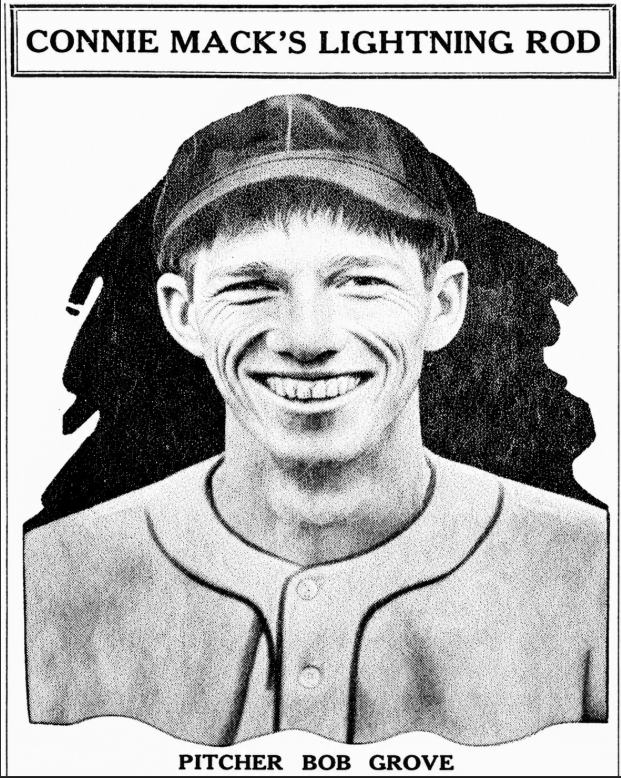
PITCHER LEFTY GROVE
NO BIG LEAGUE manager is immune to being "stung" on high-priced minor purchases, for the reason that the player often times cannot adjust himself, or lacks the proper poise, to make a go of it in the highest society. Connie Mack, shrewd as he is, has been on the losing end on expensive buys more than once and there were a lot of wise ones who figured he threw $100,600 away when he paid the Baltimore Club that amount for Lefty Grove, the left-hander. But the more Mack saw of Grove last Summer the more convinced he became that the "lightning rod" would become a winner.
It was lack of control that kept Grove from being a success in 1925. He was the wildest man in the American League, walking 131 in 197 innings. Yet, he was the leading whiffer, fanning 116 batsmen. Another element that worked against the young fellow was that he was over-exploited in publicity and the high expectations built up for him came back to haunt him. On the whole, he won ten games and was charged with 12 losses last season.
This Spring he was not bothered with a lot of publicity and with better control has jumped in to become one of Mack's real aces. He has won his last four games and is steadily showing improvement in control. Grove is a lad who has a tremendous amount of speed in his left arm and he fairly throws them past the batters. He has fanned as high as 11 men in a game this year and his games usually list upwards of five whiffings.
Robert Moses Grove joined Baltimore in 1920, having been purchased for little or nothing from Martinsburg. He developed rapidly and in 1924 was the outstanding pitcher of the International League. He was born March 6, 1899, at Lonaconing, Md., and was one of the best six-foot-two glass cutters in Lonaconing, Md., before baseball claimed him.
COLLINS' PITCHING TRIFLE WAYWARD
Ted Lyons AND Ted Blankenship WHITE SOX MOST RELIABLE PAIR.
Tommy Thomas Gives Indication of Catching Up with Himself, but Thomas Is Slow; Cubs Keep Up Good Work.
CHICAGO, Ill., May 17.—It is beginning to dawn on those who have the interests of the White Sox at heart that Manager Eddie Collins could make good use of about one more worth-while pitcher if he is to make good on the rosy predictions made in his behalf before the race started. There also are one or two other things about the team that could be improved upon, but in the main the pitching staff is the real problem.
To date, Collins has had the pleasure of watching only two of his slabbers perform consistently. A casual glance at the averages will show this pair to be the two Teds—Lyons and Blankenship, and if any club can produce a more formidable pair let it step forth and try to file its claim. The trouble is that as soon as Collins uses these two in a series he has to trust to luck in the remaining games, but, of course, there is a good possibility that this defect will be remedied slightly as the season progresses toward its inevitable windup.
Before taking up the other slab employes it might be well to say right here that Blankenship has been winning, even though not yet at the top of his form. Blankenship reported in camp a couple weeks late because of a misguided axe that almost severed a couple toes while he was functioning as handy man around the homestead at Olathe, Okla. The injury not only detained him, but necessitated him taking things easy for a couple of weeks after reaching camp. The result is that he couldn't work himself into tip-top condition, but he's about ripe now, and should travel at a dazzling pace henceforth.
Sox Stop Athletics' Streak.
Blankenship started to pitch in earnest last year on July 4, and between that time and the end of the season harvested 16 victories. Prior to that he had been credited with only one. In a game against the Athletics last week he showed the first signs of being the same pitcher he was last Fall when he tapered off with a 10-inning two-to-two tie against Grover Cleveland Alexander in the city series. In his recent start against the Macks he allowed eight hits and was beaten, 4 to 3, but the only run earned off him was a homer over the right field wall by Lamar. Incidentally, that was the last win of the Macks' consecutive streak of nine victories. Lyons broke the string the next day by a 10 to 2 score.
One reason that there should be an improvement in the Sox staff is that Red Faber should get going before long. So far he has looked like himself only in one game, but a stretch of warm weather is expected to bring him around. A fellow of Faber's years naturally needs more than the orthodox three days of rest between starts, and this will prevent Collins from working him in regular order, but this difficulty probably can be overcome by the fact that Thurston and Thomas may get going any time.
Tommy Thomas was turned loose against the champions at Washington and pitched the kind of ball that made him a winner a couple years ago. He snuffed out the champions by a 2 to 0 score on six hits. There was a time when he pitched screw balls almost exclusively, but against the Senators he displayed as good a fast ball as he's had since coming up from the Salt Lake team. That might be taken as an indication that he has changed his ideas of pitching.
So far, Thomas, who was one of Jack Dunn's big three at Baltimore, has done nothing. He has even lost control, which is unusual for him. There is a sneaking suspicion that Owner Dunn of the Orioles, worked him to death after the Sox had grabbed him. He probably will resume his stride, and there is no reason why he shouldn't be just as effective up here as he was down there.
Injuries Have Been Felt.
The Sox first invasion of the East didn't start off very well, but was about as expected considering that the team had two regulars in the repair shop. Washington was the first stop, and an even break was attained in four games. At Philadelphia, only one game was grabbed out of four.
Both Third Baseman Willie Kamm and Right Fielder Bibb Falk, who were out with bum legs, reported for the final at Philadelphia, so in the future, barring further mishaps, Collins is going to have a regular lineup at his command. Barrett and Kamm at least assure the team of a couple hitters who know how to handle the southpaw pitching that has been causing all kinds of trouble.
The Cubs still have Chicago fandom by the ears, and are even more popular than at any time in recent years. Four straight from the Cardinals followed by three out of four over the Giants caused the outburst of interest. After the Giants departed, the Bruins slipped a bit by dropping two out of three to the itinerant Robins, which team has to be looked upon as a mystery outfit so long as it continues to occupy its present position.
Many of the rival National League managers excuse the Cubs' showing by saying the team is a Spring contender. It didn't take any great expenditure of mental energy to reach that conclusion. For several years the Cubs have started off like a lot of fresh colts, only to fall by the wayside, so the critical managers weren't telling anything that the world didn't already know.
Team Will Go As It Hits.
However, it doesn't follow that the same thing will happen season after season. By this, we don't mean to say the Cubs are going to stay right up on the top crust and worry a lot of pennant seekers. The only thing that is going to knock them down is for the opposing pitchers to bust up the unlooked for attack that Manager Joe McCarthy has developed. If that hitting isn't stopped the Cubs are going to have a good time because they possess the needed fielding and pitching.
McCarthy took a tough break in the Giant series when Hack Wilson, the hero of the North Side rooting contingent, was carried from the field with a leg injury caused by being hit by a ball. Wilson has been the bell-wether of the Cub attack, but even with him out of there the team buckled down and beat the Giants just the same. That shows that there is a lot of spunk to the gang, and also some additional hitting power.
Wilson is now back in the lineup again, and hitting them far.
One thing is dead certain, and that is that the Cubs are going to reap a harvest on their coming jaunt through the Eastern end of the circuit. With a new and much-talked-of manager in charge, with Hack Wilson, an ex-Giant, doing a come-back, and with the entire team playing a brand of ball that nobody had anticipated, the foreign fans are bound to evince marked interest just as the bugs at home have done.
IRVING VAUGHAN.
SENATORIAL CRAFT KEEPS EVEN KEEL
BATTING SHOWS IMPROVEMENT TO HELP THE CAUSE ALONG.
Bucky Harris Entirely Pleased with Showing of Champions Who Have Already Sniffed First Place Atmosphere.
WASHINGTON, D. C., May 17. — The Washingtons have finished with the White Sox and the St. Louis Browns for the present trip of the Western clubs. The result with Eddie Collins and his crew was 50-50, which shows that the Alabaster Hose are no false alarm. The crippled Browns won one and lost three, but, as the Yanks and the A's did equally well against stronger teams, nothing was gained. The champions, however, remained in second place, on the heels of the leaders.
For one day, during the visit of the White Sox, the Griffs were first in the American League race. It had not been expected that they would take the lead so soon, being a veteran team that requires warm weather to get it started. It went from fourth place to first in one day, and back to fourth on the morrow, showing the closeness of the race. A team that can keep steady through a long, racking grind is going to win, and the locals are one of those teams, without a doubt.
Bucky Harris found that his big four pitchers would be better for a rest on the last day of the Browns' visit, and started Alex Ferguson, who had beaten the Chicagos on his last appearance with a little help from Firpo Marberry in the ninth, but he was hit hard by the Sisterites, who also nicked Tommy Thomas and Marberry, but were kept quiet for one inning by Keliey. Long hits rung off the visitors' bats in every direction, including a homer over the high right field wall by Ken Williams. The Griffs made as many hits and received seven bases on balls, but could only shove over seven runs to the Browns' ten.
Batting Figures Rise.
At the end of this series the locals were beginning to look more like a championship outfit, with a .297 team batting average and the first six men hitting well over .300. Buzzy McNeely, in center, is doing the best work he has shown yet. Manager Harris and Goose Goslin are playing with damaged fingers, and Walter Ruether with a broken right hand, but none seems seriously handicapped, although it is possible that Bucky may lose his bum digit if he doesn't take care of it; but, when advised to do so he says that baseball is not a baby game, and he is needed in the lineup.
Tommy Thomas handed the locals their first shutout of the year on May 10, and he had to to win, as Stan Coveleski allowed the Sox two runs.
Taking nothing for granted and omitting no chance to add players to their team whom they believe will strengthen it, the Washington Club will annex a recruit this week whom they regard as very important. The newcomer, who is due to join the team on Thursday, is Captain Bob Reeves, shortstop of the Georgia Tech baseball team.
Reeves Knows How to Hit.
In Reeves' last game which the club has a report of, his team beat that of the University of Alabama, 7 to 5, owing to three home runs which Bob made. Scout Joe Engel, commenting on this, says Reeves would have made four homers "if his foot hadn't slipped." He is renowned for his hard hitting and equally good fielding, and it takes just that to down the Alabama institution, famed as the alma mater of Del Pratt, the Sewell brothers and a raft of other big league performers.
The Atlanta Journal says of Reeves that he is the best shortstop in the South, amateur or professional, and that is saying a mouthful. The local club might be more than satisfied if he should be just a shade behind Joe Sewell, but will make no kick if he is twice as good. The acquisition of Reeves does not mean that Buddy Myer is to go, as his work is more satisfactory than ever to the Washington leaders, and he has saved one if not two games by swell plays in the last few days.
Lefty Thomas Farmed.
Lefty Thomas has been shipped to Birmingham, which is now the Griffs' regular farm. He has oodles of stuff, and is considered sure of a permanent job here, after a season's polishing up by Johnny Dobbs. Pitcher Bump Hadley was also offered to the Barons, but they are now filled up to their player limit, and he will have to be placed elsewhere.
In these circumstances, it is believed that Hadley will be transferred to Little Rock, where he should improve rapidly in the capable hands of Manager Joe Cantillon. Joe, who is having his troubles separating the sheep from the goats and making a real start, was here just after the team returned from New York, evidently looking for players who would strengthen his lineup, but no results appeared at the time.
Walter Johnson, whose two-year contract expires this season, says reports that he will retire thereafter are wrong, and that he has given up the idea of buying himself a club, and expects to remain with Washington as long as he can pitch major league ball, which, from present indications, will be a long time, as he is now leading the American League in winning percentage.
PAUL W. EATON.
ANYWAY, MR. Ty Cobb HAS HIS Earl Whitehill
LEFT-HANDER ABOUT SUREST THING TY HAS IN WAY OF SLINGING.
Turns in Four Straight After Some Tough Losses Early in Season; Heinie Neun Getting Good Shot at First Base Job.
DETROIT, Mich., May 17.—Looking back over the first month of the American League campaign, it is apparent that the Tigers owe a great deal to the pitching skill of Earl Whitehill, the young southpaw. Whitehill turned in his fourth victory of the season in Boston last Friday, giving Detroit the edge in the first series of the season with the Red Sox. In one way or another all of the other Tiger pitchers have been disappointing, but Whitehill's work has been consistently good.
The buck-haired left-hander is charged with three defeats and it is notable that all of them were suffered in the face of first-class pitching. He was beaten 2 to 1, by Cleveland on the opening day of the season, although he clearly outpitched George Uhle. He lost an 11-inning game to the Indians at Dunn Field, although even a casual analysis of the pitching on that day will show that he excelled Emil Levsen. In St. Louis, Whitehill lost a pitcher's battle to Tom Zachary. The score was 3 to 2, so Whitehill's performance could not have been bad. In fact, a Tiger error materially helped the Browns.
It was in Chicago that Whitehill first found a change in pitching luck. He turned in a triumph over the White Sox that enabled the Tigers to take the series. Against the Yankees, Whitehill was the only Detroit pitcher to go the route in four games. He followed this feat by his conquest of the Red Sox.
Rescued In One Game.
Whitehill has been batted from the box only once this season, and, curiously enough, he is credited with winning that game. It occurred on Navin Field, April 18, with the Browns offering the opposition. After the Tigers had stepped into a sizable lead, the Browns began to hit Whitehill freely. Before the lead had vanished, Cobb sent Jess Doyle to relieve the left-hander and Doyle saved the day.
In winning the final game in Boston last week, Whitehill had little difficulty. He held the Red Sox to six hits and kept them so well distributed that only one run resulted.
This game will have a place apart in the records because it saw Ty Cobb hit into a triple play for the first time in his major league career of 21 seasons. In the third inning, with Charlie Gehringer on second and Harry Wingo on first, Cobb hit a line drive over first. Phil Todt snared it and touched first, retiring Wingo. Then he threw to Rigney before the surprised Gehringer could return to second base.
Heinie Neun has vindicated Cobb's judgment in refusing to sell or trade him to Cleveland this Spring. Tris Speaker, realizing that the veteran George Burns is nearing the end of the trail, made a bid for Neun's contract. Cobb objected on the grounds that Neun would be needed by the Tigers if anything happened to Lu Blue. Doubtless, he recalled that in 1923 when Blue was injured in Philadelphia, the club had no capable replacement, and lost many games as the result of incompetent playing at that position.
The present season was less than two weeks old when "something happened" to Blue. On April 25 the regular first baseman reported ill with influenza, and Neun was sent to the post. His work has been one of the high spots of the Tigers' current road trip, and some are beginning to doubt whether Blue will be able to win back his berth.
Has Been Hitting, Too.
Blue is generally regarded as the ablest fielding first baseman in the American League. But Neun's fielding has left little to be desired, and so far his batting has excelled Blue's standard.
At this writing, Neun has played 15 games at first base. He has hit safely at least once in 16 of them. In one stretch of 11 games, he made one or more hits. All told, he garnered 27 hits in 76 official times at bat for an average of .355.
Of course, it remains to be seen whether Neun can maintain anything like this pace when the hot weather sets in and the pitchers become more effective. Surely his batting percentage has been helped by indifferent pitching. For instance, in one game with the Yankees, Neun made four hits off Bob Shawkey, Urban Shocker and Myles Thomas, who yielded a total of 15 hits to the Tigers in nine innings.
Upon taking Blue's place, Neun hit safely in his first four games. Then he was stopped in St. Louis by Ol' Tom Zachary, long a nemesis of the Tigers. The next day, Neun started his consecutive batting streak that was not ended until he ran into the curves of young Hal Wiltse in Boston.
Neun, by the way, is a chap with a lot of speed. He uses it both in the field and on the bases.
It is a singular fact that Neun twice succeeded Blue as first baseman of minor league clubs. A few years after Blue graduated from the Martinsburg team of the Blue Ridge League, Neun went down there from his Baltimore home and took the job. In the course of baseball events, Blue went to St. Paul under a Tiger option and played first base regularly there. Two years ago, Neun was a batting and base-running sensation of the American Association while attached to St. Paul.
O'Rourke Real Handy Man.
Another useful member of the Detroit roster is Frank O'Rourke. At the start of the season, O'Rourke was the club's regular second baseman. He yielded his place to Gehringer only when overtaken by an attack of the measles. When O'Rourke recovered, he found other jobs awaiting him. First he had to fill in for [Jack Tavener](https://www.baseball-reference.com/players/t/tave nja01.shtml) when the midget shortstop was suffering from a deep cold. Later, when Jack Warner was injured in New York, O'Rourke went to third base. He made his start at that post in Boston by handling six chances faultlessly and taking part in two double plays.
Gehringer, by the way, has been improving rapidly at second base, and it is doubtful whether Cobb will displace him when O'Rourke again is available. Gehringer seems to be overcoming his natural shyness and gaining confidence in himself. Little else is needed. He has the required mechanical gifts as a fielder, and there is no reason to doubt that he will hit as well as O'Rourke.
Detroit fans got a fleeting glimpse of the Tigers Sunday. They jumped home from the Atlantic seaboard for one game with the Red Sox. As soon as the contest had been decided, both teams started for the East again. The Tigers went to Philadelphia to finish their series with the Athletics. From Shibe Park they are scheduled to go to Washington for their first contest of the season with the American League champions. After that, the patrons of Navin Field will not another opportunity to see them in action.
SAM GREENE.
UNCLE ROBBY COULD USE SOME BASE HITS
PITCHERS ARE CARRYING ON, BUT THEY NEED ASSISTANCE.
Rabbit Maranville, Playing All-Round Game, One of Brightest Lights of Brooklyn Team; Babe Herman Fills In Well.
BROOKLYN, N. Y., May 17.—Rain checked the rush of the Brooklyn Robins. They had won three in St. Louis after losing the opening game there. They had lost the first game in Chicago and had won the next two. They were ready for the fourth and last game in Chicago on Thursday, May 14, when a rainstorm halted the proceedings, and they entrained that night for Pittsburg. Up to that time, the Robins had won 14 of their last 17 games. They had won nine of their last ten at home, and had won five of their first seven in the West.
That, me hearties, is some record for a team which has had nothing much except pitching and nerve. Before the season opened, it was conceded that the Robins had both pitching and hitting, but that they have not been helped much by vigorous hitting in the recent wild splurge, which carried them to the top of the National League. The hitting has been more timely than voluminous.
All of which is to say that when the Robins begin to swat according to their known ability, a lot of folks who are now regarding them with amused interest will begin to realize that a totally unexpected factor has been injected into the National League race. A cartful of beans may be spilled, to give the prophets, including the undersigned, something to do in the picking up, and backing up, line.
It isn't hard to figure it out that way as things have been going.
And Dazzy Didn't Help.
Fourteen of the last 17 games have been won with Dazzy Vance having failed in his three starts, with Dick Cox batting away below his normal form, and with Zack Wheat slumped 33 points. Cox, at last account, was batting around .225, when he should have been hitting .300 or ever.
How's Rabbit Maranville getting along? Listen:
For the first 25 games of the season, the men who had knocked in the most runs in various ways for the Robins were Jacques Fournier, 15; Gus Felix, 14; Walter Maranville, 11; Zack Wheat, nine; Dick Cox, Johnny Butler and Mickey O'Neil, five apiece.
Maranville drove in eight of those 11 runs with hits. In the averages published on Sunday, May 9, Maranville had a batting mark of .266, and he had not reached .300 by any means, but he is going as strong as ever in pulling the unexpected by making useful clouts when he appears to be all in. Wheat has slumped from .329 in the May 9 tables to .296, but the team keeps winning. Gus Felix dropped five points, to .311, in the week immediately preceding this letter, but he thus far has been, apart from the pitching and Maranville's come-buck, Brooklyn's find of the year.
Still, it's pretty dangerous stuff to talk about the "find of the year." There's Babe Herman, the left-handed first baseman, subbing for Jacques Fournier. Jacques injured his leg by a collision with Joe Gautreau of the Boston Braves, in the Robins' last game with an Eastern team. Herman played first in all of the games in St. Louis and Chicago. He drove in four runs in those seven games. If that should prove to have been his latent capabilities all along, he would have had 13 or 14 runs driven in through the stretch of the Robins' total of 25 games at this stage. That would have put Herman a shade above the useful Felix.
Likes the Full Swing.
Herman is a hit-or-miss swinger. He is not a scientific batter, and takes a heavy wallop, connecting with commendable frequency. He is the sort of batter who wins a game that has been lost. In fact, twice recently he has done that very thing, once, in St. Louis, with a home run. Also, he has been covering much ground around first base. Curiously enough, Herman played several games in which he endured the handicap of a cracked rib. He knew he had a misery in his side, but did not know he had a broken bone until May 12. He stuck to his knitting because Fournier had not sufficiently repaired his underpinning to return to the job at first base.
Fournier's heavy walloping, which netted him a batting average of .321, to say nothing of batting himself home five times with four-baggers, and driving in eight other playmates at odd intervals, all in his first 18 games, assures him steady employment at first base, but Herman looks too good to keep on the bench.
The Robins' pitching has been phenomenal. Jess Petty southpawed his team to winnings in his first five starts of the season. He came to grief in the first game with Chicago, and lost, but eight of the nine runs off him were unearned. Petty allowed four earned runs in 56 innings in his six games. Man, sir, that is going quite a few. He has allowed a fraction less than two-thirds of an earned run per nine innings, over a period of six ordinary games and two extra innings. That smells like a record.
Sinister reports had come from the Pacific Coast, whence Wilbert Robinson drafted Doug McWeeny. They said that he was a front runner, the goods while leading, but, prone to crack under the strain in a close contest. McWeeny has put the smother on those cruel slanders. He had won three straight games, to May 15, and has not been scored against in 19 innings.
Licks an Old Rival.
McWeeny shut out the Cubs in Chicago on May 12. Neither team scored in the first inning, and McWeeny had all of Chicago in which to stage an explosion, but spurned the opportunity. The Robins won by 2 to 0, beating Charlie Root, who was McWeeny's rival last season on the Pacific Coast. Babe Herman has helped with a triple to manufacture the first run in that game, which came in the ninth inning, and the Robins batted in another run in the same round.
Burleigh Grimes has been the Grimes of 1920. He began the season with tough luck. He has had just about an even break since, as regards luck. He has beaten St. Louis and Chicago on this trip. That gives him three straight wins, and a total of four won and two lost.
While the sterling stuff being shown by Petty, McWeeny, Jess Barnes, Bob McGraw and others of the pitching staff is highly gratifying, for our part, the most satisfactory element in the situation is the return of the veteran Grimes to his winning form.
When Vance gets into his swing, and has Grimes to back him, to say nothing of the younger pitchers, the Robins should not prove Spring bloomers. They should stick close to the top. They will almost certainly hit better than the mark of .264 in the Sunday papers of May 9. They should also improve in fielding. Butler, at third; Maranville, at short, and Dick Fewster, at second, are still comparatively strangers to Fournier and Herman at first base, and to one another. The goose is hanging high.
THOMAS S. RICE
Scribbled by Scribes
NO TEAM in the history of baseball ever achieved greatness without a good defense, and in speaking of defense, we include both pitching and fielding, writes H. G. Salsinger in the Detroit News. Consider the outstanding teams in history and you discover they were rich in pitching talent or outfield or infield defense, generally a combination of the two.
The Chicago White Sox team of 1906, known as the "Hitless Wonders," had an excellent pitching staff and a great defensive outfielder in Fielder Jones. This team, more than any other perhaps, demonstrated the value of defense in baseball.
The world's champion Boston Red Sox had a good pitching staff and the best outfield the American League has known.
The champion Cubs, of Frank Chance, were a balanced team with one of the best double play combinations of all time. Connie Mack's great machine of a dozen years ago had a crack pitching staff and an immortal infield in Stuffy McInnis, Eddie Collins, Jack Barry and Frank Baker.
The later White Sox team—the one wrecked by scandal—had some splendid pitching talent and a corking infield.
The old Pirates had an infield around Fred Clarke and good pitching.
John McGraw's best teams were famous for their pitching and fielding.
The Detroit team that won three consecutive pennants under Hughie Jennings, depended on its pitching and outfielding, chiefly.
Someone has said that you can no win games without scoring runs, but it is equally true that you do not have to score many times to win if you can keep the other fellow from scoring.
The man that does not get a hit but chokes off three runs by his expert fielding is worth 33 per cent more in the standings column than the player that drives in two runs and who, in the same game, makes it possible for the opposing team to score three because of his poor fielding.
In our cry for players that can hit we all too often overlook their fielding faults. We forget that a player that kills runs is just as valuable as the player that drives them in.
Until a very few days ago, in common with practically all fans, and certainly with most players except a few survivors from the older generation, this writer did not know that up to 16 years ago there was no such thing in baseball pitching as the change of pace, comments L. H. Gregory in the Portland Oregonian. Yet the change of pace is today considered perhaps the most effective of all pitching deliveries. Managers hammer at their pitchers to learn it, because against a good change of pace, the heavy sluggers are helpless.
Don't confuse "change of pace" with the slow ball and slow curve. A slow ball is a change of pace, but "change of pace" in professional parlance, means a ball thrown like a fast ball, with exactly the same motion and delivery but coming to the plate at about half speed. It is not a "knuckler" nor a "floater." They come under the slow ball category. What makes "change of pace" so effective is that it's a distinct let-up from a fast ball, thus throwing a batsman who is not set for it, completely off his timing, yet fast enough so that, having started his swing, he hasn't time to recover and take a full sock at the pellet, as an agile man can sometimes do with a slow one.
"Pull the string on him," says a manager to his pitcher, meaning to "slow up" on the batter with a change of pace. This delivery created a furor in baseball when it was invented in 1910. It revolutionized the whole art of baseball pitching.
The change of pace was invented by a kid pitcher who was just 22 years old at the time and had been in the major leagues but two years.
And he's still pitching, by the way, pitting one of the keenest brains that ever functioned on the mound against the heavy slugging and lively ball of this era, and doing it so well that after 22 years in baseball livery he still wins his 20 games per season.
His name? The man who devised the change of pace and is still one of the greatest of all masters of its use is Doc Crandall of Los Angeles—"Ol' Doc" Crandall of affectionate recollection in the big leagues, and especially with the New York Giants, for whom during six big-time campaigns he was perhaps the most effective relief pitcher that ever lived. No applesauce about this statement—John McGraw called him that and Christy Mathewson once wrote it himself for publication under his signature.
Shadows of minor league oblivion are on Art Nehf's horizon, comments Chester L. Smith in the Pittsburg Gazette-Times. A brief dispatch from Cincinnati told of his sale to the Reds. Twenty-five words sufficed to chronicle the passing of one of the most important pieces of human machinery in the Giant juggernaut of recent history.
When McGraw secured Nehf from the Braves in 1919, the sale commanded columns on the sports pages. Now an inch or two of type is all he "rates."
Two achievements will serve to recall Nehf when his name no longer adorns big time box scores.
One is the spell which the little southpaw wove about Pittsburg bats in 1921 and 1922. Single-handed, he virtually knocked the Buccos out of even a faint chance at the pennant.
The second—and this is the more spectacular of the two—was his complete mastery over Babe Ruth in the memorable World's Series battles of 1921 and 1922. The sight of the pint-sized Hoosier humiliating the mighty Bambino time after time brought a thrill to fandom the land over that has hardly ever been equalled on the diamond.
Garry Herrmann, owner of the Cincinnati Reds, whose foaming seidels and furlongs of bratwurst are a feature of every big league meeting, comes out with a proposal which is likely to bring loud cries of indignation from the magnates, writes Manning Vaughan in the Milwaukee Journal. Garry, who is one of the too few real sportsmen in professional baseball, says one of the reasons for the slump in corner lot and amateur baseball is the high price of sporting goods. At the same time, he proposes that the big leagues pay more for their diamond paraphernalia so the sporting goods manufacturers can cut prices for the sandlotter.
This, of course, will arouse large and sundry protests from the magnates. At the same time it will probably bring an indignant denial and a lot of figures from the manufacturers to show that they are making less than one-half per cent on their investment.
Of course, the magnates will not cut prices, but Herrmann has an interesting slant on the situation just the same. Equipment has seemingly gone beyond reason and no doubt the slump in amateur baseball is due, in a measure, to the prices of bats, balls and gloves.
Ty Cobb may lack some of the speed that featured his play in 1915 when he stole 96 bases, but he still can hit, writes Billy Evans for Newspaper Enterprise Association. His arm may be minus some of the power it once had, thereby enabling fast runners to take liberties at his expense, but he still can hit. Ty Cobb may not be able to cover the wide expanse of territory he once did as the fleet center fielder of the Detroit Tigers, but he still can hit.
Cobb, after 22 years a big leaguer, is still as great a menace as ever at the bat, despite the fact that only a few months ago he underwent a rather delicate operation for a growth on one of his eyes.
The ability of Ty Cobb to hit all kinds of pitching, right-handed or left-handed, with unerring accuracy, will continue to be one of the wonders of baseball long after he has passed out of the game.
CASUAL COMMENT
BY THE OBSERVER
THE LAST, and even unto the least, of the minor leagues are now under way and the baseball season may be said to be in full swing, with the majors and most of the more important minors having passed the first month period of their schedules. Twenty-eight minor organizations were booked to start and all seem to feel they are going to have one of the best years in the history of baseball.
Certainly, at every opportunity so far, the fans have given cause for such feeling. On two consecutive Sundays—the only real chances to prove the interest of the fans—the Cubs in Chicago packed in 35,000 persons and turned thousands away. The Yankees on May 9, the first real chance to draw out their patronage, reported attendance well above 50,000—all seats occupied in the immense Ruppert stadium except a few in the far corners of the bleachers.
Competition in the minors for trophies for best opening day attendance brought out crowds that made new records, notably at Fort Worth in the Texas, and Mobile in the Southern. Since the opening of the Lone Star circuit, however, the Fort Worth fans have been "enjoying" the experience of a losing ball team, something distinctly new for them, and it will be of interest to see how they accept the unexpected turn that has come to Paul LaGrave and Jake Atz.
One can imagine that way down in Texas sending up prayers for the return of Joe Pate and Lefty Johns, aces of the Fort Worth pitching staff in former years, who are now struggling for footholds in the American League. Loss of those two pitchers, if permanent, may mean an upset in Texas League circles, where Fort Worth has been cock of the walk for so long. A new pennant winner in that circuit would do no harm—except to the feelings of Paul LaGrave and his Fort Worth following.
While there has been comment on the rather high strikeout figures in the National League in the first month of the season, attributed in certain circles to pitchers using resin, has any one noticed the way shutout games have accumulated in the American? A dozen of them, in the first month of play, weather unfavorable for good pitching, is rather notable, by comparison with records of the past few years. It's not due to resin, of course; must be the less lively ball—or is pitching improving?
Note, too, the decline in team batting averages over previous seasons, with only the murdering Yankees over .300 as a team. True, there are some high individual averages among players, but they are adjusting themselves.
A big baseball season, coincident with less hitting, will give those critics who have always harped on the "town lot" brand of ball a chance to say, "We told you so."
Those surprising Cubs of Chicago, on whom William Wrigley Jr. did NOT spend a million as he promised, are making quite a stir in the National League. Chicago fandom has taken them to its collective bosom. In the four-game series with the New York Giants more than 100,000 paid admissions were recorded, and it was not the best sort of baseball weather, either, as any one who has studied the daily reports of temperature knows.
Wrigley is said to regret now that he didn't spend some of that million double-decking his stands at his ball park; he's likely to turn away enough fans before the season is half over to have paid the cost of the additions.
Manager Joe McCarthy is the present hero of the Windy City, sharing honors with Hack Wilson, who has done some notable swatting for the Cubs. This fellow, a discard of John McGraw's, by the way, performed so well in the series against the Giants that McGraw went to some length to alibi himself for over letting Hack go.
To offset the impression made by Wilson, McGraw sang the praises of Ty Tyson, but that sounded somewhat like unto whistling in a graveyard. Tyson gives the impression that he has a weak arm.
However, if Chicago fans are all excited about the Cubs, most of the gentlemen classed as "experts" still express doubts. They cannot see McCarthy's infield as of championship caliber. "Too slow," say the experts. As one of them remarked of the infield work in a recent game: "Charlie Grimm, Johnny Cooney, and Sparky Adams had what would have been three double plays for a real big league infield; in each case the batter landed safe at first, because the work was so slow."
And then we are reminded, to cinch it, that the Cubs also made a flying start last season—and landed last.
"You can't make a bunch of ball players over night," continues the experts. "No, not even a new manager like Joe McCarthy can do that."
Well, we shall see what we will see.
Of great and unexpected aid to the New York Yankees in keeping to the front so far this season is the work of Joe Dugan, third baseman of age and experience. Jumping Joe had a rather poor season in 1925; that trick knee of his bothered, and he was generally out of sorts, as is his temperament on occasion. He hit .290 in 102 games.
This year Dugan started off with a bang and has kept it up. He has been hitting over .400 and playing a wonderful fielding game, covering ground he could not reach last year. He has been, next to Babe Ruth, the most effective batter on the Yankees' team, as his showing of runs batted in proves.
Dugan thus rounds out a wonderful infield—the best hitting infield, at least, that any team in the majors can boast. And excepting the veteran Jumping Joe it is made up of youngsters with every promise of improvement as they go along. Lou Gehrig won his "letter" last year. Now Mark Koenig and Tony Lazzeri are doing all their most optimistic boosters predicted for them. When the story is written of "First Year Men Who Made Good," at the end of the season, the names of Lazzeri and Koenig will loom large.
It is to laugh, commentators, admitting the good work Pat Collins is doing for the Yankees, qualifying it by saying he is a youngster handicapped by lack of experience and knowledge of batters in the American League. Pat sat on the bench of the Browns for several years, with nothing much to do, but study the batters of the league.
And because he demanded that he be allowed to get in there and show what he knew about them, he was suspended—yes, actually suspended because he showed a desire to work! Later shipped to the minors.
Meanwhile, what has become of Hank Severeid, who was preferred over Collins? And what of Bubbles Hargrave and George Dixon, who were taken on and Collins let out? Wally Schang, a veteran discard, is doing most of the backstopping for the Browns.
In estimating the chances of the Athletics in the American League race this season, do not overlook the factor Lefty Grove (he seems to have dropped the "s" off his name) promises to be. Bought from Baltimore to start the 1925 season, Grove (Groves it was then) was a good deal of a disappointment and was now and then unkindly referred to as the "hundred-thousand-dollar lemon."
But even in his failures he gave proofs of what had made him a great pitcher in the International League. His worst fault was lack of control. Cutting a letter off his name seems to have corrected that—though indeed he was making progress toward the end of last year.
Baseball By-Plays
AS EACH MAN THINKS.
Said the owner of the ball club: "I’ve spent a lot of dough; I’ve bought a fancy ball club, That ought to make a show."
Said the skipper of the ball club: "That’s all a lot of bunk; It’s me that’s made the ball club, From a lot of worthless junk."
Said the players on the ball club: "Don’t listen to such stuff; It’s us that’s made the ball club, Though we don’t get paid enough."
Said the fans who back the ball club: "Cut out that noise and din; It matters not who makes the club, Just so it’s made to win." —L. H. ADDINGTON.
Jesse Altenburg, who was responsible for the yarn about Frank Emmer of the Cincinnati Reds, "Ull" Donking himself out of the minors and into the majors, was handed a good one the other day. At his home in Lansing, Mich., Altenburg, who is not yet attached for the 1926 season, has been taking occasional workouts in his backyard and playing semi-pro ball. He has a young Polish neighbor who throws the ball around with him and said young man is a close follower of baseball.
"Does dis guy, Emmer, allus wear a Bill Doak glove?" Altenburg’s friends asked him.
"Yes, I understand he does—at least, he did," answered Altenburg.
"But dis guy musta went back to the motorman’s mitt," came back the young Pole.
It was the day after Emmer had made three errors for the Reds and Altenburg was stopped in his tracks.
They are telling a fairly warm one concerning Outfielder Pete Scott, who joined the Chicago Cubs this spring. Scott went to Catalina Island with a reputation for speed, and Manager Joe McCarthy knew all about his ability to get over ground because of having seen him for several seasons in the American Association.
Now, McCarthy likes to have his little joke to sort of buoy up spirit, etc., so one bright March day during practice, Joe dared Scotty to beat out a bunt. Gabby Hartnett was catching and was in on the trick.
Scott laid down a neat bunt and tore for first. Hartnett hesitated a moment while Pete stepped for first and threw an extra ball to first a few steps ahead of the runner. The third baseman in the meantime had pocketed the ball Scott hit. Not less than four times was this pulled on Scott and he finally went to the bench panting.
Scott was about ready to admit he had slowed up when McCarthy let him in on the joke.