Sporting News Special Edition, Part 2: Alexander, Editorials, and Baseball's Midseason Debate
Part two of our July 1, 1926 Sporting News special edition collects editorials, columns, humor, reader questions, and baseball commentary—from praise of Grover Alexander to debates over pennant races and baseball strategy.
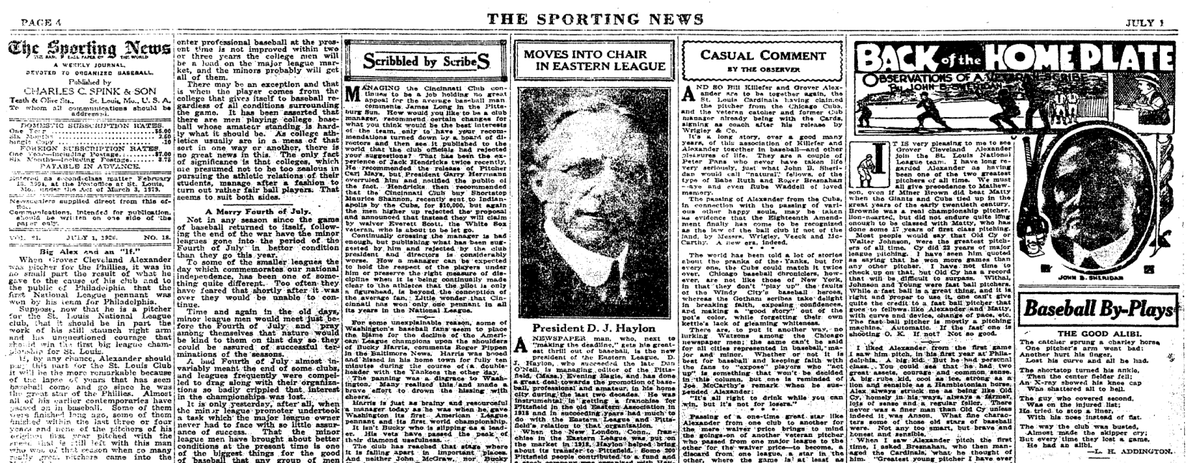
From the Sporting News - Thursday July 1, 1926
- Editorial Comment
- Scribbled by Scribes
- Back of the Home Plate
- Casual Comment
- Moves Into Chair in Eastern League
- Baseball By-Plays
- Questions and Answers
- Advertisements
Editorial Comment
Big Alex and an "If."
When Grover Cleveland Alexander was pitcher for the Phillies, it was in no small part the result of what he gave to the cause of his club and to the public of Philadelphia that the first National League pennant was won by his team for Philadelphia.
Suppose, now that he is a pitcher for the St. Louis National League club, that it should be in part the work of his still staunch right arm and his unquestioned courage that should win the first big league championship for St. Louis.
If, by any chance, Alexander should play this part for the St. Louis Club it will be the more remarkable because of the lapse of years that has seen baseball come and go since he was the great star of the Phillies. Almost all of his earlier contemporaries have passed on in baseball. Some of them were finished long ago, some of them finished within the last three or four years and none of the pitchers of his original first year pitched with the speed that is still left with this man who was of that season when so many really great pitchers came into the National League.
Suppose that Alexander should be a determining factor in the championship of this year. Would he not receive a reception at St. Louis similar to receptions that he has been tendered in other cities and would he not be looked upon as sort of a "clincher of championships" for cities which have never enjoyed one? If he helped to win for St. Louis, that city would no longer be obliged to endure that unenviable reputation for non-winning which has fastened itself upon it, as it had fastened upon Washington for a long time.
We scarcely imagine that the City of Chicago would be resentful if St. Louis won a pennant. Chicago has had its championships in the past. Few cities have enjoyed more of them. The championship habit is not such a desirable one if it be held too long in one place. Pennants won over and over again by the same city clog the appetite and deaden the taste. A steady diet of chicken pie would sour the disposition of the soundest of men however much they might have wished when they were boys that they could have chicken pie three times daily.
Whatever differences may have existed between Chicago and Alexander are a matter largely between the club and its former player. No matter what may have happened, the fact still asserts itself that if this pitcher, whose curves and speed dominated the National League batters for years, should happen to be a principal factor in winning championships for the city that yearns for a bunting, his career would have found itself as lustrous in its waning days as ever it was when he had but to walk up Broad Street in Philadelphia to hear the fans say, "There goes Alex."
Managers who did not find it possible to obtain his services when he was ready for the major leagues were wont to decry his skill. Yet he is still pitching away with might and main and some of the managers—well, they aren't there. That's the difference.
Maybe Alex is the tonic for cities that never have won a pennant and maybe Chicago's quarrel with him is the St. Louis Club's yard of bunting.
And the old ball players all are with Alex.
The College Player
Annually a great deal of Winter fuss is made over the college baseball player. There is also some fuss made over him in the Summer. Much of the latter is a mild fuss in passing him along from one to another.
When the minor leagues have been short of anything else to criticize they have belabored the majors for invading the field of college players and taking the latter away from the minors. But why should the minors be so vexed about it? Why shouldn't they be glad? Where is there so much in college baseball, fresh from the college campus, that should want to make any sane man fight for the product?
Look over this year's list and enumerate those college men of the past season that have been proving themselves worth as much as some of the sandlotters. The latter come into baseball, warm for it, greedy for it, their hearts aching to get into it, while the college men enter greedy for a bonus, greedy for a high salary, greedy for everything that has to do with the hire they shall get and without such a great lot of ambition to do much of anything after they get in.
The college baseball player who has a touch of the sandlotter, the player who has had to work his way through college and who has known what it is to earn a dollar, and has discovered what the dollar means to him, is worth ten of the class who have lived pretty well and who are willing to turn to baseball after the college year is over because they seek an easy source of spending money.
The college baseball player has not as yet proved himself worth half of the advertising that he has got. There are writers, some of them in the East, who have boosted the college player to the baseball skies. And for what? Show any percentage of college players in baseball today who are stars of the first magnitude and then the boosting will be worth something. Adulation addressed to men who seek flattery does not make athletes.
If the class of college players who enter professional baseball at the present time is not improved within two or three years the college men will be a load on the major league market, and the minors probably will get all of them.
There may be an exception and that is when the player comes from the college that gives itself to baseball regardless of all conditions surrounding the game. It has been asserted that there are men playing college baseball whose amateur standing is hardly what it should be. As college athletics usually are in a mess of that sort in one way or another, there is no great news in this. The only fact of significance is that colleges, which are presumed not to be too zealous in pursuing the athletic relations of their students, manage after a fashion to turn out rather fair ball players. That seems to suit both sides.
A Merry Fourth of July
Not in any season since the game of baseball returned to itself, following the end of the war have the minor leagues gone into the period of the Fourth of July in better condition than they go this year.
To some of the smaller leagues the day which commemorates our national independence, has been one of something quite different. Too often they have feared that shortly after it was over they would be unable to continue.
Time and again in the old days, minor league men would meet just before the Fourth of July and pray among themselves that nature would be kind to them on that day so they could be assured of successful terminations of the seasons.
A bad Fourth of July almost invariably meant the end of some clubs, and leagues frequently were compelled to drag along with their organizations so badly crippled that interest in the championships was lost.
It is only yesterday, after all, when the minor league promoter undertook a task which the major league owner never had to face with so little assurance of success. That the minor league men have brought about better conditions at the present time is one of the biggest things for the good of baseball that any group of men has achieved.
This Fourth of July sees championship races going on full tilt in the minor leagues at a pace that most of the major league clubs could not command in old days. Baseball is progressing when we can record changes like that.
Batting Out of Turn
Most of the baseball writers have come to see there is nothing in the extension of the sacrifice fly rule that is not perfectly logical. Of course, if you don't happen to like the sacrifice fly, that is something else. We know a few rather sound and sane old-fashioned advisers who never did like the sacrifice fly rule, and it has been suspected always that there was a motive behind it of fattening batting averages.
Even if it did fatten some a little, it is hardly worth while to make a fuss about. If you are going to recognize that batting a fly can advance a man one base, there isn't anything under the burning sun that should prevent the same credit being given if a batter advances a runner some other base by a batted caught fly.
There is one rule in the code to which the rule makers may give a little attention another year. They, perhaps, did not overlook it this last year. It is a hard rule with which to fool. It relates to the chap who bats out of order. It is Rule 51, Section 1. That rule can be made susceptible of a multitude of situations which would stand the molder of a puzzle bureau on his red head.
If there is any chap who can fix it up so that it will hold good for three or four batters batting out of turn, now is the time to get busy, and the baseball writers, who did pretty well with their suggestions last Fall, might turn in and take a hand at once. In advance we warn them that it is some task and then again.
A Victorious West
The old order of things shall pass away and it has. Imagine the Western section of the National League leading the Eastern section "complete, whole and substantial" as it did after the West had turned home following its last port of call in the East.
Time was when there were great ball clubs in the Western half of the National League, but a lot of time has come and gone over the kitchen door since there were three Western clubs that could command every position from first place to third, inclusive, with the Giants in the second division.
If New York were not a leader it seemed as if the National League had not left port a decade ago and now the Giants are making a fight to get out of the second division and then must make another to get any kind of a place in the first division with such contenders as the Cincinnatis, and the Pirates, and the St. Louis team making hay in the Western half.
Little by little the balance of power has been taken away from the Eastern section of the National League. Not only the balance, but the scales with the balance, and perhaps it doesn't matter so much because it has proved that all baseball cannot be centered in one spot if men will arise and hustle.
In the American League, Chicago, Detroit and Cleveland have been doing well enough, but no team seems capable of catching the Yanks just at this time.
Quick Punishment
It is said that summary punishment was dealt to a minor league president who had been caught "acting up" with the rules and the regulations of baseball.
Action is quick these days. Time was when such cases were heard about a year after the fault had taken place and some times they were never heard. Leagues came and went and men who were involved in that which was not always for the good of baseball, slipped out of their entanglements at times because the mill ground too slowly.
There is better regulation now. The minor league offenders are beginning to discover one by one that there is no chance to beat the law as relates to any particular misconduct in the scheme which has been set down for regulating affairs. Baseball has a character of its own. Once there were many who thought that it was a little old crazy quilt at which they could take a snip whenever they felt like it. The quilt is very sound these days.
Scribbled by Scribes
MANAGING the Cincinnati Club continues to be a job holding no great appeal for the average baseball man, comments James Long in the Pittsburg Sun. How would you like to be a club manager, recommend certain changes for what you think would be the best interests of the team, only to have your recommendations turned down by a board of directors and then see it published to the world that the club officials had rejected your suggestions? That has been the experience of Jack Hendricks twice recently. He recommended the release of Pitcher Carl Mays, but President Garry Herrmann overruled him and notified the public of the fact. Hendricks then recommended that the Cincinnati Club buy Shortstop Maurice Shannon, recently sent to Indianapolis by the Cubs, for $10,000, but again the men higher up rejected the proposal and announced that instead they will claim by waiver Everett Scott, the White Sox veteran, who is about to be let go.
Continually crossing the manager is bad enough, but publishing what has been suggested by him and rejected by the club president and directors is considerably worse. How a manager can be expected to hold the respect of the players under him or preserve the right measure of discipline when it is being continually made clear to the athletes that the pilot is only a figurehead, is beyond the conception of the average fan. Little wonder that Cincinnati has won only one pennant in all its years in the National League.
For some unexplainable reason, some of Washington's baseball fans seem to place the blame for the decline of the American League champions upon the shoulders of Bucky Harris, comments Roger Pippen in the Baltimore News. Harris was booed and hissed in his home town for fully ten minutes during the course of a doubleheader with the Yankees the other day. The panning was a disgrace to Washington. Many realized this and made a brave effort to drown the hissing with cheers.
Harris is just as brainy and resourceful a manager today as he was when he gave Washington its first American League pennant and its first world championship. It isn't Bucky who is slipping as a leader. His vets have passed the peak of their diamond usefulness.
The club has reached that stage where it is falling apart in important places. And neither John McGraw, nor Bucky Harris, nor Jack Dunn, nor any other great leader could do much better with the Nats without getting some new blood.
Probably the most vital weakness in the Nats is at shortstop. Just as Baltimore couldn't have won seven flags without Joe Boley, so Washington couldn't have won in the American League without Roger Peckinpaugh.
Peck's legs are so bad at present he has been having them treated. He is far from the Peck who helped make up the best defensive infield in the Johnson loop.
Whether or not Ty Cobb is still one of the truly great outfielders is open to discussion, writes Bert Walker in the Detroit Times. Naturally he is not as fast as he once was. After 21 years of strenuous baseball, it is plain that one must slow up. However, there can be no question as to his value to his club when playing the outfield. What he lacks in speed, if any, he makes up in dynamic leadership and inspiration that he imparts to his club.
When Ty is in the game the club plays better. Cold figures prove this. Including the game of June 21, the Tigers had won 32 games and lost the same number. Ty has been in 39 games and of these the Tigers have won 23 and lost 16. With Ty in the game the club had a winning percentage of .590. That is a higher percentage than any club in the league enjoys, save only the Yankees.
On the other hand, Ty had been out of 25 games, and of these the Tigers have won but eight and have lost 17, for a percentage of only .320.
As showing how necessary Ty is in the lineup it may be recalled that Ty was ejected from a game the other day in the sixth inning. When Ty went out the score was tied, neither side having made a tally. The moment the Peach left the game the Tiger defense went to pieces and the foe scored ten runs in the round.
Manager Cobb should be in there every time it is possible for him to play.
What happens to all the Spring baseball predictions? asks Warren Brown in the Chicago Herald-Examiner.
Take the National League, for instance. In the Spring, three clubs, Pirates, Giants and Cardinals, were given the best of it. In the American League, two clubs, Athletics and Senators were tabbed as the teams to beat.
The big league races are approaching the half way mark, and the Springtime opinions are still worth heeding. To be sure, the Yankees have stepped out at a furious pace, and have batted their way into a lead that should enable them to coast the rest of the way.
Washington's old men have had an attack of aches and pains, and seem to have lost their sense of direction. But the Athletics and the Sox have been bearing up well enough, and every other club has gone where it figured to go, save Cleveland, whose pitchers finally decided to pitch, after several seasons of inactivity.
Cincinnati has shown signs of hanging on in a red hot race in the National League. Nevertheless, there is a general feeling that Pittsburg and St. Louis have the pennant in their keeping.
The Giants, because of various causes, not the least of which may be dissension on the ball club, are not doing as well as they should. But even they are not to be counted out of the race.
A contemporary declares the Giants in on the 1927 pennant scramble, conceding that they have little or no chance to make it interesting for the Pirates, Cardinals and Reds this Summer, writes Chester Smith in the Pittsburg Gazette-Times. Isn't he presuming just a little too much on the acknowledged team-building proclivities of McGraw?
It took Connie Mack 11 seasons to reconstruct the Athletics. The Indians and Dodgers have been at it six, with no signs even yet of the trail's end. From 1909 to 1925 the Pirates found the peak unsurmountable.
National League clubs of late have shown a tendency to hesitate to sell any portion of their strength to New York. McGraw has been forced to develop his own power from raw material. Nor has he shown any particular liking for the task. Just now he owns a third or fourth place team, and if he moulds it into a pennant-winner within five years he should congratulate himself.
When R. L. Hedges, as owner of the Browns, prepared the official release slip for Bobby Wallace, says Sid Keener in the St. Louis Times, he patted the little Scot on the back and with tears rolling down the cheeks mumbled:
"Bob, my boy, this hurts me more than you."
There was silence in the room. And Hedges was sincere—it hurt him to release his idol, Bob Wallace. But it comes, sooner or later, to all of them.
Another touching scene has been enacted in baseball. Grover Cleveland Alexander, premier pitcher, $100,000 prize at one time, hailed as one of the greatest of the hill profession, has been cast aside for the paltry waiver price.
There is deep sentiment in baseball. But it only has a thin surface. After all is said and done, business rules the game.
Regardless of Chicago's opinion of Alex, he is welcomed with open arms in St. Louis. Sam Breadon is to be congratulated on the move.
BACK OF THE HOME PLATE
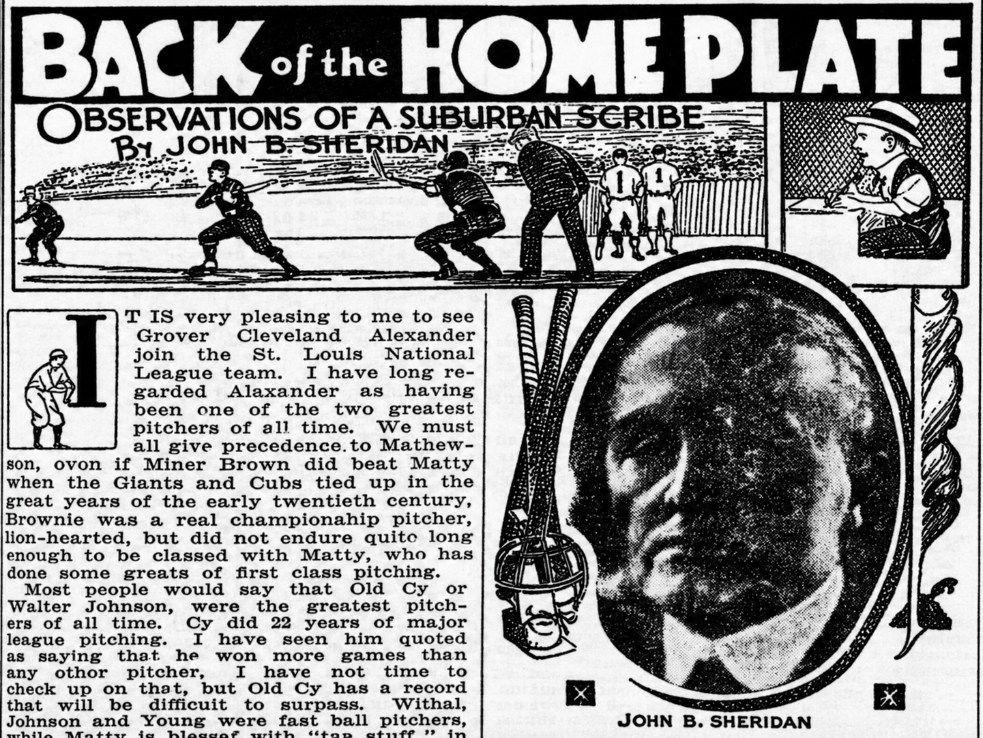
IT IS very pleasing to me to see Grover Cleveland Alexander join the St. Louis National League team. I have long regarded Alexander as having been one of the two greatest pitchers of all time. We must all give precedence to Christy Mathewson, even if Mordecai "Three Finger" Brown did beat Matty when the Giants and Cubs tied up in the great years of the early twentieth century. Brownie was a real championship pitcher, lion-hearted, but did not endure quite long enough to be classed with Matty, who has done some 17 years of first class pitching.
Most people would say that Old Cy Young or Walter Johnson, were the greatest pitchers of all time. Cy did 22 years of major league pitching. I have seen him quoted as saying that he won more games than any other pitcher. I have not time to check up on that, but Old Cy has a record that will be difficult to surpass. Withal, Johnson and Young were fast ball pitchers. While a fast ball is a great thing, and it is right and proper to use it, one can't give quite the credit to a fast ball pitcher that goes to fellows like Alexander and Matty, with curve and device, change of pace, etc. The fast ball pitcher is mostly a pitching machine. Automatic. If the fast one is shooting O. K. If not? Not so good.
I liked Alexander from the first game I saw him pitch, in his first year at Philadelphia. A big kid. But he had personal class. You could see that he had two great assets, courage and common sense. A big rube kid, cool as ice, strong as a lion and sensible as a Hambletonian horse. Alex always struck me as being like Old Cy, homely in his ways, always a farmer, lots of sense and a regular feller. There never was a finer man than Old Cy unless indeed it was Cap Anson. What fine characters some of those old stars of baseball were. Not any too smart, but brave and honest and sensible.
When I saw Alexander pitch the first time, I asked Roger Bresnahan, who then managed the Cardinals, what he thought of him.
"Greatest young pitcher I have ever seen," Roger said. "Bound to be one of the greatest pitchers in the game."
I always liked Alexander's way of working. Loafing along under wraps, giving the sucker hitters lobs to hit at, and getting rid of them, saving himself, side-arming along at his ease. Then when a man got within scoring position and a good hitter up, a change came over the pitcher. He got to work and "sent it in."
To give the reader an idea of just how even-minded Alexander is, I may say that about three years ago, when he had pitched some 14 years of major league baseball and was getting along toward the dreaded sere and yellow, he drew back his arm to deliver a pitch during a warm-up on the opening day of the season at Chicago. A photographer ran into the arm as it extended and gave it a wrench. Indeed, it never has been the same arm since. Now, that was a terrible thing to happen to a pitcher, especially a pitcher who was getting along in the service. Some pitchers would have killed the offender, but old Alex did not even raise his voice or make a fuss or anything. Just took it as part of the day's work. Let them photograph him left and right just as if nothing had happened. Many men never let a photographer come nigh them.
I do not know that Alex is the same Alex as he was, but he can lose nine-tenths of his skill and still be a greater pitcher than most of the ice cream kids that come along in these degenerate days. In any event, I hope to have the frequent pleasure of seeing a real pitcher, a man who knows how to pitch, pitching in St. Louis. My great pleasures have been to watch Rogers Hornsby hit, Alex pitch and Babe Adams work against Hornsby.
Read the other day a story written for Babe Ruth, in which was recounted discussion of their daily pitching experiences by Waite Hoyt, Urban Shocker, Herb Pennock, Sam Jones and other Yankee pitchers. The pith of the discussion was that a pitcher never is effective when he tries too hard, bears down heavily, tries to put too much on the ball.
Sure. That is why style, not form—form is quite different from style—is so important. Style means attaining the desired result with the least possible effort. A thing is best done when done without effort. Take the ditch digger. The "fancy" ditch digger has a style, an easy way of accomplishing a very trying task. To dig ditches ten or 12 hours a day under a hot sun is most exhausting labor. The effort used by the green hand who has not the style of a real digger, will burn out the strongest of men in an hour.
So it is in games. Take the great pitchers. For most of them it was little or no effort. No preliminary fussing or winding up. Just a nice two-footed position on the rubber, the ball held lightly by the thigh, one wind-up motion, a nice, easy, smooth delivery, smooth step and there she is hopping a foot high. I'd say that most pitching begins in the plates, goes to the ankles and the muscles of the leg and back. My idea is that a good pitcher makes very little use of his arm, save as a sort of sling to lend effect to the operation of the foot, leg and back.
"Bearing down," as baseball players say, "pressing," as golfers say, is the most common and most injurious thing in all games. A player should never apply pressure on himself.
I believe that "bearing down" is fatal to a fast ball pitcher, although he may get by on a curve. The fast ball, I believe, should be thrown with a wide, smooth, easy step and motion. If you bear down on the fast one it won't shoot right.
Of course, there is Dazzy Vance to knock all this endwise. Vance is under terrific pressure all the time. He is a great pitcher when right. I question, however, that Vance will ever stand among the great pitchers of the game. He won't endure long enough to command all-time rating. Bill Terry had a delivery comparable to that of Vance, tore himself apart on every pitch and while Terry pitched well for a time he did not go so long.
Yes, style is attaining the desired result with the greatest ease. It means that when a man has to labor hard at a job, "bull it," rupture himself in the effort, he cannot really do a good job. To me it is pleasant to watch the stylish ditch digger or the stylish hod carrier. To see the giant negro hod carriers, swing that 200-pound hod about as if it was an egg shell is most entertaining. Time, rhythm, grace, ease. Ease counts most in golf. Who is the most facile golfer in the world? Who plays golf with least effort? The world knows. Bobby Jones, amateur champion of the United States, open champion of Great Britain, once champion and twice runner-up for the open championship of the United States. No effort for Jones. Just walks up to the ball, takes his stance, puts the face of the club to the ball once, takes her back and with a slow, steady, even swing, hits her a mile, straight as a string.
It is awfully hard to get men to hit easily even at a golf ball. It will be harder to get men to hit easy at a baseball. But pitchers and throwers should be able to control their pitching and throwing motions and to always remember that ease is most important, especially in the delivery of the fast ball. I saw a young pitcher, Walter Beall of the Yankees, last week. But that must wait for next week.
CASUAL COMMENT
By The Observer
AND SO Bill Killefer and Grover Cleveland Alexander are to be together again, the St. Louis Cardinals having claimed the pitcher from the Chicago Cubs, and the veteran catcher and former Cub manager already being with the Cards, signing as coach after his release by Wrigley & Co.
It's a long story, over a good many years, of this association of Killefer and Alexander together in baseball—and other pleasures of life. They are a couple of Peter Pans who never have taken life very seriously, just what John B. Sheridan would call "natural" fellows, of the type of Babe Ruth and Roger Bresnahan—aye and even Rube Waddell of loved memory.
The passing of Alexander from the Cubs, in connection with the passing of various other happy souls, may be taken as evidence that the Eighteenth Amendment finally has come to be recognized as the law of the ball club if not of the land, by Messrs. Wrigley, Veeck and Joe McCarthy. A new era, indeed.
The world has been told a lot of stories about the pranks of the Yanks, but for every one, the Cubs could match it twice over. Chicago baseball chroniclers, however, are not like those of New York, in that they don't "play up" the faults of the Windy City's baseball heroes, whereas the Gotham scribes take delight in breaking faith, exposing confidences, and making a "good story" out of the pot's color, while forgetting their own kettle's lack of gleaming whiteness.
There are, to put it another way, no lurking Watsons among the Chicago newspaper men; the same can't be said for all cities represented in baseball, major and minor. Whether or not it is best for baseball and keeping faith with the fans to "expose" players who "act up" is something that won't be decided in this column, but one is reminded of Joe McCarthy's remark when he suspended Alexander:
"It's all right to drink while you can win, but it's not for losers."
Passing of a one-time great star like Alexander from one club to another for the mere waiver price brings to mind the goings-on of another veteran pitcher who passed from one major league to the other for the waiver price—to become, a discard from one league, a star in the other, where the game is at least as fast.
Reference is made to that pronounced left-hander, Sherrod Smith, who has been having a big part in the season's success of the Cleveland Indians, while celebrating his sixteenth season in baseball, minor and major. After nearly seven years with the Brooklyn Robins, during which time he helped pitch the Dodger team to two pennants, Sherry Smith was dumped in mid-season on the market and the Cleveland Club took him on waivers. Tris Speaker and Jack McCallister had seen enough of Sherry to believe he still was a pitcher. He has proved it quite to their satisfaction.
Sherry Smith, by the way, began pitching baseball back in 1910. He and Jack Quinn are veteran twirlers of the 1926 season in the American League who, along with Urban Faber, seem never to grow too old to win. They do not approach Walter Johnson in time of service in baseball, but it will be noted that the great Walter is not mentioned along with them as one of the veterans who can still win. Walter hasn't been doing so well of late, after a good start. Nor is any other pitcher of the Washington team for that matter, and the two-time champions of the junior major are finding it rough going, so rough they are unable to keep up to the .500 mark in the club standing.
Comment of other contenders in the league indicates the Senators are not being reckoned with at all as in the pennant fight. Nor is there as much serious consideration given the Athletics as there was early in the season. The White Sox, having shown they can win ball games even with Eddie Collins out of it, are causing some worry, now that Ted Blankenship seems to have found himself, and the Indians have been mentioned.
Meanwhile, the Yankees run along with a narrowed lead, but still one that is a great advantage as the season reaches its half-way mark. The contenders in the American are more apparent than in the National, where here as late as July, one can't begin to predict what will happen. When a team like Cincinnati can stay around the top until the Fourth of July, then what is the answer?
"Experts" still say that answer is the Reds have no business up there, that the honored positions belong first to the Pirates and next to the Cardinals—but remember even Brooklyn led the league for quite a period. Pirates and Cardinals have extended stays at home in July, and the Cards in particular are a good home team; it would surprise no one to see them in first place by the Fourth of July. And if Alexander should decide that he will "show 'em," now that he's from Missouri, anything may happen.
A patron of the Cleveland American League club has started a one-man crusade to force managers of teams opposing the New York Yankees to give Babe Ruth a chance to hit more homers. He demands that pitchers be compelled to put the ball over the plate for the Babe.
The fan's ire was aroused when he attended a game the Yanks played in the Ohio city recently and Ruth was walked three times out of four trips to the plate. This fan and his friends had gone to the game in hopes of getting a thrill out of a Ruthian homer or two, but the strategy of Tris Speaker interfered.
'Tis not the first time a fan whose big idea of what makes a ball game is a homer by Ruth has protested against the more or less intentional passing of the Bambino. The answer of opposing managers and players is that the object of playing a ball game is to win it primarily, not just to give Ruth a chance to display his hitting prowess. It is a pretty effective argument, at least with baseball fans who look on winning the game by all legal means as the purpose of play.
We are not going to discuss here the failure to work out the rule intended to curb the intentional pass, but the subject is brought up because a smart American League manager has a suggestion to make to Miller Huggins—and to Ruth. If Huggins and his star attraction writhe under the strategy that calls for passing the Babe in a tight situation, then, says this manager, Huggins should have the Babe lead off his batting order.
At least once in the game, and more likely oftener, the Babe then would probably be pitched to, for he wouldn't be walked if he was the first man up. That's the theory of it, but what's a batting order anyway? After the first inning the lead-off man may never be at the "top" of the batting order again.
The approved batting order is to put a hard man to pitch to first up, a good sacrificer next, and then a couple of heavy hitters as "clean-up" men. But has any one ever figured whether the chances are one in ten or one in 20 that the arranged batting order will appear as intended after the first inning?
Batting orders are made up by managers the way they are, principally because they always have been made up that way. A thing may be all wrong and the majority will admit it's wrong—but just because it always has been done that way the determination is it always must be done that way.
MOVES INTO CHAIR IN EASTERN LEAGUE
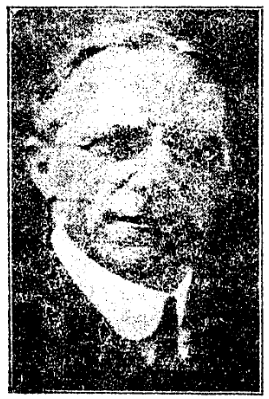
President D. J. Haylon
A NEWSPAPER man, who, next to "making the deadline," gets his greatest thrill out of baseball, is the new president of the Eastern League. D. J. Haylon, who succeeded the late Dan O'Neil, is managing editor of the Pittsfield (Mass.) Evening Eagle, and has done a great deal towards the promotion of baseball, professional and amateur, in his home city during the last two decades. He was instrumental in getting a franchise for Pittsfield in the old Eastern Association in 1918 and in succeeding years had much to do with the Eastern League and Pittsfield's relation to that organization.
When the New London, Conn., franchise in the Eastern League was put on the market in 1918, Haylon helped bring about its transfer to Pittsfield. Some 200 Pittsfield people contributed to a fund and a stock company was organized with Haylon as president. Haylon retired as president after a year, but saw his team win the pennant. He was out of the game in 1920, but returned the following year when he was again elected president of the club and for a second time was recompensed for his labors when his team won another flag. Haylon continued as president of the club during the seasons of 1922 and 1923.
In the Winter of 1923 he was elected treasurer of the Eastern League and filled that position until the time of his election as president of the circuit. His term expires in December.
Baseball By-Plays
THE GOOD ALIBI.
The catcher sprung a charley horse,
One pitcher's arm went bad;
Another hurt his finger,
Lost his curve and all he had.
The shortstop turned his ankle,
Then the center fielder fell;
An X-ray showed his knee cap
Was shattered all to hell.
The guy who covered second,
Was on the injured list;
He tried to stop a liner,
With his nose instead of fist.
The way the club was busted,
Almost made the skipper cry;
But every time they lost a game,
He had an alibi.
—L. H. ADDINGTON.
Bert Walker Detroit scrivener, hands this one along from a real estate man who had been in the South on a trip. He lets the realtor tell it:
"I was on a dining car down near New Orleans and seated at a table opposite was a large and pompous man who seemed to have a grouch on. When he had finished his breakfast and looked at his check a dark cloud gathered on his brow and he called sharply for the negro waiter.
"'Here, you,' he exclaimed, 'what do you mean by charging me 90 cents for a dish of oatmeal?'
"'I don't know, suh, bos,' replied the waiter, 'I'll ask the steward, suh, boss.'
"The steward appeared and explained that the 90 cents was for ham and eggs, and not for oatmeal, but that it was written on the wrong line and appeared to be set opposite the oatmeal item. This didn't pacify the customer entirely and he continued to grumble about the inaccuracies of dining car employees in general and left the car still grumbling.
"'Do you know who that was?' the dining car steward ask the waiter.
"'No suh, boss, I sure don't.'
"'Well, that was Irvin S. Cobb.'
"'Oh, lordy boss, no wonder he was sore. He ain't won three ball games in two weeks.'"
Professional ball players have to be serious only about three hours a day, and plenty of leisure time combined with youth makes them as carefree as a bunch of college freshmen.
A favorite old diversion, says Al Demaree, used to be the dropping of a bag filled with water from the fourth or fifth story window of a hotel on the unsuspecting bean of fellow players or others. Sherry Magee pulled this on Eppa Rixey several years ago and it took five minutes to pry Eppa's straw hat off of his ears.
When a player is reading a newspaper in the lobby of the hotel, says Demaree, and gloating over his base hits in the box score, one of his teammates will set fire to his paper.
Sam Bohne pulled this on Jakie May of the Reds. Jakie calmly dropped the paper on the rug and walked away leaving it burning. The hotel manager was horrified. Stamping out the fire, he read the riot act to May.
Jake invited him outside to fight.
"Are you going out?" he yelled at the hotel man.
"No, but you are," he answered.
Jack Hendricks had an awful time pacifying him and keeping him from running the whole club out of the hotel.
HITS.
"Hit the ball, old fellow,"
You'll hear the fans cry out;
"Hit 'er a mile, big baby,"
You'll often hear 'em shout.
"Hit the dirt, you onion head,"
Is another one you'll hear;
Or "hit your stride, big fellow,"
It's a rough old game, I fear.
It's always "hit" the public wants,
And some poor guy's the chump;
If it isn't a cry to hit the ball,
Then it's "murder—hit the ump."
Heinie Groh, formerly with the Giants, is of a saving and canny disposition. At the conclusion of a practice session at Sarasota last Spring, the veteran stooped over and picked up a penny, lying face up. He showed it to several mates delightedly and then dropped it in his shoe.
"That means luck for me,"
was his comment.
Of course, Groh may not think he has been so lucky, since he has dropped out of the majors to the Toledo Club, but that does not spoil the story.
Hughey McQuillan, the Giant pitcher with the taxicab complex, happened to be nearby when Heinie picked up the penny and couldn't resist making comment.
"I'll bet you've got dollar bills in those shoes as well as pennies,"
said McQuillan.
Heinie looked at the pitcher tolerantly.
"You said it, kid," he snapped back. "They pad my feet when I walk and I don't have to use taxicabs."
This one first happened in the comic strips ten years ago, but it happens again and again, so it must be good.
The other day in Philadelphia, Barney Friberg's automobile, being piloted by the player's wife, was steered to a trouble shooter. It is told by members of the Phillies, that the mechanic lifted the hood while the engine was running and took one look.
"No wonder," he told Mrs. Friberg. "One of the spark pluggs is missing."
"Really," replied Mrs. Friberg. "Why I'm sure I didn't hear it fall out."
Joe Bush, it is related, learned something about repartee one day last Fall when, driving along a rainy highway he met a chap who was apparently in something of a fix. His car had skidded and overturned and he had just crawled from the wreckage when Joe stopped alongside.
"Have an accident?" queried Joe, solicitously.
"No, thanks," replied the unfortunate one, passing a languid hand across a blackened brow, "No, thanks, really, I've just had one!"
QUESTIONS AND ANSWERS
ZANESVILLE, O.— Did Babe Pinelli ever play with the Detroit Club?—C. W. S.
Pinelli was with Detroit in 1920.
LOS ANGELES, Cal.— Publish whereabouts of Wally Simpson, former Eastern League player.—W. M.
Simpson was released by Brooklyn to Syracuse in May, and shortly after released to Jersey City, of which club he is now a member.
TWIN FALLS, Ida.— Did the Chicago White Sox have a player named Rosenberg in 1923?—H. W. W.
Louis Rosenberg was with the White Sox in the Spring and Fall of 1923. According to the records, he did not participate in any games.
LINCOLN, Neb.— Publish whereabouts of Carlisle, former Western League player, Ernie Calbert and Lou Koupal.—M. M.
Carlisle has been out of professional ball for several years. Ernie Calbert is with Saginaw of the Michigan State League. Lou Koupal is a member of the Buffalo Club.
BALTIMORE, O.— Is Akron, O., in Organized Ball at the present time? What leagues has it been represented in?—E. D.
Akron is not in Organized Ball at the present time. The club was in the Ohio-Pennsylvania League from 1905 to 1910, inclusive; Central League in 1912, and International League in 1920.
BAY CITY, Mich.— Give batting average, two-base hits, three-base hits, home runs, stolen bases and runs scored by Kiki Cuyler including games of May 31, 1926.—R. B. P.
Including games of May 31, Cuyler had a batting average of .378; nine doubles; six triples; four home runs; 12 stolen bases and 32 runs scored.
LEAVENWORTH, Ind.— Did Roy Chesterfield pitch in either game of the double-header between Baltimore and Newark on June 6?—R. C. R.
Chesterfield pitched the ninth and tenth innings of the first game. He gave two bases on balls; no strike outs; allowed two hits and no runs and was credited with the victory, as his team won out in the eleventh inning.
DENVER, Colo.— Are pitchers in American and National leagues permitted to use resin? If batter hits fly ball to outfield that advances base runner any base, is he credited with a sacrifice fly?—P. S.
Pitchers in both major leagues are permitted the use of resin under the direct supervision of the umpire-in-chief. When a base runner advances a base after catch of fly ball, batter is credited with sacrifice fly.
NEW YORK, N. Y.— Has Keifer reported to the Wichita Falls Club? At what hotel do the Wichita Falls players stop while at home?—A. N.
Keifer has reported and already taken part in games for Wichita Falls. When clubs are at home they do not stop at any particular hotel; most of the players live at private homes or maintain their own residences. Several Wichita Falls players live at the club house, where the club has afforded all conveniences.
CLARKSBURG, W. Va.— In a recent game, Fairmont was leading, 3 to 2; Clarksburg had a runner on second base and two men out; batter singled to left field and coacher at third base sent runner from second, who was pitcher, home, and he was out on a close play. Was this the proper thing for coacher to do?—A. S.
It is a difficult matter to answer a question such as yours without seeing play. In this case it seems as though the coacher adopted the proper procedure in sending the man home, as you say it was a close play, and everything had to be perfect to accomplish the desired result.
FORT MADISON, Ia.— What pitcher holds the record for the longest no-hit game in the major leagues? When did Jack Quinn first enter the major leagues?—H. B. S.
On August 1, 1906, Harry McIntire of Brooklyn held Pittsburg hitless for ten innings, but lost in the thirteenth. On May 2, 1917, Fred Toney of Cincinnati pitched a ten-inning no-hit game against Chicago. In the latter game, Jim Vaughn of Chicago did not allow a safe hit until the tenth inning. These two games are the longest no-hit games on record in major league ball. Jack Quinn made his major league debut with the New York Yankees in 1909.
FORT WORTH, Tex.— Give records of Pitcher Paul Wachtel and Jimmy Walkup of Fort Worth.—H. M.
Wachtel began with Green Bay, January, 1912; Milwaukee, 1913; released to Fond du Lac, March, 1913; recalled by Milwaukee and sent to Dayton for 1914; served by Dayton for 1915-16; released to Muskegon, June, 1916; reserved for 1917; sold to Brooklyn, July, 1917; reserved for 1918; Fort Worth from 1919 until present time.
Walkup started his professional career with Muskogee, June, 1915; released, May, 1916; Ennis, July, 1916; released, February, 1917; Clinton, March, 1917; Oklahoma City, June, 1917; reserved for 1918; no record for 1919-20; Okmulgee, May, 1921; reserved for 1922-23-24; sold to Fort Worth, August, 1924, where he has remained since.
ADVERTISEMENTS