Babe Herman Sinks Cardinals While Browns Collapse in Philadelphia — St. Louis Baseball Coverage from May 9, 1926
Babe Herman’s late homer sinks the Cardinals at Sportsman’s Park while the Browns are crushed 14–0 in Philadelphia. Plus: rumors swirl around George Sisler’s future, Brownie Notes, and a fascinating 1926 column on Ernie Nevers and baseball’s reserve clause system.
This Edition
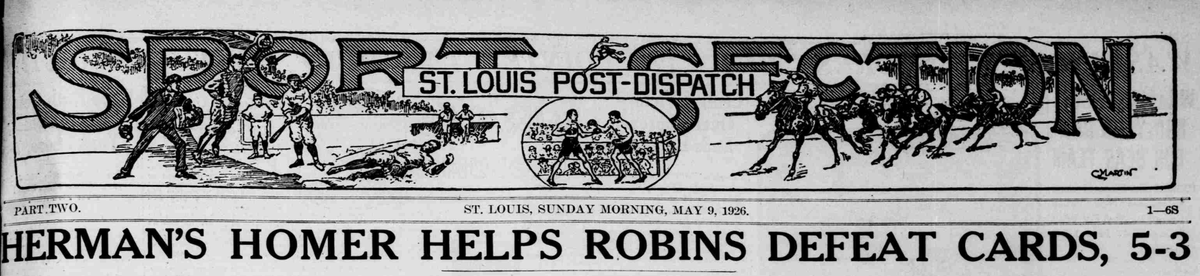
- Herman’s Homer Helps Robins Defeat Cards, 5–3
- Athletics Maul Three Brownie Hurlers and Win, 14 to 0
- And They Talk of Firing Sisler
- Brownie Notes
- Wray’s Column
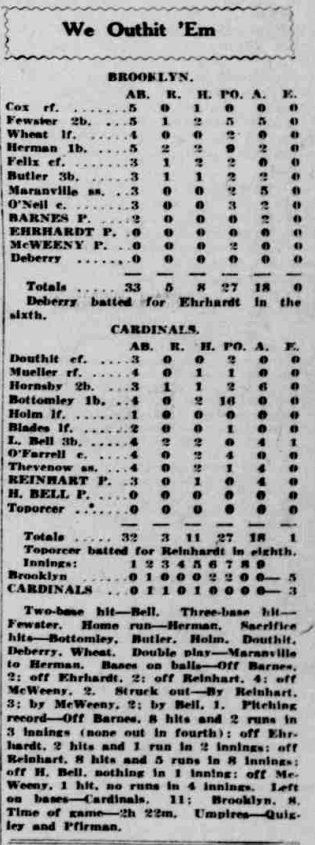
Herman’s Homer Helps Robins Defeat Cards, 5–3
Barnes Sent to Showers Early but McWeeny Again Stops Hornsby’s Sluggers
By J. Roy Stockton - St. Louis Post-Dispatch May 9, 1926
Babe Herman, a long string bean of a first baseman, who is first basing for the Brooklyn Dodgers while Jack Fournier recovers from injuries suffered in a recent collision, won a ball game for Uncle Wilbert Robinson and kept the Dodgers in first place in the National League race by hitting a home run at Sportsman’s Park yesterday afternoon.
Herman, who is nicknamed “Babe” because Floyd is not a good baseball monicker, crashed into one of Art Reinhart’s curves in the seventh inning and broke a 3-3 tie. Fewster was on base at the time, so the four-ply blow accounted for two runs, the margin by which the Dodgers spanked the Cardinals, 5 to 3.
In addition to hitting the circuit wallop, Herman distinguished himself by getting a single in the second inning, the first hit off Reinhart, and scoring on an infield out after a single by Felix the Cat and a sacrifice by the Babe to third.
Reinhart Batted Hard.
Although the box score shows that the Cardinals outhit the league leaders, 11 to 8, Reinhart was not nearly as good a pitcher as that. The Dodgers poked his offerings all over the lot and several times it was feared that the infielders would lose limbs trying to stop the ferocious drives of the men from Brooklyn.
The trouble with the Cardinals was that they did their hitting at the wrong time.
After the Dodgers had scored a run in the second the Cardinals came back with one in their half, but they should have had more. After one was out, Les Bell singled to center. Bob O’Farrell singled to the field, sending Bell to third. Tommy Thevenow raised a dinky fly to right, but it fell safe for a single and Bell scored and O’Farrell went to second.
One Run on Three Safeties.
Reinhart popped out, but Taylor Douthit drew a pass, filling the bases. Heine Mueller, however, couldn’t deliver in the pinch and grounded to Herman, who was grabbing everything that went his way.
Thus the Cardinals produced only one run on three singles and a base on balls.
In the third Rogers Hornsby walked, stopped at second on Jim Bottomley’s hit to right and advanced on Wattie Holm’s sacrifice. Only one run was produced, however. Hornsby scored while Maranville was throwing out Bell and O’Farrell ended the inning with a grounder to Maranville.
After Ray Blades had walked and died stealing in the fifth, Bell doubled to left and scored on O’Farrell’s single to center. Thevenow flied out and Reinhart tapping to Fewster.
Robinson’s men tied the score by scoring two runs on one hit, a single, two walks and a sacrifice fly. Felix started with a walk, Butler singled and Rabbit Maranville walked, filling the bases. O’Neil hit to Thevenow and Felix scored while Tommy was tossing to Hornsby to force Maranville. Deberry sent a long fly to Douthit and Butler scored with the second run.
Bell’s high throw in the seventh gave Fewster a life at first. Zack Wheat sacrificed and then came Herman’s home run.
Thus in two innings the Dodgers scored a total of four runs on only two base hits. Contrast that with the fact that the Cardinals made two hits in the first inning, three in the second, two in the fourth and two in the fifth and yet scored only three runs, one at a time, and you have the key to the situation.
Holm Crashes Into Wall.
Holm, Cardinals left-fielder, was injured in the fifth inning when he collided with the left field bleacher concrete wall after catching, or appearing to have caught, a drive from Fewster’s bat. Holm crashed into the wall after stabbing the ball with his gloved hand. He fell to the ground, had the presence of mind to reach out and grab the ball from the ground and toss it to Douthit and then he collapsed.
A contingent of Cardinals rushed from the dugout to give first aid to the injured and another surrounded Umpire Quigley, contending that Fewster should be declared out, inasmuch as Holm held the ball temporarily before crashing into the wall. Umpire Quigley overruled the Cardinals and the hit went for three bases.
Dr. Robert F. Hyland, who attended Holm after he was injured, stated last night the outfielder suffered contusions of the left knee and of the left elbow. Dr. Hyland said Holm would be out of the game for a week or ten days unless complications developed.
Hallahan to Oppose McGraw in Series Final
Young Bill Hallahan will throw his left-handed slants at the league-leading Dodgers this afternoon in the fourth and final game of the series. St. Louis fans hoped they’d get a look at Mr. Jess Petty, who won five games without being defeated. However, he will be saved for the opener at Chicago tomorrow and Bob McGraw, a right-hander, will pitch against the Cardinals.
Heine Mueller was trapped off third in the first inning. Hornsby was on first and was safely on his way to second on a delayed steal. But Mueller thought it was a double steal or something and wandered off the sack. He was run down.
Heine had no chance after Hornsby advanced to third. Rog might have given Mueller two bases and twice as much chance.
Herman and Felix singled in the second and advanced on Butler’s sacrifice.
Reinhart reared right and easy for Maranville’s high bounder, but it barely flicked his glove. Hornsby got it and threw out the Rabbit, but Herman scored.
Bell smacked a line drive over second. The only way to put him past Maranville was to O’Farrell followed with a smash to right. It was foul by an inch or two. Bob then pumped a single to center, sending Bell to third.
At last a break. Thevenow hit an ordinary fly to right center. Wheat started around, but Cox and Felix got their signals crossed and the ball fell safe, Bell scoring.
That was all. Reinhart popped out after Douthit walked, filling the bases. Mueller grounded out to Herman. The call was three and two and the base runners were on their way.
Athletics Maul Three Brownie Hurlers and Win, 14 to 0
Quinn Hands Sisler’s Men First Shutout
Ballou, Vangilder and Davis Pounded for 14 Safeties for Total of 24 Bases — Rice Makes Two Singles
By a Special Correspondent of the Post-Dispatch.
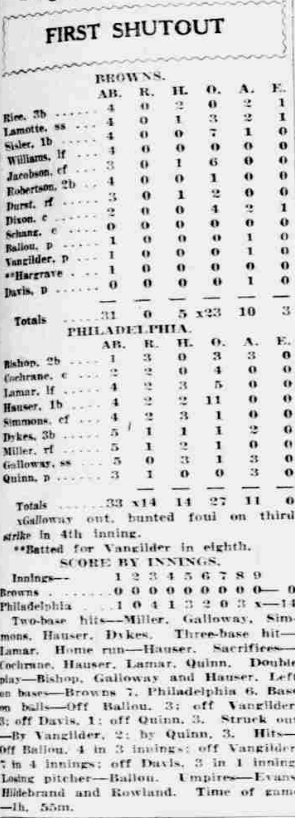
PHILADELPHIA, Pa., May 8. — The Browns felt the full force of a wild Athletics attack today and as a result dropped their third straight game here, 14 to 0. It was the first shutout defeat of the season for George Sisler’s men.
Three Brown pitchers were unmercifully hammered by the rejuvenated Philadelphia machine. Win Ballou, Elam Vangilder and Dixie Davis all were manhandled by the Philadelphians. The Macks totaled their 14 runs from 14 hits which netted them 24 bases, the best bit of hitting they have done this year.
The Sislermen found a tough bird to kill in old Jack Quinn. The aging Pole held them to five scattered blows and five little hits while the foe is getting 14 will hardly win a ball game. Sam Rice was the only man of Sisler’s attack who could fathom Quinn’s so-called spitter. Harry got two singles. But the rest swung a mystic stick and were as soft clay in the hands of an expert potter.
Lamar Lams the Leather.
Lewin Lamar’s triple to Bill Lamar probably was the real cause of the Browns’ downfall. Anyhow, that was the sole excuse for Ballou being yanked from the scene of action after the third. Lamar singled over the first run for the Athletics in the first inning and then he cleaned up a bathful of A’s in the third with a long triple past Ken Williams.
This blow was more than enough to clinch the afternoon’s tilt for the Mackmen and end any chance Sisler may have treasured of victory. Vangilder, who took up the pitching in the fourth, was no terror to this hitting Quaker machine and when he ceased pitching for a pinch hitter in the eighth, the Macks had tickled him for six runs and seven hits. Davis toiled in the eighth and after the first two hurls were down, he ran afoul of trouble. Two doubles, a pass and a single produced more Mack runs and ended a disastrous day here for the Browns.
Browns Weak on Attack.
There was little to the ball game to interest St. Louis. Inability to hit has been the glaring weakness of the Browns here. In Thursday’s game they got nine blows, made six yesterday and today, their total slumped to five. Little chance was left to win ball games these days with such hitting, especially when the other fellows are off on such a streak as the Athletics are now enjoying.
Sisler and Williams were powerless before Quinn. They swung at anything but a trouble-making stick. Both had chances to help the club’s cause at times but neither could oblige in the pinch. But there were other Browns who also found this Quinn person a mean pitching party. It was Quinn’s day and he probably would have beaten any club.
Quinn’s Fourth Victory.
It was also Quinn’s second victory of the week, his third in succession and his fourth of the year.
The loss of Marty McManus and Bennie “Frenchy” Bennett has cut deep into the Browns’ attack. With Bennett and McManus out of action, Sisler sadly feels the loss and this had much to do with the poor showing of the club here.
And They Talk of Firing Sisler
Complete answer to baseball fans’ inquiries as to why the Browns are not winning ball games is found in the figures on the work of the club’s pitchers.
Eleven moundmen have worked 219 1-3 innings in 25 games, and have been batted for 497 safe hits and 160 runs. They have struck out 68 batters and issued walks to 108. This means that opposing teams have scored six and two-fifths runs for each game played, have made more than one hit per inning and have received passes at the rate of one every two innings. Only Tom Zachary and Milton Gaston have shown any form, the former having won three games and the latter two. Of the Browns’ seven victories, Ernie Wingard and Win Ballou have got credit for one each when serving in relief.
By the Associated Press.
PHILADELPHIA, May 8. — Willis E. Johnston, traveling secretary of the Browns, visited the press box at Shibe Park today during the St. Louis-Philadelphia game to inform newspapermen that rumors of dissention in the St. Louis club were without foundation. Rumors also had it that Phil Ball, president of the club, was dissatisfied with his team’s showing; that a shake-up was coming and that it was proposed to release George Sisler, first baseman and manager.
“Mr. Ball is not satisfied with the team’s showing,” Johnston said, “but it is not the fault of Sisler or any one else. We have had a string of accidents and bad luck and apparently this is not right. No manager can be held responsible for injuries that rob him of his best players.”
The club’s hospital list includes Outfielder Bennett, Infielders Marty McManus, Wally Gerber and Pitcher Charley Robertson.
Brownie Notes
Max Bishop’s first four trips to the plate resulted in passes and three of them blossomed into runs.
The Browns hit Jack Quinn hard at times, but they were line drives and went right at some Mack infielder.
Marty McManus may be able to play Monday. And George Sisler will surely use him, for that war club is sorely needed.
The Macks walloped Elam Vangilder and then Ballou’s hard curve and timely low Lewin Lamar’s shaver and timely hits hurt the Browns.
In six games here this week, the Macks have scored 47 runs, made 66 hits for 96 total bases.
Wray’s Column
By: Ed Wray
Our Human Chattel.
Today in St. Louis we have with us Ernie Nevers, Brown recruit pitcher, and a highly prized college star. The Browns are on the road, but Nevers chafes at home idle, though paid well for taking his ease.
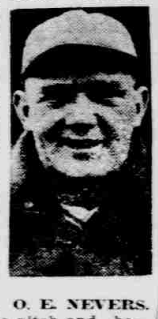
Nevers is feeling the yoke of the baseball serf, tied to the soil by the laws of the game. The club left him at home because he was not sufficiently advanced to pitch and because Nevers’ wife insisted on accompanying her husband if Nevers were taken.
Nevers objected to being left at home, because he could learn nothing away from the club. He objected to going away without his wife because there is no clause in his contract which forbids taking his wife—it is simply an unwritten law.
Nevers was then offered the alternative of going to Tulsa for further seasoning. But no minor league for me, was Nevers’ comeback.
Ernie is going through what all newcomers to major league serfdom experience. Like them he’s finding out that in return for high pay he must surrender something of his personal freedom. The laws controlling ball players are exacting for the reason that there would be no baseball, if they were not.
No Minors for Ernie.
Nevers has been with the club all season yet hasn’t thrown a ball. The Browns won’t or can’t use him. He complains at inaction and lack of progress. He wants to be traded to another major league club. He is willing to work, able to work and not allowed to work, which is against reason, Nevers argues.
The matter may be put up to Judge Landis.
Two Sides to It.
Nevers seemingly has a case but not in baseball. He signed for better or worse and received very much the better of the contract. He is getting the money and the club is not getting results.
Then, too, he seems to blame in not wanting to go to the minor leagues. If he is not ready for big league stuff, he should consent to be educated in the lesser leagues, as all players must be.
If he is in baseball to stay it would seem better to do this. If he is in it only because of a fine contract, he would do well perhaps to choose another profession.