Grover Cleveland Alexander Beats Cubs as Record Crowd Packs Sportsman's Park
Grover Cleveland Alexander defeated his former Cubs in his St. Louis debut as a record crowd of nearly 38,000 packed Sportsman's Park for a dramatic doubleheader that also featured a controversial bottle-and-cushion barrage.
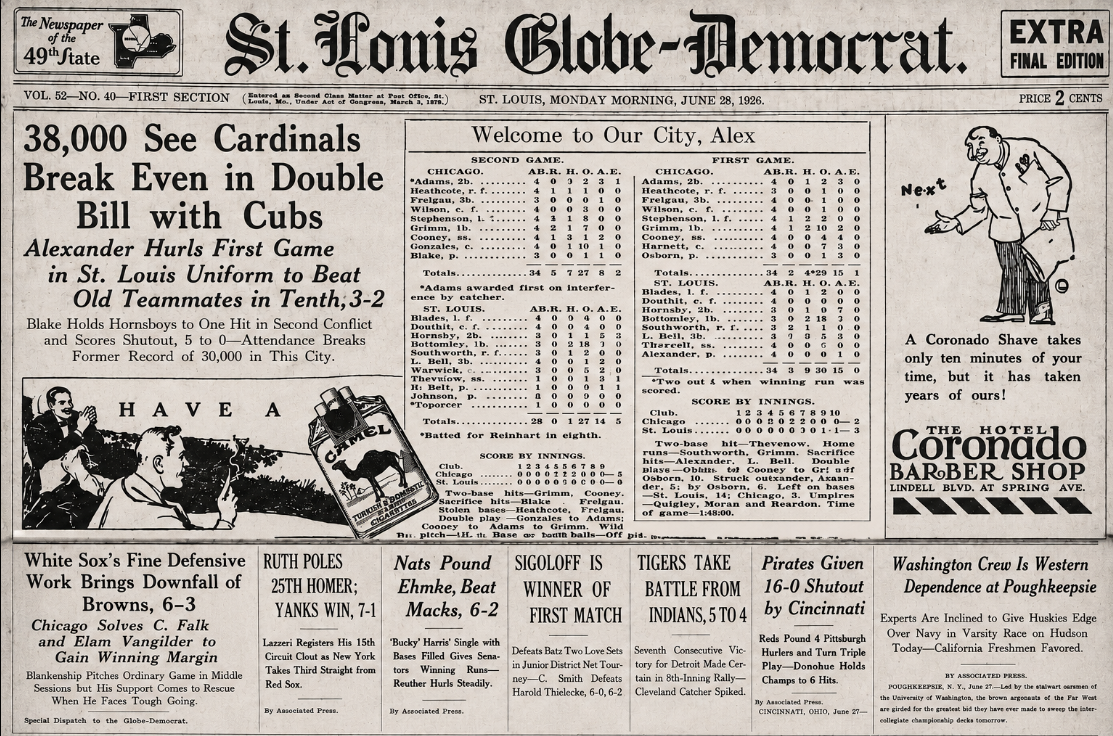
Content from the St. Louis Globe-Democrat Monday, June 28, 1926
In This Edition
- 38,000 See Cardinals Break Even in Double Bill with Cubs
- 37,196, New Record for St. Louis, Pay to See Cardinals and Cubs
- Cardinal Notes
- White Sox's Fine Defensive Work Brings Downfall of Browns, 6-3
- Advertisements
38,000 See Cardinals Break Even in Double Bill with Cubs
Alexander Hurls First Game in St. Louis Uniform to Beat Old Teammates in Tenth, 3-2
Blake Holds Hornsboys to One Hit in Second Conflict and Scores Shutout, 5 to 0—Attendance Breaks Former Record of 30,000 in This City.
By MARTIN J. HALEY.
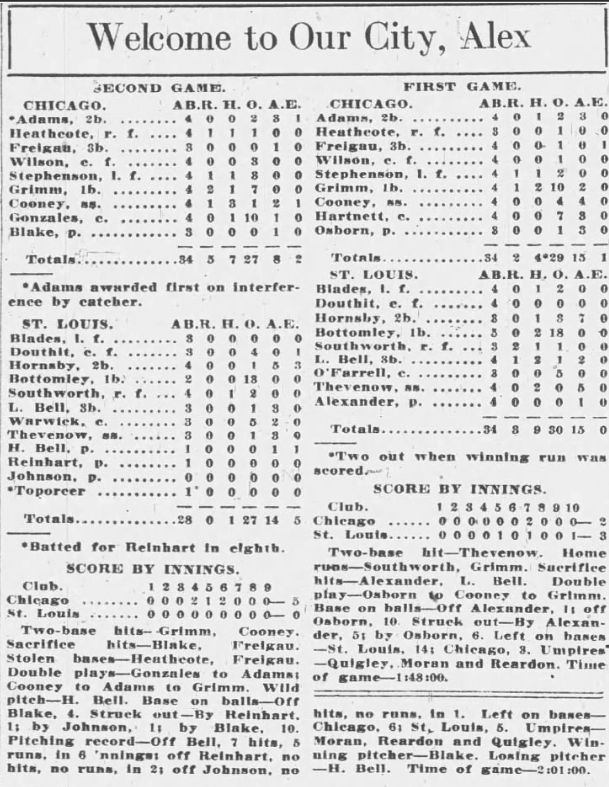
All records for attendance at baseball in St. Louis were shattered at Sportsmans Park yesterday's sunny Sabbath when approximately 40,000 fans jammed every available vantage point to witness the double-header between the Cardinals and Chicago Cubs, which was evenly divided when the Cubs won the second game, 5 to 0, after the Cardinals had taken the opening contest, 3 to 2, in ten innings.
The previous record crowd at a baseball game in St. Louis was 30,000 which packed the old Sportsmans Park in 1922, at a spring series game between the Cardinals and Browns. That was when Sportsmans Park seated only 18,500. That 1922 crowd necessitated the stretching of ropes, but this was not necessary yesterday, thanks to the past winter's reconstruction by which the double deck grand stand was extended on both wings and by which a new pavilion was erected in right field and a new bleacher in left and center.
Crowd Jams Aisles
Yesterday those thousand of fans who could not find seats located standing or sitting room in the aisles and in the rear of the lower deck, where thousands were packed in several feet deep.
For a few minutes in the ninth inning of the second game it appeared as if the game would not be played out to the end, when hundreds of fans showered cushions and pop bottles into the playing field, apparently as a protest to a decision rendered by Umpire Moran, who was behind the plate.
With two out in Chicago's ninth, Charlie Adams popped punily to Rogers Hornsby, but was permitted to take first base on interference by Catcher Bill Warwick, who tipped Adams' bat.
In another moment, Jim Bottomley made a spectacular catch of Cliff Heathcote's foul fly down the first base line and Chicago's ninth inning was at an end. It was then that some fan in the upper deck of the third base grandstand hurled a cushion. That acted as a fuse, and for the next four minutes the field was subjected to a bottle and cushion barrage, the like of which has never been witnessed before in St. Louis, although there have been cushions and bottles hurled here in the past. Almost two decades ago Umpire Billy Evans was struck on the head with a bottle at the old Sportsmans Park and almost killed.
Fortunately there was no one injured yesterday, although a number of bottles fell dangerously close to Umpire Moran, when he went over to the Cardinal dugout for a conference with Manager Hornsby, and also close to Umpire Ernie Quigley, who was stationed at third base.
The barrage stilled, a corps of groundkeepers, assisted by a number of fans, began the work of cleaning off the field in order that the game could be resumed and played to its finish. All told, the game was interrupted for almost fifteen minutes, and when the Cardinals finally went to bat in the ninth and were downed without a run it was well after 6 o'clock.
A Brilliant Battle
As to the games, the first was an excitingly brilliant pitching and defensive struggle, which ended in a conquest for the 39-year-old veteran of sixteen major league campaigns, Grover Cleveland Alexander. Only last Tuesday Alexander was bought from the Cubs for the waiver price, which is $4000. Yesterday this same waiver price veteran held his former teammates to four hits for ten innings.
One of these hits was a home run by the St. Louis boy, Charlie Grimm. This wallop into the right-field pavilion came after Riggs Stephenson singled to center in the seventh inning and gave the Cubs a 2-to-1 advantage as the Cardinals had scored a run in the fifth inning, when Billy Southworth, late of the New York Giants, hit a home run into the same pavilion for the Cardinals.
Chicago's 2-to-1 lead was as short-lived as possible, for the Cardinals promptly tied the count at 2-2 when they went to bat in their seventh. In this deadlocking instance, Les Bell singled to left, went to second on Bob O'Farrell's infield out and crossed the plate on Tommy Thevenow's single to right field.
Later in the same seventh, the Cardinals had a chance for another run, but missed. The Cards also were forced to pass up scoring opportunities in the eighth and ninth as a result of the splendid pinch pitching of Bob Osborn, a young, rangy right-hander who is serving his first year with the Bruins.
Base on Balls Fatal
In the tenth, however, Osborn gave a base on balls to Southworth, the Cards' first batter in the extra round. Lester Bell immediately sacrificed Southworth to second. Then O'Farrell was purposely passed in order to bring Thevenow, who drew a life at first base to fill the bases when his ground ball was booted by Third Baseman Tony Freigau.
Alexander himself now had a chance to win his own ball game, but after he had hit a long foul to left, Alec struck out. Ray Blades now was the batter and with the 38,000 patrons calling crazily for a base hit, Blades swung hard and half topped the ball, which bounced lazily to Charley Grimm as Blades tore for first and Southworth for the plate. Grimm fielded the ball as quickly as was possible, but his throw to Pitcher Osborn, who was covering first, was dropped by the pitcher and the game was over. Blades, however, was credited with a hit on the play.
The Cubs had no chance whatsoever to score a run after Grimm homered in the seventh, for Alexander did not let another Bruin reach first base in the last three and two-thirds innings. In his victory Alec struck out five men and walked only one. In the first, fourth and fifth innings, in addition to the eighth, ninth and tenth, Alexander retired the Cubs in a row.
The second game was a one-hit triumph for Sheriff Blake, another Chicago right-hander. Blake pitched a no-hit game for six and two-thirds innings, but in the seventh, with two out and Bottomley on first as the result of a walk, Southworth hit a long, clean line single to right-center field, Bottomley going to third base. Thus Bottomley had the rare distinction of being the only Cardinal to get past first base on Blake. All told, the Cards had only seven base runners against Blake. Four reached first, the result of passes, two on errors and one on the solitary hit.
Besides holding the far-famed Cardinal punch to one single, Blake struck out ten men, including Manager Hornsby, who fanned in the first inning.
Opposing Blake at the start of the second game was Herman Bell, who recently pitched a seven-hit game in Boston. Today, however, Herman was not in his Boston form and was removed from the box after being located for seven hits and five runs. Only the first two of Chicago's five runs were traced directly to Herman Bell's inferior pitching, however, for the Cardinals would have held the Bruins well in hand had they given their pitcher decent support.
There were five errors charged against the Knot Holers in the second game. This is superlatively significant in view of the fact that the Cardinals made only one error in the five games previous to yesterday's nightcap.
Manager Hornsby himself was the chief transgressor, the Rajah booted three times, two of these errors coming in the sixth inning, when the Bruins scored their final two runs. The other two errors were divided by Herman Bell and Taylor Douthit and both played a part in Chicago's run production.
The only clean runs counted by the Cubs against Herman Bell came to pass in the fourth, when Jimmy Cooney, a former Cardinal, singled to center after Stephenson had beaten out a hit to Les Bell and after Charley Grimm had doubled down the left-field line.
In the fifth, the Cubs added their third run. With one gone, Heathcote singled to center and continued on to second when Douthit fumbled the ball. In another moment, Heathcote reached third on a wild pitch and then scored on Freigau's sacrifice fly to Douthit.
Scoring the final two for Chicago in the sixth, Grimm drew a life on Hornsby's fumble of a grounder and reached second base when Hornsby's throw to the mound was muffed by Herman Bell. Grimm completed the circuit on Cooney's double along the right-field line and Cooney scored when Hornsby kicked Mike González's grounder out into center field.
Reinhart, Johnson Relieve
The last three innings were pitched by Polly Reinhart and Sylvester Johnson and the only Chicago player who reached first base on these two hurlers was Adams on the aforementioned interference play in the ninth inning.
The Cardinals against Blake had only one scoring possibility. This exception arose in the seventh through Southworth's no-hit shattering single. There were two men out at the moment, however, and Blake quickly pitched himself out of the difficulty by retiring Lester Bell on a long fly to Stephenson.
In the first inning, after Blades led off with a base on balls, Douthit struck out. Hornsby also fanned and on his third strike Blades was cut down trying to steal second.
The next Cardinal base runner against Blake was Bottomley in the fifth inning. Jim walked at the start of the round, but he was erased in a double play arranged by Lester Bell's grounder following Southworth's long fly to Stephenson. In the sixth, when Thevenow was safe on Cooney's high throw to Grimm, the Cubs protested Umpire Reardon's decision vehemently, but to no avail. The error did the Cardinals no good as Reinhart, batting for Herman Bell, struck out and Blades flied out to Hack Wilson.
Thevenow again reached first base on Adams' error of a ground ball in the eighth, but Blake applied steam and fanned both George Toporcer, batting for Reinhart, and Blades. Blake also had struck out Warwick at the start of the eighth, so that he wound up with three strike-outs in the inning. The ninth round had Douthit leading off with a base on balls, but Douthit got no further around than first base. He marked time at that station while Blake interred Hornsby, Bottomley and Southworth to terminate the hostilities for the day.
Alexander while pitching his four-hit game did not permit a Chicago player to get past first base outside of the seventh inning, when Grimm homered. Until that seventh inning the Cubs had had only three base runners, Grimm singling with two out in the second, Adams singling with two gone in the third and Heathcote walking with two dead in the seventh.
As a result of dividing the double-header, the Cardinals lost a half game to the league-leading Cincinnati Reds, but gained a half game on the third-place world champion Pirates, who were beaten for the third straight time by Cincinnati. The Cardinals now are two and a half games in the wake of the Reds and a game ahead of Pittsburgh.
37,196, New Record for St. Louis, Pay to See Cardinals and Cubs
The actual paid attendance at Sportsmans Park yesterday was 37,196, according to figures announced by Sam Breadon, president of the Cardinals. Breadon declined to give the actual paid receipts, but, unofficially, the receipts are estimated at approximately $40,000, these figures based on 29,796 grand stand admissions, ranging from $1.75 for the front row boxes down to $1.10 for seats in the unreserved grand stand section, and also based on the 75-cent admission to the pavilion and the 50-cent admission to the bleachers.
There were 4400 bleacher tickets and 3000 pavilion tickets sold, according to President Breadon. Combined, this total of 7400 paid admissions to the pavilion and bleachers, subtracted from the grand total of 37,196 paid attendance, means that there were 29,796 paid patrons in the grand stand.
In addition to the cash customers, there were several hundred fans admitted to the park through the pass gate and several additional hundred who gained admittance by climbing the fences, according to President Breadon. The actual attendance, therefore, when all avenues of admission are considered, was approximately 38,000.
The paid attendance of 37,196 is 7570 larger than the previous paid attendance at Sportsmans Park. The old record is 29,626, which is the number of fans who paid to see the Cardinals and Browns play a Sunday spring series game at the old Sportsmans Park in April of 1922.
Cardinal Notes
Yesterday's record-breaking crowd is magnificent proof that St. Louis loves a winner and will support one. As early as 10:30 o'clock yesterday morning the fans commenced to file into the grand stand. It was at that time that Secretary Clarence Lloyd opened the grand stand gates to take care of the several hundred fans who had lined up on Dodier street from the ticket windows to Grand boulevard.
At noon the pavilion and bleacher gates were thrown open to accommodate the patrons who had formed in lines on Grand boulevard at the pavilion entrance and on Sullivan avenue at the bleacher gates.
An hour before game time there were countless lines of thousands of fans massed on Dodier street and extending down to Spring avenue and east to Grand boulevard and extending further, both north and south, on the boulevard for a block. The crowd was so dense in front of the grand stand gates on Dodier street fifteen minutes before game time that it was next to impossible to push one's way through. Women fainted in this massed throng and children became lost, but no one was injured, according to reports from the Cardinal headquarters.
Such was the crush at game time, 2 o'clock, that hundreds of the reserved and box seats were unoccupied. The holders of tickets to these seats were unable to get through to the entrances, and it was not until the third or fourth inning of the first game that all the boxes and reserved seats were filled.
The bleachers and pavilion were crowded to the wall long before Grover Cleveland Alexander pitched his first ball, and the few scattered seats which had remained unfilled at game time were jammed to overflowing when the second inning was finished.
Besides parking themselves in all spots imaginable in the grandstand, bleachers and pavilion, a number of the overflow fans found points of visibility in the ventilators which dot the concrete outfield walls.
That there were countless bottles of pop and countless cushions sold was evidenced in the ninth inning of the nightcap when hundreds of the fans tossed bottles and cushions into the playing field. The chief ground keeper, Bill Stocksick, estimated that approximately 400 bottles and 100 cushions were hurled into the field.
Certainly no fewer than that number. The outfield, when the barrage was over, was a sea of bottles thrown into the field by the pavilion and bleacher fans. Bottles also were hurled from the grandstand, but, in the main, the grandstand "boneheads" who saw fit to throw something, wielded the heavy cushions, which covered the field in front of the boxes when the firing ceased.
This cushion and bottle throwing is another black eye to St. Louis baseball, which also is charged with the injury to Umpire Billy Evans almost twenty years ago, and to Outfielder Whitey Witt's injury four years ago. Both men were struck by bottles. Evans was severely injured, but Witt escaped with a superficial wound.
President Sam Breadon of the Cardinals said last night that he did not think the license for selling soda pop and cushions would be revoked as a result of yesterday's debacle.
Immediately prior to the "rain" of bottles, Umpire Ernie Quigley had gone down the third base line to "shoo" back into the stands a number of fans who had climbed over into the playing field, but just prior to that was Umpire Moran's decision on Charlie Adams of the Cubs in Chicago's ninth inning of the second game. To the fans, Adams had popped to Rogers Hornsby for the third out in the ninth, but Moran ruled that Catcher Bill Warwick of the Cards had interfered with Adams at the plate and, therefore, Adams was given a life at first base.
The fans, not knowing of Warwick's interference, decided that Moran was trying to "give" the Cubs something and became hostile, verbally, and when one thoughtless fan hurled a cushion, it required only a moment for the "mob" to follow. The great majority of the fans, however, became incensed at the "throwing" and sided in restoring quiet.
Alexander was given a tremendous ovation as he walked to the mound at the start of the first game. It was his first active appearance in a St. Louis uniform. It was the first game he pitched since May 22, when, as a Bruin, he was knocked out by the Braves in nine innings.
Alec's performance yesterday strengthens the Cardinal's chances of winning the pennant. Alec appeared the master of old. He had perfect control and, while his speed might not be equal to his speed of years ago, his sharp breaking curve is just as sharp breaking as ever it was. Barring a pass to Cliff Heathcote in the sixth inning, Alec's control was perfect.
Alexander's record for the season now is four victories and three defeats.
Bob Osborn pitched a great game in opposition to Alexander and it was too bad he had to lose on an infield hit, following an error. Osborne came up to the Cubs from Wichita Falls of the Texas League.
Sheriff Blake had the Cardinals in a hitless frenzy in the second game. He mixed his beautiful curve, fast ball and a change of pace so artistically that he had the Cards looking like tyros. Tough that his no-hit game was spoiled, but Billy Southworth's hit was as clean-cut as possible and would have been sweet for two bases but for Outfielder Hack Wilson's glove-hand stop and quick return to the infield. Wilson fielded the ball in deep right center.
Tommy Thevenow played a wonderful game at short. The silent one cut off at least a half dozen hits in the two games. This 22-year-old kid covers worlds of territory to either side and can throw as accurately out of step as the best we have ever seen.
Taylor Douthit made the best outfield catch of the day when he somersaulted in shallow center to rob Mike González of a hit in the ninth inning of the second game.
Prior to yesterday's nightcap in which they made five errors, the Cardinals had committed only one miscue in five games, and had played thirty-three successive innings without an error, dating from the fifth inning of last Wednesday's game.
For this afternoon's contest Vic Keen is slated to work against the Cubs. Tony Milstead, a southpaw, or Charlie Root, ex-Brownie right-hander, probably will pitch for Chicago.
White Sox’s Fine Defensive Work Brings Downfall of Browns, 6-3
Chicago Solves C. Falk and Elam Vangilder to Gain Winning Margin
Blankenship Pitches Ordinary Game in Middle Sessions but His Support Comes to Rescue When He Faces Tough Going.
Special Dispatch to the Globe-Democrat.
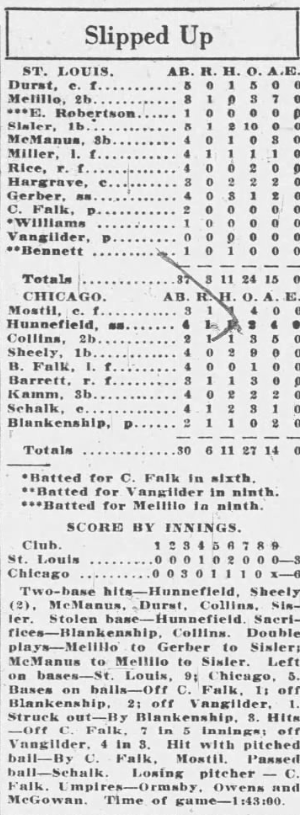
CHICAGO, ILL., June 27.—Bits of snappy fielding around second base at the right times and a few base hits proved a winning prescription for the White Sox today at Comiskey Park. The snappy, defensive contributions kept big Ted Blankenship going and the timely clouts collected runs so the Pale Hose left the St. Louis lads bringing up the rear of a 6 to 3 score before about 18,000 customers, who for a few innings had the pleasure of watching Bibb Falk trying to hit the pitching of his kid brother Chester Falk.
Chester is a tall loose-jointed left hander and on a cloudy day might be taken for brother Bib. The lad had two chances to throw at the other member of his family and he did it so well that Brother Bib didn’t wallop anything safely. However, there were others who didn’t treat the kid that kindly so after five innings he went away for a pinch hitter. By that time the Sox were fairly secure with four runs, but by way of making it more comfortable for all concerned, they picked up a couple more on Elam Vangilder in the sixth and seventh.
Blankenship Not So Good
Blankenship was a good hurler in the first two innings and in the last two, but in between he sort of sagged. In fact he sagged so much in the fifth and sixth that the boys in the bull pen got themselves ready for a hurry call, but Ted managed to wriggle through both bad innings, because in one Moe Hunnefield assisted with a neat stop and in the other Boss Eddie Collins skidded over toward first and smothered a hard drive that might have been disastrous had it escaped. Two were on bases at the time and two had already scored.
Besides contributing defensively, “Honey Boy” Hunnefield also figured prominently with his bat. He uncorked a two-bagger over third after Ray Schalk and Johnny Mostil had singled off Brother Chester in the third inning. The two scored on the clout. Then Hunnefield burglarized third and ran over the plate when Collins slammed a long fly to Ike Boone Durst in center.
The Browns hung up their first mark against Blankenship in the fourth. He opened by slipping a pass to Frankie Melillo. George Sisler flied out, but Marty McManus clouted a double to left and Melillo scored. The Sox redeemed this tally in the fifth by the simple process of hitting. Blankenship singled and Collins drove him around with a double.
Browns Score Some
Blankenship’s shaky sixth started with a two bagger by Sisler. McManus fanned, but Bing Miller singled Sisler home. A fast play by Collins retired Sam Rice. Bubbles Hargrave and Wally Gerber singled, Miller scoring on the latter’s hit. The two runners moved to third and second respectively on the return throw and at this stage Brother Chester was excused to let Ken Williams bat. Ken walloped the first pitch and it looked much like a real hit, but Collins scooted over behind Earl Sheely and shot the ball to first in time to end the inning.
Collins’ gang increased its one-run lead with one off Vangilder in the sixth. Singles by Alex Barrett and Willie Kamm and Schalk’s squeeze bunt that was converted into a hit did the trick. Collins scored the remaining run by walking in the seventh and traveling the rest of the way on a two-bagger by Sheely.
NOTES
A game with the Browns tomorrow afternoon completes the at-home stay of the Sox. They leave for Cleveland tomorrow night for two games. They also play three games at St. Louis and one at Detroit before returning to the South Side next Monday.
When Hunnefield stole third in the third inning he twisted his weak wrist, but wouldn’t listen to any suggestion that it might be well for him to let some other fellow play short the remainder of the game.
The Browns ruined a fine scoring chance in the fifth by bad base running. Hargrave walked and Gerber singled with none out. Hargrave permitted himself to be caught between third and second. C. Falk then forced Gerber and Durst doubled. On the next batter Hunnefield made a neat stop to retire the side.
Bennett, a pinch batter, opened the ninth with a single, but it didn’t disturb Blankenship. He flattened the next three men in a hurry.
Melillo and Gerber comprise a great fielding combination around second base, in fact, few are better on double plays. They worked two fast twin killings on the Sox today.
ADVERTISEMENTS