Babe Ruth’s 11th Homer Lifts Yankees as Giants Falter and Robins Hang On — May 15, 1926
Babe Ruth smashed his eleventh home run of 1926 to lift the Yankees over Cleveland in a tight pitching duel, while the National League pennant race grew even tighter as the Robins and Pirates battled through rain and the Giants fell to Cincinnati. Vintage newspaper coverage from May 15, 1926.
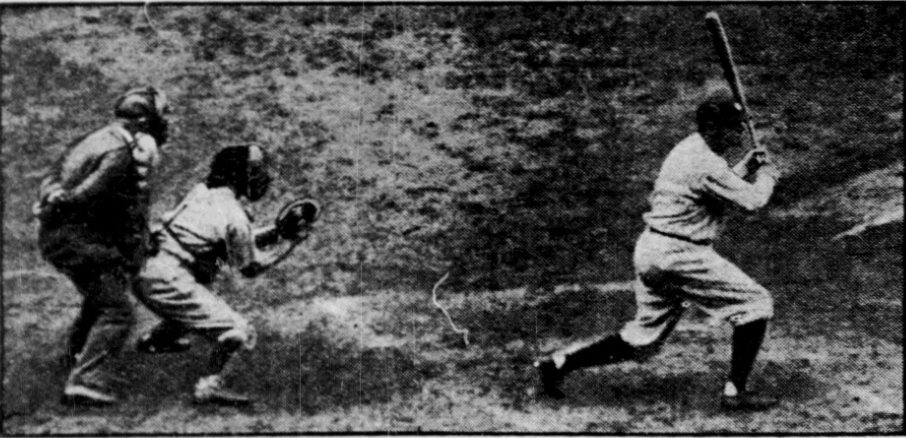
All content originally published in the NY Daily News, Saturday May 15, 1926
This Edition
- Babe Ruth’s Eleventh Homer Wins Game for Yanks, 2 to 1
- Robins and Pirates Play Tie as Rain Halts Game
- Giants, in Relapse, Defeated by Reds, 6–4
Babe Ruth’S ELEVENTH HOMER WINS GAME FOR YANKS, 2 TO 1
By MARSHALL HUNT. - NY Daily News, Saturday May 15, 1926
There was no chorus of Yankee base hits yesterday as there was the two days before, no rhapsody of swat, no orchestration of sock, no medley of maul. But the Yankees won, nevertheless, by a score of 2 to 1 from the Cleveland Indians in the final game of the series because that inimitable confectioner, G. Herman Ruth, sang a bass solo in the first inning.
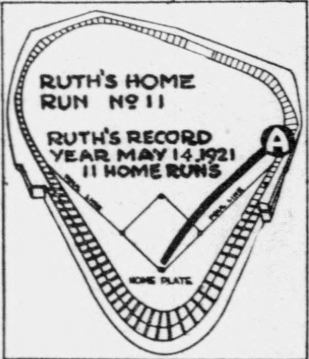
His eleventh home run of the season went singing into the right field bleachers in a decidedly major key when Lou Gehrig was on base and that aria alone won for the New Yorkers.
Thomas Pitches.
It was on May 14 of 1921, as of yesterday, that Mr. Ruth patterned his eleventh home run, the season when the Bam went hog wild and ran his total to fifty-nine. But in 1921 Ruth hit his eleventh home run in the twenty-second game the Yankees played and yesterday was the Yanks' twenty-seventh, so the Babe is five homers behind so far as games go.
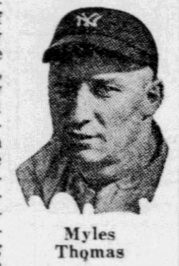
Young Myles Thomas pitched for the Yankees and allowed six hits, only one of which threatened to hurt the home boys.
And a youngster named Emil Levsen, formerly of the International league, held the Yankees to two hits, Mr. Ruth’s homer in the first inning, and a single by Pat Collins in the second. That was all.
Gehrig had walked and was impatient on first when Ruth did his stuff.
The Indians Score.
The Indians scored their run in the seventh when Rube Lutzke tripled to left center and scored on Luke Sewell’s infield out.
The Indians arrived in New York tied for first place with the Yankees. They came to lose three straight games and the Yankees are in a happy mood, what with winning four straight games, the Detroit Tigers having lost their final engagement here.
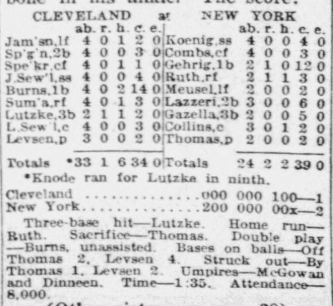
Urban Shocker of the Yanks' pitching staff had eight of his teeth removed yesterday as a result of ulceration. Bob Shawkey, another of the Yanks' flingers, is suffering a fracture of a small bone in his ankle. The score:
ROBINS AND PIRATES PLAY TIE AS RAIN HALTS GAME
Dodgers Near Tumble From League Lead.
By JACK FARRELL.
Pittsburgh, Pa., May 14.—Gosh, this fight for the National league leadership has reached a critical stage. Two weeks ago yesterday your Robins were out in front by a scant game or so, but nevertheless out in front.
Today, as you will observe after a perusal of the team standing, they are still leading the procession, not by a game nor a half game, but by mere fractions.
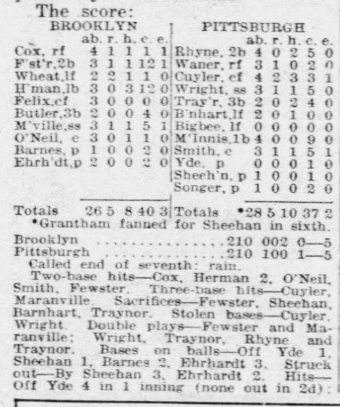
Although the Robins were out in front by one run in the last of the eighth the score reverted back to the seventh inning when Umpire Bill Klem gave the “Game off” signal and the bout ended in a 5 to 5 draw.---
It was mighty fortunate for the Robins that the game was not continued after the usual thirty-minute respite. The Pirates had three men on base with only one out and the menacing figure of Pie Traynor was looming at the plate.
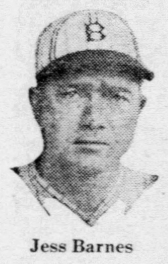
While Jess Barnes and Emil Yde were the opposing slabbists, developments of the first few innings proved beyond question that neither lad was destined to finish. Jess gave way to Rube Ehrhardt in the fourth after being struck for eight of the ten hits made by the Pirates and four of their five runs. Mr. Yde was shelled from his moorings early in the second inning and replaced by Tom Sheehan.
GIANTS, IN RELAPSE, DEFEATED BY REDS, 6—4
M’GRAW BOYS MAKE NINE HITS, BUT WHAT OF IT!
By WILL MURPHY.
Cincinnati, O., May 14.—There is no need for unseemly haste about purchasing the red fire and roman candles to be used when the Giants return home. Having made a few motions recently toward higher and better things, Mr. John McGraw’s young men had a relapse today.
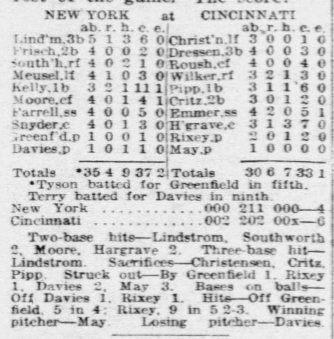
They lost to the Reds, 6 to 4, in the season’s first tangle between the clubs. Listen. Our side made nine hits, six of them for extra bases. The Reds made seven hits, all singles but two, and yet the Rhineland troop won all the marbles.
Young Al Moore dropped a fly after a hard run in the third inning, and that just about accounted for the Reds two runs there. Bubbles Hargrave, who poled three hits for his day’s work, and Eppa Rixey followed with singles and a sacrifice fly fetched in the second run.
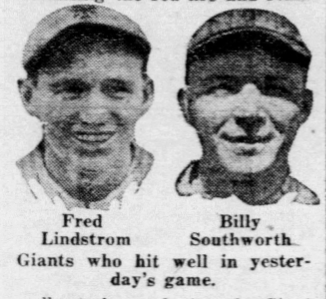
Our lads rapped Eppa Rixey around regardless, but couldn’t score until the third, when Billy Southworth doubled, George Kelly walked and Moore retrieved his budding reputation with a line double, scoring two runs.
Hard drives by Freddie Lindstrom and Frankie Frisch brought over another in the fourth. Kelly started the sixth with a three base knock and scored on Shortstop Red Emmer’s brilliant relay into the New York dugout.
From then on Jakie May did all the talking. He ended that promising sixth inning when Lindstrom lined to Paul Dressen for the third out. Freddie had made three hits in a row, but he didn’t get any more. Neither did any other Giant. May didn’t let a soul see first for the rest of the game. The score: