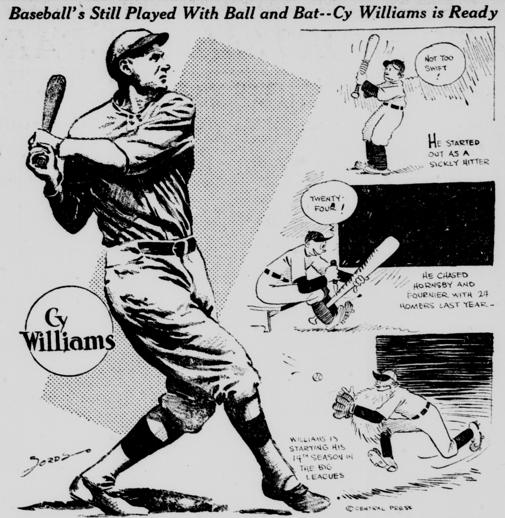
Baseball's Still Played With Ball and Bat--Cy Williams is Ready
By NORMAN E. BROWN. (Central Press)
April 21, 1926 - East St. Louis Daily Journal 3PM Edition
Much was written over the winter months concerning changes expected in baseball—changes to the so-called resin ball rule, the alteration in the composition of the ball, the change in the sacrifice fly rule, the influx of new stars from the minors, etc.
But after all the haranguing and whatnot the season opened with the game still much the same as it was a year ago. Which was about what one could expect.
"Cy" Williams, grand old beacon light of the Phillies, expected it. He hove into the training camp resting easy in that thought and has now proceeded to play baseball "as usual."
As long as the main part of baseball seems to be the ability to sock with regularity and much gusto a horse-hide ball with a wooden club Mr. Williams will be in the game, judging by his record to date.
Started With Cublets.
Williams is starting his eighth season with the Phils and his fourteenth in the big leagues. For six years before joining the Quaker City outfit he played with the Cubs.
With the exception of the first three years with the latter and his first year with the Phils he has galloped through well over a hundred games each season. He lacked experience when he joined the Chicago team direct from Notre Dame. And Uncle Sam cut short the 1918 season, his first in the eastern ball yard.
The odd feature about Williams' career to date is that while he has been known for some time as a behemoth of swat he started out as a sickly hitter and the technical cod liver oil the Cubs bosses fed him for six years failed to improve his hitting strength. He hit .279 one year and didn't recover from the surprise until the Christmas holidays. His first two years with the Phils he hit .276 and .278, and felt this a dizzy pace to maintain.
The next year out he must have taken a new grip on the bat or moved up his hand sights. Anyhow Mr. Williams' hitting was all that prevented the year being a perfect bust for the Phils.
He collected an average of .325 for the year, led his league in home runs with 15, and slammed out 36 doubles and 10 triples.
He has dropped below .300 but once since, in 1923, when he hit seven points under the line. The other years have found his average well above the charmed circle margin. Last year he slapped the apple for a .327 average and gave Jack Fournier and Rogers Hornsby a battle for home run honors. Cy grabbed 24, Hornsby 25, Fournier 27.
This is just another year to Cy. And that goes. Even if the resin becomes so thick on the ball he has to dust it off as he swings.
Source: (1926, April 21) East St. Louis daily journal. Retrieved from the Library of Congress, https://www.loc.gov/item/sn92053739/1926-04-21/ed-1/.