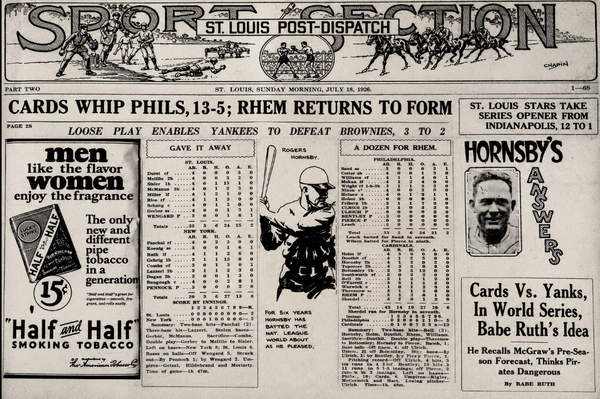
Bells Deliver for Cardinals; Hornsby Explains the Game — Twin St. Louis Accounts of a 3–2 Victory
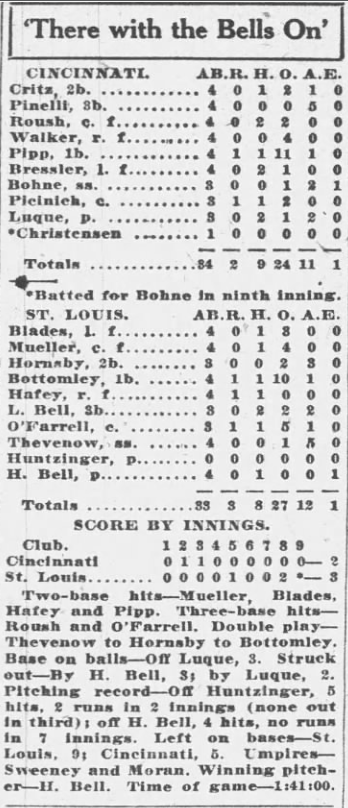
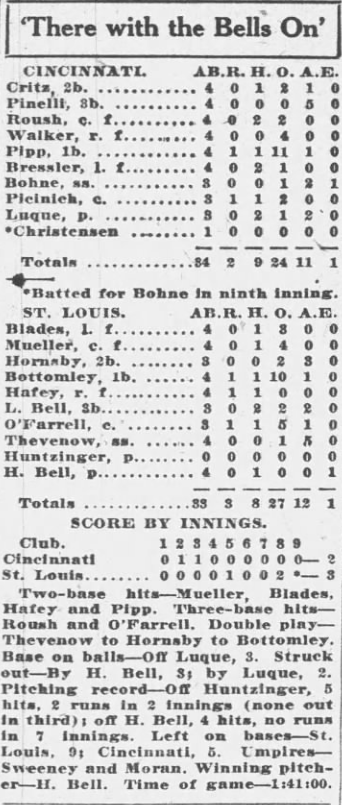
Herman Bell Pitches Cardinals to 3-to-2 Victory Over Reds
Lester Bell Drives In 2 Runs in 8th
By J. Roy Stockton - St. Louis Post-Dispatch May 5, 1926
Herman Bell, big-fisted, raw-boned and with a deep love for rough and tumble, is sergeant-at-arms of the Cardinal baseball club. His office is not appointive, nor is it elective. Herman is the sergeant-at-arms, that’s all. He has constituted himself as a guardian of things as they should be when ever the Cardinal club assembles, in clubhouse or on the diamond.
Herman first did his stuff on a recent Cardinal trip. The team was losing and destined to lose some more. Rogers Hornsby’s men were finding new ways each afternoon to kick away ball games. And the Cardinal temperature was rising. The men were red hot around their collars. And it would have been dangerous to beard such lions in their dens, even if Herman Bell had not been there. But Herman was there.
A Bathhouse Buzz-Saw
It was a professional, though rather inexperienced and unethical, bearder of lions that tried to do the bearding on that particular afternoon in Chicago. He worked his way into the Cardinal dressing room after a terrible game at the Cubs’ park. He wanted to hear what the Cardinals were saying and perhaps get a good story about what Hornsby would say to his players after such an atrocity of the diamond.
But he was seen, spied and ferreted out. He was asked what he wanted. He replied that he wanted to see Mr. Hornsby. Herman Bell, sergeant-at-arms, entered the picture at this point. Herman’s badge of office on this particular occasion happened to be a big Turkish bath towel, well weighted with aqua, not so darn pure, but extremely soapy. Herman wielded the heavy Turkish towel and the professional though inexperienced and unethical bearder of lions raced for the exit. The faster he ran, the faster fell the flagellant towel, and when he had finally been belted out of the dressing room he was not so inexperienced, even more professional and perhaps in the future he will be a bit more ethical.
This made a tremendous hit with Hornsby. It is a relief to find a fighting character in these days of chocolate malted milk lunches and men who think fondly of the first and fifteenth of the month, while hostile base runners chase wildly on the sacks. Herman Bell, sergeant-at-arms, had won himself a chance to pitch, even if he had lost his way in the spring and wandered into camp late and fat and soft. He was hard now, hard, tough and keen for a battle. Just waiting for a chance.
Herman Bell’s chance came yesterday afternoon. Walter Huntzinger, a polite young right-hander, was being far too polite for the Cardinals’ good. The rough and ready Cincinnati Reds were playing fast and loose with Huntzinger’s suave curves.
Wally Pipp had doubled in the second inning and scored on Bressler’s single. In the third inning Eppa Rixey had singled and then had gone to third when Luque, a pitcher, mind you, had singled on a hit-and-run play. But that wasn’t all. Rube Bressler had followed with another single and the Reds had two runs, men on first and second and nobody out.
Call for a Rough Bird
Time for Herman Bell, sergeant-at-arms, a rough and tumble fighter to quell the turbulent Reds. In came Herman and the Reds subsided. Pinelli bunted and Bottomley’s throw to Lester Bell forced Luque at third. It was not done as simply as that. Umpire Moran did not call Luque out. But Herman Bell took the leading role in some fine glaring at the situation and Umpire Sweeney told Moran that he guessed they’d better not cross this tough baby out there and Luque was called out.
The Reds then tried to do some glaring, but they didn’t make any impression after the umpires had seen Herman do his so professionally. Then the Reds tried a double steal. But Herman Bell gave them no lead off the sacks and Rixey’s throw to Lester Bell snagged Critz at third. Lester Bell then threw out Edd Roush for the Sergeant, and the Reds were tamed for good.
There were several attempts to break out and cause trouble, but the rough and tumble Herman Bell was able to handle all situations. In the sixth Roush tripled with one out, but Walker hit to Thevenow and Roush was nailed at the plate. In the eighth the Reds advanced a man as far as third, but Herman Bell put on the brakes and the plate remained safe for the Cardinals and the Bells.
Another Bell Rings Out
There had to be some defensive and offensive support to give the Sergeant his victory. And it was there. Bob O'Farrell tripled to the flagpole in center in the sixth and scored on sergeant-at-arms Herman Bell’s single. That put the Cards within a run of a tie, and in the eighth the other Bell, Lester, came through with a timely sock.
Hornsby walked to start the inning, only to be forced at second on Jim Bottomley’s attempted sacrifice. Chick Hafey, however, smashed a double to left. Lester Bell decided that he’d be a fine crackpot if he permitted Herman to have all the glory coming to the Bells on such an afternoon and whistled a single past Pinelli, scoring Bottomley and Hafey and winning the old ball game and breaking the Cardinals’ losing streak, which had reached five and become unbearable.
Today Flint Rhem will try his luck against the Reds. Rhem has won three and lost one. But all the Cardinal pitchers will breathe easier now. For they know that Herman Bell, sergeant-at-arms, will be out there ready to throw out the enemy if he gets tough.
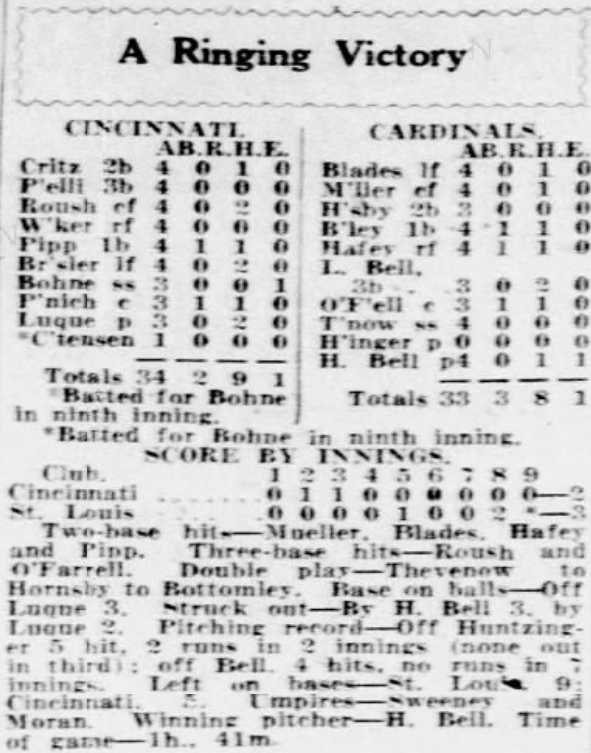
Two Bells Enable Cards to Beat Reds, 3–2, and End Losing Streak
By Martin J. Haley - St. Louis Globe-Democrat May 5, 1926
A ringing victory is a fitting description of the Cardinals’ 3-to-2 decision over Cincinnati’s Reds yesterday. Ringing is right, seein’ as how the two Bell boys, Herman and Lester, tolled the knell of parting day for the Rhinelanders and the departing of the Cardinals from a losing streak which had reached five straight games.
It was the Lester Bell end of the family that converted the day into one of rejoicing for the followers of the Red Bird standard. Up in the eighth inning, with the Reds ahead, 2 to 1, and with two mates in scoring position, Lester Bell shot a single past Third Baseman Pinelli, and the fans howled victoriously. The verdict was reached.
As for the other member of the Bell duet, this big right-hand pitcher played a dual role, for he not only humbled the Reds, after relieving Honeyboy Huntzinger in the third inning, but he drove the Cardinals’ first run with a clean single to center field.
Coming to Huntzinger’s rescue, Herman Bell faced a 2 to 0 deficit and a ticklish runway setting. The Reds had just made three straight singles in the third inning and had two men on first and second with nobody out when Herman made his entry. The Reds seemed in a hitting mood. At any rate, they already had made a total of five, and the game had only started.
Red Party Stopped
Then Herman came on duty. He had a tough man to face in Pinelli and another bad hombre in Edd Roush, but Herman was hard boiled himself yesterday, and he not only disposed of Pinelli and Roush, but he also pitched in a manner that made it easy for Bob O'Farrell to nail the front base runner stealing, so that dangerous inning was history. Hooray for Herman!
That effectiveness was not a mere flash in the pan for the erstwhile Milwaukee right-hander. Not at all. Herman was to maintain that pitching pace right down to the sweet conclusion. Herman’s right-hander stuff had the Reds in such a swing only miss frenzy that the Reds got only four hits after Herman made his entry.
That pitching gave the Cuban veteran, Adolfo Luque, something to think about. Yes sir, it made the little brown right-hander hustle. A winning hustler, Ado was for seven innings. For four innings Luque tamed the Cards on one hit, but in the fifth they got to him for three more and for their first run.
All told, the Cards solved Luque for only six hits until the eighth, and they wound up with a grand total of eight, or one less than the Cincinnati aggregate of Huntzinger and Herman Bell.
Bell Drives In Two Runs
Leading to the winning rally against Luque, Rogers Hornsby drew a walk at the start of the eighth. Jim Bottomley tried to sacrifice his manager to second, but Pinelli hawked the bunt and whipped to Critz in ample time to force Hornsby. Then Chick Hafey shot a long double to left center, Bottomley stopping at third.
Lester Bell was up. Les had walked in the second, had been beaten out of a hit by Pinelli in the fifth and had singled in the sixth. Was he equal to this occasion? The question had a brief life. Bell whizzed the leather like a 30-30 steel jacket past Pinelli, and Hafey followed Bottomley across the plate.
That Luque escaped further damage later in that round, even though Bohne booted Thevenow into a life at first base, doesn’t matter. The verdict was in, for Herman Bell set the Reds down in a row in the ninth, same as he had done in the fifth and again in the seventh.
Reds Score in Third
Cincinnati’s third inning run came quickly on successive singles by Picinich, Luque and Critz, Picinich scoring. It was here that Herman Bell brought his right arm to the mound. First to face Herman, Pinelli essayed a sacrifice, but forced Luque at third. Bottomley to Bell.
Then Critz was nipped stealing third. O’Farrell and Roush closed the inning when Les Bell fielded his grounder perfectly.
Until the sixth inning, then, the Reds got only one scratch hit off Herman Bell, but meanwhile the Cards picked up a run on Luque, who had held them to one hit for four innings. This was a double through Critz by Mueller in the first and was wasted when Hornsby and Bottomley could not get the ball out of the infield.
In the second, Les Bell’s pass broke the monotony of Luque’s effectiveness, but in the third and fourth, the Cards were subdued rotatingly. Opening the fifth, Pinelli started to erase Les Bell, but O’Farrell drove to the flagpole for three bases. Bob marked time at the far corner as Pinelli tossed out Thevenow, but scored when Herman Bell singled over the midway.
It appeared as if the Cards would overtake the Reds in this very inning when Blades followed with a drop single to right, but with men on second and third, Mueller bounced out to Pipp.
Nail Roush at Plate
Both clubs missed scoring chances in the sixth. For the Reds, Roush tripled to right center with one out and was nailed at the plate while trying to score on Walker’s grounder to Thevenow. For the Cards, Bottomley singled and was forced by Hafey. Les Bell also singled and O’Farrell was passed, packing the paths for Thevenow, who struck out after working Luque into a three-to-two hole.
Three up and three down for each side in the seventh. The eighth saw the Reds get two hits and place men on first and third with two gone, but in this pinch, Herman Bell downed Walker on a pop to Thevenow.
To draw the final curtain, following the Cards’ two-run rampage in their eighth, Herman Bell made Pipp and Pinch Batter Christensen fly to Mueller and knocked over Bressler on strikes.
Third of the series today.
Rhem and Lucas Today
Flint Rhem and Fred Lucas, both right handers, are the pitching choices for the third Cardinal-Cincy fracas this afternoon. These rivals have parallel records since the season opened. Each won his first three starts, only to lose the fourth. Lucas once was an infielder with the Braves.
Harry Ables, a left-hand pitcher years ago and now president of the San Antonio club, was in town yesterday looking for players, but the Cards had not turned any over to him at last report. Santone is the club from which the Cards obtained Catcher Warwick.
Following long conferences yesterday, Duster Mails finally decided to be “dressed in” at Syracuse, but he claims he’s been given a raw deal. Here’s Mails’ side of it:
“I worked like a truck horse in my South home for seven weeks without pay getting into condition. What good did it do? The season has been running for three weeks now and I’ve been worked in one inning, just long enough to be charged with the loss of a game. I’ve been used in batting practice only once in three weeks. It looks as if I’ve been ticketed for some time. However, I’ve had many ups and downs, and I guess I can stand this one.”
Hornsby’s Answers
St. Louis Post-Dispatch May 5, 1926
Baseball Rules & Situations Explained
(1) Runners on first and second. Runner on first goes to second and touches base. Pitcher throws to third for a force. Is the runner out?
(2) Batter hits ball, which hits fair and rolls foul. The umpire called it a foul. Was he right?
(3) Runner on first. Catcher missed the next pitch and a bystander picked it up and handed it to him. Catcher threw it to second and caught the runner. Was he out?
— Raphael Donner, St. Clair, Mo.
Answers
(1) There is no force out unless the batter starts one. The runner in this case was not out unless tagged with the ball.
(2) If the ball rolled foul before passing first or third base it was a foul ball. If it went foul after passing first or third, it was a fair ball.
(3) In cases where spectator overflow on the playing field occurs, special ground rules on balls that go into the crowd are made by the captains prior to the opening of play and such rules govern throughout.
Batter hits line drive which caroms off a base runner and is caught on the fly by the shortstop. Does this count as a double play?
— J. J. M.
No. The runner is out for being struck by a batted ball, but the ball is dead as soon as it strikes him, the batter being awarded his base.