Sporting News — April 29, 1926 (Edition Roundup)

The Sporting News Roundup: April 29, 1926
Two weeks into the 1926 major league season, the baseball world was already being turned upside down. Favorites stumbled, contenders emerged, and The Sporting News captured the early-season chaos from St. Louis, Chicago, New York, Boston and beyond.
First Two Weeks Finds Major Races Very Much Upside Down
At Least, Dope Comes In For A Rude Shock
Browns Have Athletics to Keep Company with; Cardinals Kick Pirates Into Hole, Then Step on Them.
ST. LOUIS, Mo., April 26.—Those gentlemen of baseball who engage in the fanciful, but hazardous business of doping the pennant races each Spring, are reading from the bottom side up in the standings after two weeks of the major league season. In the National League, the Pirates, favored repeaters, have been doing the anchor stunt, while in the American League, conditions are even the more topsy-turvy. Here we find the Browns and Athletics, both nominated as “one, two” finishers keeping each other company.
But there is an old saying that one swallow does not make a Summer, and by the same token, few April reverses, or victories, do not decide pennant races. Hence, the obituaries must not be prepared at this time. These favored teams, notably the Browns, have not yet found the even tenor of their ways.
However, it seems, George Sisler’s team is about to straighten out for a continued good run. Thus far the pitching has not been what it should be. Neither has the batting co-ordinated for the determination of things. But you can’t keep a team of Williams, Rice, McManus, Sisler and Jacobson down for long.
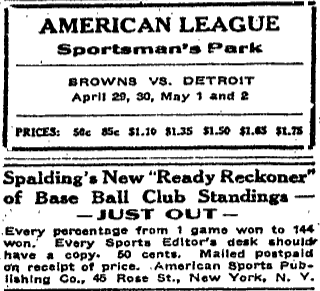
The Browns came home from the opening two-series road trip with but one victory, that having been scored against the Tigers. They opened at Sportsman’s Park before close to 15,000 fans on a raw, windy day, and with Tom Zachary pitching four-hit ball, turned in a 5 to 1 win. But the next day the pitching went on the rocks again and the Sox carted away an 11 to 7 game.
Browns Find the Wall.
Milton Gaston, Sisler’s ace right-hander, stopped the Sox in the third game, 2 to 1, although the visitors outbit the Browns nine to six. Then more spotty pitching was registered in the windup and the Sox managed to get an even break in the series. This, in spite of the fact that three home runs were punched out by the Browns—Sisler, McManus and Schang getting theirs.
But hark to this for the sixth inning in the windup with the Sox—Sisler hit a home run, Williams walked and stole second, McManus hit a home run, Jacobson singled and was forced by Schang, Melillo singled and Scharg went to third. That was all, but there you had two hits, two of them home runs, and only two markers chalked up. There was ample individual effort, but it was not united for productive results.
Schang’s homer came in the eighth, and as luck would have it, there was nobody on.
Nevertheless, the outbreak gave some idea of what could be expected when the Browns actually got their wind. In the very first game with the Cleveland Indians, who came to St. Louis leading the procession, Speaker’s men tasted of the pent up energy in the Brownie bats. We reproduce the fifth inning of that game as we did the fifth inning of the final Chicago game: Kerr went into pitch for Cleveland. Williams struck out. McManus bounced a home run off the pavilion in right. Melillo singled, scoring Jacobson. Zachary’s third hit was a home run into the pavilion far down in right center, Melillo scoring ahead of him. On the next pitch Rice hit over the right field pavilion into Grand avenue.
Williams Slams Two.
In this game, Kenney Williams bat woke up and his first home run of the season in the second inning was followed by his second in the sixth. All told, the Browns got 16 hits and seven runs. The Indians, the worst licking they had run into up to that time, the score being 11 to 5. Zachary went the route, turning in his second win in four starts.
We have recited some of the high spots in the recent hitting of the Browns to show that the old “socking line” is still there. A little more co-ordinacy in the pitching and the Sislers will draw in their belts and start looking around.
Oscar Melillo has been playing third base since the second game of the Detroit series when Goinz Robertson had a finger smashed by a pitched ball. The former Milwaukee second sacker has fitted into things nicely, too. The place is a bit strange to him, but he is adapting himself to the business there in fine shape.
Melillo has also been hitting well. At the time he marks is better than any of the Brownies, which might well be something to his credit. Melillo is heralded as a winning ball player by his friends in Milwaukee and he certainly strikes one as being just that. He seems to rise to occasion, and while not a long distance clouter, is ever apt to poke through a hit when it is most needed. Oscar is “growing” on St. Louis.
Bob Lamotte is being played at short and the Frenchman has been doing very well. He totes a better punch than the string, Gerber and his fielding has even improved over last year, when he came in so handy with Gerber laid up with a broken leg. Sisler likes Bob because there is an inherent drive in him.
Two Double Play Marks.
The Browns’ infield has been working in good shape, all-around. In the second game of the series with the White Sox last week, two double plays were put through, this tied the American League record. In the National League, the record stands at six. Melillo, McManus and Sisler accounted for one in the second inning; Lamotte, McManus and Sisler one in the third; Melillo and Sisler worked a third in the fourth; Lamotte, McManus and Sisler repeated in the sixth, and Hargrave and McManus in the seventh. In spite of the quintet of two-ply slaughters, the Browns lost the game.
The Browns have released Nolan Buckner and Walter Shannon, two youngsters, to the Little Rock Club of the Southern League. Buckner is a pitcher from the California semi-pro ranks, while Shannon was a St. Louis Mound leaguer last season. Options are kept on both.
The Cardinals have been doing very well on the road. They hopped into Pittsburg for the Pirates’ opening and picked up the trail just where they left off when the world’s champions visited St. Louis.
Barney Dreyfuss’ field on April 22, Hornsby’s men took them down the line, 5 to 3, in a ten-inning fracas. A home run by Chick Hafey, with a man on, settled the matter in the extra round.
Keen pitched this game for the Cardinals and was a thoroughly reliable right-hander throughout. It was his second straight win for Hornsby.
The Pirates managed to eke out a win in the second game of the series, 3 to 2, although the hard-lucked Sylvester Johnson pitched six-hit ball. All of the Pittsburgh runs were scored in the first frame and but for a boot by Thevenow and a futile shooting effort by Holmer Mueller in the inning the Cardinals might have won the game with a shutout.
The next day Hornsby’s men socked out 18 hits, Roe leading the attack himself, with three out of three, a homer, double and single, and the Pirates went down, 11 to 3. Rhem held the champions to four hits, chalking up his third victory in as many starts.
The Cardinals now hold a big advantage over the world’s champions, holding five victories to two against them for the two series. Hornsby’s men knocked the Bucs dizzy in the very first series of the season, taking three out of four and they have had trouble finding themselves. They literally kicked them into the “hole” and then stepped on them.
Hornsby, by the way, has been setting a great pace with the bat. The Cardinal leader, who has topped the batters of the National League six consecutive years, was in his accustomed place in the averages, with a mark of approximately .442, when this story was written. He was also leading in number of hits registered. If anything, Rogers has a better start in his batting this year than he has had in several seasons past.
Cubs Begin to Act Like Grown Bears
By Irving Vaughan
They’re Gobbling Lots of Prey in the National Hunt.
‘Weaklings’ So Far Have Displayed Batting Punch and Plenty of Pitching, Sox Puzzle Against Southpaws.
CHICAGO, Ill., April 26.—Long faces are not in style around the Cubs’ park here. In fact, fans and players alike are acting as though they’re glad to be alive. And not without reason. Haven’t the Cubs, generally regarded as sure tenants again this season in the eighth apartment, topped right out and showed that they must be regarded as something more than the league’s doormat?
Naturally one game doesn’t make a season any more than one swallow makes a jag, but you can put it in your hat that if the Cubs keep going as they started, they’ll put gray hairs in the head of more than one manager, and McCarthy won’t be among them. Not that Chicago is going to win a National League pennant. Merely, that the Cubs, full of ambition and vinegar, as they are, are going to be hard to beat about five times out of six. If they had the needed wallop they’d be different, but it still looks as if they will be one run shy in many of their games.
At this writing, the Cubs have engaged in 11 games. They started at Cincinnati by winning one and losing two, the latter pair being hard luck affairs. Then they moved over to St. Louis to give the eye to the highly touted Cardinals and in four games earned an even break. Next to Chicago to resume with the Reds. Out of this batch of four scheduled games, the Cubs grabbed two wins and a tie. The other battle was wiped away because of rainfall, and it was a tough blow to the team and officials alike. The Cubs figured they would have had an easy time because the Reds were without pitchers and the officials were figuring on a Saturday turnout of about 30,000. And they would have had them, too, because there seems to be more real interest in the Cubs now than at any time in the last few years. The next day they bowled over the Pirates.
They’re Getting Their Blows.
The surprising feature about the Cubs thus far is that they haven’t given any real indication of being as weak with the bat as most of the experts suspect. Only twice have they been held to what you might call weak sticking. Red Lucas did it to them once in Cincinnati, and Flint Rhem once at St. Louis. In all their other games they have run up fairly good scores, not taking of which were due to big innings—against Cincy they scored five runs in one inning, off one game, seven runs in another. At St. Louis they had a couple chapters of four tallies each, and there against the Reds the other day they notched 18 runs in one game, due to two large and productive rounds. That indicates strength in the pinches, if not in the averages, and the former counts more than the latter.
It might be well to state right here, as well as elsewhere, that there is no reason to think the Cubs are going to be weak for left-handed pitching. In fact, it looks as if they would be better off if there were no right-handers in the league. The theory, that a right-handed batter hits a southpaw doesn’t always work out in practice, but the Cub layout seems to follow the rule. By putting Pete Scott in left and Mandy Brooks in right field, Manager McCarthy can employ eight right-handed hitters against left-handed pitching. If necessary, he can make it nine by using Tolson at first base instead of Grimm.
Know How To Do Things.
The weather was so cold for the Sunday game that only about 16,000 braved the breezes, but the atmosphere didn’t bother the Cubs. They bopped the champion Pirates by 4 to 3 and had to play tight baseball to do it. The title holders made only four hits off Percy Jones, the southpaw, but collected three runs because Rhyne doubled after Jones had filled the bases on passes with none out. The Cubs grabbed their winning tally in the eighth on a beautiful squeeze play, executed by Grimm, and they play convinced a lot of the spectators that McCarthy has his men trained for any emergency.
If any one player is deserving of a lot of credit for the manner in which the Cubs have performed, it is Hack Wilson. He has been hitting the ball consistently and most of the time for extra bases. Freigau also has maintained a pretty good pace with his bat, but behind the entire showing is the fine pitching that has kept the opposition from making fresh in a run-making way.
After making their fine start by knocking the Browns for three in a row in the opening series, the White Sox ran into a stone wall and didn’t look like the same team. Everything was fine until Tris Speaker and his Indians came to town. The Grey Fox figured the easiest way to stop Collins’ gang was to use southpaw pitching. He proceeded to follow out his idea, and it worked admirably—for the Indians.
Don’t Like Left-Handers.
Speaker started off by pitching Miller. He made the Sox yelp. Then Sherry Smith did it. Then Joe Shaute. That was enough to turn Manager Collins red-headed, but he got another dose immediately at St. Louis when Zeb Zachary stopped in and collected a win for himself and his Brownie friends.
By these games alone a blind man can see that the word is out to give the Sox plenty of southpaw pitching, so they are going to see plenty of it between now and October. Of course, there is this. If enough left-handers face them, they may become so accustomed to wrong-armed pitching that they’ll sock it.
There is somewhat of an alibi for the southpaw defeats in that Barrett and Mostil were absent most of the time. A leg injury has kept the former out since the start of the season, and Mostil was out until the St. Louis series last week. He managed to play when Zachary pitched, but his presence couldn’t swing the boom in the Sox direction.
However, if Barrett and Mostil are both in there, it is a dead cinch that southpaw pitching will not fare as did the three Cleveland fellows. Barrett and Mostil always could land on the left-handers fairly effectively. It can be said of the White Sox that they are trying every minute they are on the ball field. It is the same kind of a Collins team that went so well last year until Eddie was hurt.
New Yorkers Hear Big Guns Booming
By Joe Vila
Both Yankees and Giants Dig In Like Real Warriors.
Hitting of Miller Huggins’ Team Makes Up for Any Slack in Pitching; Collins Wins Favor with Sticking.
NEW YORK, N. Y., April 26.—At this writing the Yankees and Giants are performing in a way to lead New York fans to utter guffaws at what writers may have been saying to get choice seats at the World Series next Fall. The last clip at which the Yankees have been traveling has surprised even their most ardent admirers. Little Miller Huggins, now is enjoying many a chuckle at the expense of the critics who labeled his aggregation a bunch of misfits while the Yankees were training in the Southland.
Perhaps the most noteworthy work on the part of any individual member of Colonel Ruppert’s aggregation has been contributed by pudgy Pat Collins, who has added much strength to the team’s attack. Collins delivered four home runs and a bevy of doubles in the Yankees’ first ten games and is destined to the bulk of the receiving, even though his throwing to bases is not as good as Benny Bengough’s.
Collins’ slugging has given a punch to the lower end of the batting order and the famous “Murderers’ Row” of a few seasons back may have been extended until it covers the entire batting order.
The whole team is pounding the cover off the ball, in spite of the fact that the lively ball is supposed to have passed out of existence. The team averaged 12 hits to a game during the exhibition trip and did slightly better than that in its first ten league games.
How’s this for slugging?
The Yanks put on a tremendous hitting bee in Washington when they bombarded Bucky Harris’ hurlers for 22 hits, netting a total of 23 bases. Walter Johnson was the first victim on that afternoon.
Babe Ruth was the particular big noise in that explosion of base hits. The Bambino poked a home run, two doubles and two singles in six trips to the plate, looking very much like the Ruth of old. He scored one run himself and drove in six more, thus accounting for ten of the 15 markers chalked up. That is not a record, but it is a highly creditable achievement. Ruth is holding very well and running the bases in fine style. The big boy seems to be possessed with a determination that will not be denied.
The Bambino’s attitude toward the game reflects the spirit of the entire team. No doubt, Huggins is a bit surprised at the new spirit displayed by the athletes under his command. There is an air of aggressiveness everywhere that is tinged with the purpose of winning the pennant at the expense of individual glory.
Possibly what has had more than anything else to do with infusing the players with the spirit of co-operation was the panning the team received from the scribes who looked it over in the training camp and found it so no good.
The infield, so far, has shown much more strength than in 1925. Lazzeri has proven himself a hawk at second base. Koenig, the new shortstop, is not as polished a fielder as Lazzeri, but he is hitting nicely now and as soon as the rough edges wear off his surroundings his fielding should improve.
Lou Gehrig is fielding much better at first base than formerly. In fact, he ranks as a mighty good first baseman on his present form, even leaving his hitting out of consideration. Dugan is doing great work. His knee no longer troubles him.
Hoyt is doing the best work among the pitchers. Waite is some 20 pounds lighter than last year, tipping the beam at 176 right now. He announced during the Winter that he was going to make this a big year and is living up to his prediction. Over a stretch of 16 innings he allowed only six hits.
Pennock also is supporting on the mound, and Shocker has been good enough. Jones has been very unfortunate thus far.
The Giants have gone back to the old style of attack and are doing very well with it. They have a fast team and the boys are stealing lots of bases and working the hit-and-run play overtime. Every man in the regular lineup seems to have the faculty of hitting behind the runner. That’s a great help.
Jess Petty was the only enemy moundman to beat the Giants in their first eight starts and he had to pitch a one-hit game in the season’s inaugural to finish on the right side of the score.
Al Tyson, the new center fielder, made good from the start, but recently suffered a slight attack of the grip and had to go to the bench. Billy Southworth was inserted in the center field groove and proceeded to show that he was anything but a back number.
Emil Neusel, who reported late because of his differences with the management over salary, was slow in getting into shape, but he has rounded to form and is doing as well as anyone could ask. Young appears to be all set for a prosperous season. Ross had a hard time last year, being held back by illness, which forced him to play many a game solely on his nerve.
Travis Jackson is mainspring. Jackson, with the knee which impeded his efforts last year no longer causing him annoyance, is playing wonderful ball at short. Those who saw the Giants and the Robins open the season in Brooklyn last week were treated to a fielding exhibition by Jackson that made plain the reason for the decline of the Giants when Travis was injured last year. Jackson and not Frankie Frisch, brilliant as the latter is, is the mainspring of the Giant infield, just as Dave Bancroft was before him. McGraw plugged gaps at first, second and third last year and the team continued to win, but when the game was opened at short by Jackson’s injury, McGraw was unable to fill the breach and the team stopped winning.
The pitching staff of the Giants has been fully up to McGraw’s expectations. Jimmy Ring, after a shaky start, showed much better in his second trip to the firing line. He won both times, but in his first game it was the heavy attack of his mates that gave him the victory. In his second attempt, he won strictly on his merits.
The team is hitting well and has taken the measure of the best pitchers on the rosters of the Brooklyn and Boston clubs. McGraw’s men pounded out 17 hits in the Brooklyn opening, chased the great Dazzy Vance to cover.
The attendance has testified to the revival of baseball interest in New York and the fans have been rooting hard for the team.
Helps to Darn the Red Hose
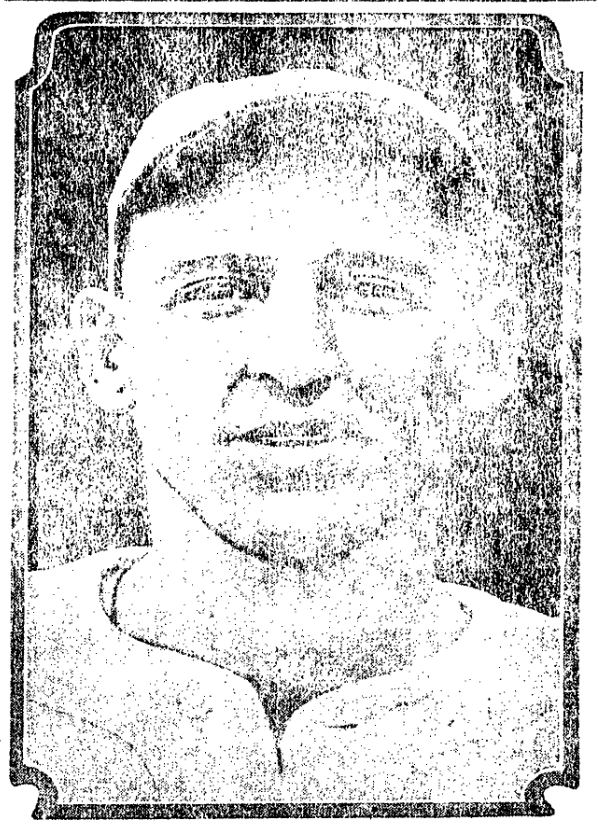
Outfielder Ira Flagstead
BOSTON. Fans are finding plenty to enthuse over in the 1926 edition of the Red Sox. There is youth and dash, plus an apparent improvement in team ability, and the followers of Lee Fohl’s rebuilding program are getting ready to forgive now other unfortunate teams for their lot. But, while much is being said of youth on the Boston Red Sox nine who is not quite as youthful as years before, it is the veteran providing the fireworks for the Boston fans just at present. He is Ira Flagstead, who patrols the outfield for the Nobles and who has been setting a wonderful example for his younger mates, and his friends believe he is in for the biggest season of his major league career. Hitting, fielding and throwing have all stood out in the veteran’s early work and he is the biggest influence on the team.
Flagstead, it will be remembered, warmed the bench and got into occasional skirmishes with the Detroit Tigers for a number of years before going to the Red Sox. Last season he amassed a .350 batting mark in 148 games, but nobody did very much for the hapless Boston team in 1925.
Ira was born in Montague, Mich., September 12, 1891, and now calls Little Rock, Ark., his home. He began playing ball with Tacoma in 1917, and was sold to Detroit the same year. Aside from being farmed to Chattanooga for a few months at the start of the 1919 season, he was with the Tigers until May, 1923, when he went to the Red Sox.
Ira hits from the third base side of the plate and also throws with his right arm.
Club Owners of A. L. Meet in New York
Revised Constitution of League Will Be Discussed; Washington Pitchers Said to Have Used Resin.
CHICAGO, Ill., April 27.—A meeting of American League club owners is set for Wednesday afternoon at the Belmont Hotel in New York. It is understood that the constitution of the league, which has been rewritten in part, is to be taken up with Ban Johnson. This matter was originally discussed at the meeting in Washington.
As far as is known, the resin bag, which the American League voted against, and which Commissioner Landis has made an important issue of, by insisting that it be available for pitchers in all leagues, no matter what the attitude of the club owners, was not to be the topic.
On the eve of the meeting, however, it was learned from an unofficial source that certain Washington pitchers were approached sometime ago and urged to “stand for their rights” and ask for resin. If the pitchers were to have asked for the “bag” and were denied it, it would have brought the American League into conflict with the commissioner’s wishes.
On top of this, came charges from Philadelphia players late last week that Walter Johnson and Dutch Ruether of the Washington staff were secretly using resin. In view of the fact that Johnson heretofore has pitched without the aid of “foreign substance” on the ball, this came as a big surprise to persons close to the game.
When the charges reached the ear of Ban Johnson, president of the American League, who championed the fight against the spitball and other trick deliveries some years ago, he immediately issued a warning to managers that they would be held personally responsible for any infraction of the league rules. Connie Mack, manager of the Athletics, is unalterably opposed to a revival of resin or any form of trick delivery.
President Clark Griffith of the Senators later denied that any of his pitchers were applying resin. When the matter of the resin bag originally came up, Griffith was listed among the “antis,” and voted that way when the American League took its position against the rule.
Shaughnessy Quits at Reading.
READING, Pa., April 27.—Frank Shaughnessy, following a poor showing by the Reading team in the International League race, turned in his resignation to the club. He left the city without making a statement, but his friends say he was not satisfied with the material given him to work with.
Byrd Lynn, veteran catcher, was named acting manager. Shaughnessy was manager of the Syracuse team until the middle of last season, when he took charge of the Providence team, which later became Reading in the double club transfer which shifted the old Reading Club to Newark.
Cardinals Offer Mails in Deal.
ST. LOUIS, Mo., April 27.—According to advice from Sacramento, the St. Louis National League club has offered Walter Mails, left-handed pitcher, and a catcher, presumably Ernie Vick, to the Sacramento Club of the Pacific Coast League for Catcher Merwin Shea. Shea is the backstop several major league clubs tried to purchase last Fall.
Louis Moreing, president of the Sacramento Club, is understood to have turned down the Cardinals’ offer. The local club made no comment on the matter. Mails came to the Cardinals from the Oakland Club a year ago.
Hugh Fullerton Picks Athletics and Pirates
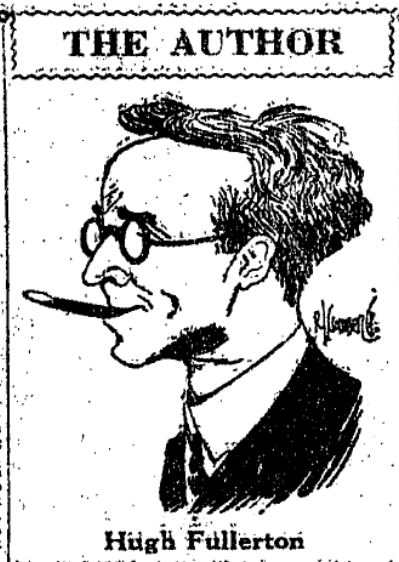
By Hugh Fullerton
Figures Browns and Giants Will Be Knocking at the Door
Noted Baseball Dopester Says Pittsburgh Will Continue to Improve; Reserves Have Been Wisely Added.
In Liberty:
PITTSBURG and the Philadelphia Athletics should meet in the World’s Series next Fall, if the dope strength of the teams as they figure during the Spring training works out. The New York Giants, with a better infield, will drive the Pirates a hard battle and, if there are weak spots at short and second fielding positions, may triumph through superior field generalship and recover their lost laurels.
The St. Louis Cardinals, a fast, noisy, and like a red hot team, should force the leader for a time, but most of the other teams are dangerous, save Cincinnati which relies almost entirely upon pitching, has an outside hitting chance.
The American League is a much more difficult proposition and there are so many ins in it that almost anything may happen. The race is close enough right now to be closely and bitterly fought. Five clubs have a chance to win, the rest Washington and New York, both composed of veterans, which took long before starting to rebuild. Both teams have the formation of great attacking power and, with Ruth back in shape, the Yankees will be powerful enough to take their way into the first division. They will present eight .300 hitters to cover other weaknesses.
The real fight, however, promises to be between the Athletics and the St. Louis Browns, who are ready to make their great bid for a championship. The Detroit Tigers, Cobb’s team, which lacked pitching for many years, also has been strengthened. The third base hole appears patched, and the team may be anywhere if the buck breaks and the vacancy at second base can be even fairly well filled, which it seems to be through the securing of Gehringer.
How They’ll Finish?
Hugh Fullerton, noted baseball analyst and commentator, believes that the world’s champion Pittsburg Pirates will continue to repeat in the National League, and that Philadelphia Athletics will triumph in the American. He lists his forecast as to how they will finish:
American League
Philadelphia
St. Louis
Detroit
New York
Washington
Chicago
Cleveland
Boston
National League
Pittsburgh
New York
St. Louis
Cincinnati
Brooklyn
Boston
Chicago
Philadelphia
Boston’s Red Sox may improve in field, they have started off the right track but they have impossible odds, handicapped. They depend largely upon a single pitcher and the rest of the staff is weak. They will finish last.
Chicago, always a problem, is more so now. The team was two winners last year until Collins damaged a leg, then it stopped entirely. It was playing better than it was entitled to do and the poor showing this year is a revelation. Trouble in the outfield, weak pitching and pitching. The White Sox have not lost promise to a greater extent. The youngsters are not so bad, and they may have to carry the team.
The Yankees are having a little of the explosion of last year. Ruth is back in form, but it is doubtful whether he can last through a third season. They were stronger a year ago, but the team is now better shape. Singer, Scott, Koenig, the infield has not had a real shortstop, and the promise of Tony Lazzeri, the best shortstop in the minor leagues, the infield. If Dugan’s knees hold up the infield will be fairly sound.
Pat Collins, from St. Paul, was the best catcher in the American, and the Yankees needed catching strength. Myles Thomas of Toronto rated the best of the International League pitchers, and youngsters, or two are trying to brace the pitching staff.
Turn to the National League and you find a different situation. Pittsburgh, strongest at the start, and developing its team, seems to have had more luck than anybody else in securing additional power or possibly Barney Dreyfuss shrewdly system of signing minor league players is paying off now. The Pirates secured Hal Rhyne and Wright reported the best infielder and outfielder in the Pacific Coast League, and their oldest rivals, the Giants, secured much needed additional pitching strength.
Rhyne probably will develop into a second baseman or winner, used part time in the outfield. Pittsburgh will have gained strength at first and second, but Stuffy McInnis, old Jess Stout, and Traynor can play first, throw, hit, and the infield is all right, where they can replace Carey’s major loss.
The Giants still are dangerous. In fact, despite McGraw’s reliance upon a bunch of faltering legs, they should give the Pirates a battle and perhaps beat them out. Young, Groh and Travis Jackson all have bad legs. By securing Tyron, perhaps the best outfielder of the American Association, McGraw has added to his team, and he should have no trouble at first and third, and not stand over young men. He can use Groh and McGraw is forced to switch players constantly. Pittsburgh should romp.
It has become a sort of habit to forget to figure St. Louis teams, but this season the Mound City promises excitement in both circuits. The Cardinals have a pitching chance to win a championship if their pitching stands up and something slips with the Pirate machine. Hornsby has a team of uneven strength. Bottomley and the make it big strongest at first and second. They have a short, weak hitter but good fielder, and Les Bell, a fair third baseman. Flowers, yet called from Oakland, may help. Thevenow, Blades, Mueller and Hafey form a strong outfield.
The Cards are strong in catching, with O’Farrell, one of the best in the business, Vick, formerly All-American center with Michigan, and Bill Warwick former University of Pennsylvania star, trained at Notre Dame, on the staff.
Cincinnati is very strong in star pitching, but not numerously, and is spotty, both in the infield and the outfield. It is dangerous at all corners but not likely to win consistently. The big ruin of the Reds, it seems to me, is securing Wally Pipp to play first, a position that he has been incompetent to handle most of the time since Jake Daubert’s death.
Brooklyn has improved in reserve strength at least, but like so many of the National clubs, is lacking instead of building entire. The trade with Brooklyn that brought Johnston, Taylor and Brown to Boston adds to the hitting strength. The team ought to win at least seven more games than it won last season, and make do better if the youngsters are tried in the outfield.