Sporting News Extras — April 29, 1926
Beyond the headlines and box scores, the April 29, 1926 edition of The Sporting News offered humor, poetry, opinion, and glimpses into the personalities that shaped the game.
Back Home Plate
By John B. Sheridan
Observations of a Veteran Scribe
Can a hitter imitate any other hitter in stance to the bat, his address to ball, swing, step, etc., with success? In a way, yes, for a great hitter. To advise other hitters to imitate his stance, address, swing, step, etc.? These questions occur to me because I note that some of the St. Louis National League players appear to be imitating Rogers Hornsby at the bat, adopting his far-away stance from the plate with what appears to me little success. I note that the Cardinal players have established a nefarious young theory for frequent strike-outs.
I have seen the Cardinals in but one game in 1926. That was on April 7, when Kauffman of the Cubs struck out nine of them, even if he did lose a tough nine-inning battle through his own wildness in the first inning. I noted in that game that two of the Cardinal right-handers, Bell and Hafey, were standing in the extreme left rear corner of the batter’s box, as far away from the plate as the rules permit.
That is the Hornsby stance. I noted, too, that Kauffman was beating Hafey and Bell with a fast curve ball, low and outside. I particularly noted that Bell hit not one fair ball on the outside corner and that the line of his bat stroke did not at any time or place intersect the line of the pitch. That means that Bell was hitting at balls which were beyond the latitudinal limits of his bat stroke. To me that means that Bell, a natural pull hitter, was standing too far away from the ball to do himself justice. These things apply to Hafey in a less degree, but although, like Bell, Hafey was being completely beaten by balls pitched.
As I remember, Hafey struck out on each of his first three times up without getting so much as a decent foul tip. Kauffman merely measured his bat strokes and kept the ball safely outside of his reach. As far as the opposing pitcher was concerned, he had the outside corner of the plate for his free, unimpeded usage. In other words, Hafey and Bell were standing so far away from the plate that they might as well have remained at home because they could not, with their particular styles of swing, defend the outside corner of that most important citadel, the well conceived attack of the pitcher. Kauffman was not a particularly good pitcher that day, because he lacked control to work corners closely, but he was good enough to beat Bell and Hafey every time they came up for his attention.
Withal, Hornsby stands in the extreme rear corner of the batter’s box and Hornsby is particularly strong in defense of the extreme outside corner of the plate. Why cannot Bell and Hafey do what Hornsby does?
It is quite true that Hornsby does stand as far back in the extreme rear corner of the batter’s box as the rules will permit. It is also true that Hornsby does defend the outside corner of the plate with most extreme efficiency. The outside corner of the plate is Hornsby’s strong point. But Hornsby is Hornsby and I assume that Hafey and Bell are Hafey and Bell.
Clarence Walker and Eddie Mann were death to left-handed pitchers. I have never had data kept on Hornsby’s hitting against left-handed pitchers. From mere observation I would say that Hornsby hits right-handers much better than he hits left-handers. This may appear to be an extraordinary statement. It is akin to saying that a certain left-handed hitter hits left-handed pitchers harder and oftener than he hits right-handed pitchers. I have never known of any such instance. Left-handed hitters have told me that they hit left-handed pitchers better than they hit right-handed pitchers.
A good left-handed hitter, now deceased, once told me that hitting left-handed pitchers was his strong point. I noted that whenever a crack left-hander appeared against his team that particular left-handed hitter who claimed to be sudden death and eternal damnation for left-handed pitchers, reported absent that day.
Be that as it may, I have formed the impression that the great Hornsby, unquestionably one of the greatest, if not the greatest, hitters of all time, is more effective against a good right-handed pitcher, such as Alexander was and, I trust in mind, will long continue to be, than he is against an ordinary left-handed pitcher like Clarence Mitchell. I am not exactly informed on Hornsby’s record against these pitchers, but I have seen him clout Alexander’s best fast curve, low and outside, in the dark of the evening, against the right field fence for a two-base hit to win a game, and I have seen the same Hornsby unable to hit the apparently slow ball of Clarence Mitchell past the pitcher’s plate on a bright day.
The reason is logical enough. Hornsby likes them on the extreme end of his bat, which means that to get best results the ball must be as far away as he can conveniently reach, which is somewhere between the plate and the south pole. Hornsby’s bat is like a golf driver, all the driving power on the extreme end. So when the cunning left-hander sends the ball towards Hornsby, that great hitter is liable to catch it six or more inches from the extreme end of the bat. Being like a golf driver, Hornsby’s bat has no driving weight except for about four or five inches at the extreme end.
The curve ball of the right or left-handed hitter will fool the best of pullers so that they cannot hit it with a certain spot in the bat as easily as a Hornsby or any good driver or cutter can hit the ball with the bat when they aim to drive to center or out to right. Anyhow, I like the bat with plenty of driving space. Ruth’s bat, for instance, more than Hornsby’s bat, is, in effect, a wooden golf club, all its driving power concentrated in the extreme end.
Hornsby can hit the ball outside, not so much because of his peculiar stance in the extreme rear end of the box, though that is a contributing factor, but because of his attack, because of his step towards the plate, not towards the pitcher, and his lunge after the ball. When Hornsby starts to hit, he starts towards the plate. This start enables him to follow the ball and hit it even when it is far outside of the plate.
Hornsby observes one great fundamental of all ball games—always going toward the ball when you hit it, or catch or throw it. Now, most hitters are not going toward the ball when they hit at it. They are going toward the pitcher. Some of them are going toward the third baseman.
The pulling hitter will not be going toward first base as Hornsby is going when he hits at the ball. The best the pulling hitter can do is to step towards the pitcher, whereas Hornsby steps toward the ball, not towards the pitcher, but at right angles from the pitcher. For this reason a ball on the outside will worry the pulling hitter. He cannot be going towards it as Hornsby, the driving or cutting hitter, goes toward it.
I do not know that Hafey, Bell and other Cardinals are consciously or unconsciously endeavoring to imitate their great hitting manager in standing off from the plate, but I do observe that in so standing, these young men are making serious mistakes. They are not drivers and cutters like Hornsby is. Bell, at least, is a natural pulling hitter. Therefore I do not believe that they can adopt Hornsby’s style with advantage to themselves or to their team.
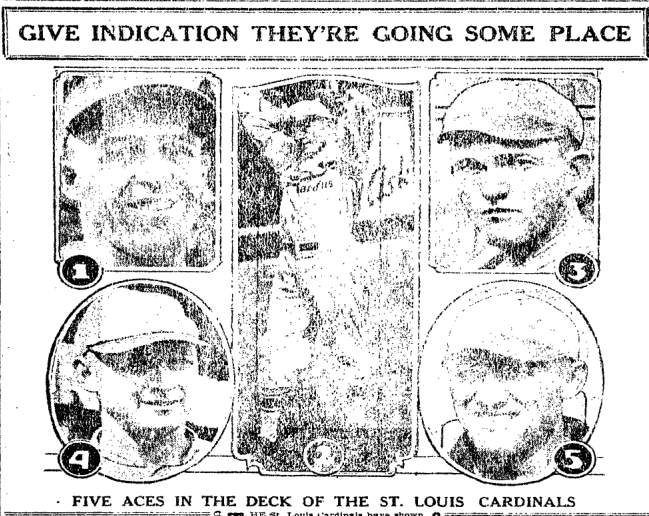
Give Indication They’re Going Some Place
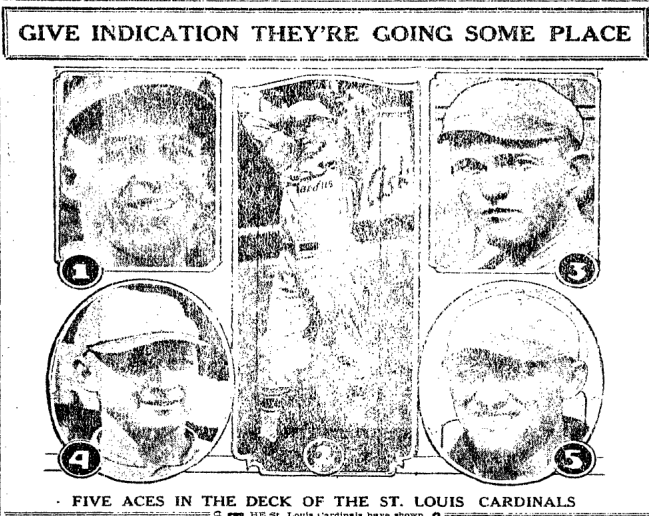
THE St. Louis Cardinals have shown an early season dash which indicates that they will keep faith with the dopesters who picked a high finish for them in the National League race. Hornsby’s team has not gone along solely on offensive strength, but the pitching thus far has been better than most observers expected.
In the group are shown (1) Jim Bottomley, slugging first baseman; (2) Charles Reinhart (Flint), young southpaw, who has gotten away to a good start; (3) Mickey O’Farrell, ace catching; (4) Bob O’Farrell, clever outfielder; (5) Heinie Mueller, St. Louis home-bred outfielder, who has been playing the best game of his career.
Baseball By-Plays
By L. H. Addington
When a Pitcher Needs a Friend
When everything is rosy,
And the game is runnin’ on;
And you’re mowin’ down the hitters,
All up and down the line;
When your curve is breakin’ dandy,
And your fast one has a hop,
And plunks into the catcher’s mitt,
With a loud and cracking pop;
When your club is way ahead in front,
With runs enough to spare,
Then’s when the world seems rosy,
And your heart is light as air.
The other times it ain’t so good,
You’re off your usual stride;
And everything you try to throw,
The batters drive a ride.
Your curve ball simply will not break,
Your fast one has no zip;
Your flingers start to nick the ball,
And all get struck with pip.
The umpires both have lost their sight,
They miss a hundred plays;
They both seem set against you,
In a dozen different ways.
Your club is run and runs behind,
You wish the game would end;
Then’s the time, I tell you, boys,
When a pitcher needs a friend.
Baseball By-Plays
Mrs. J. C. Dunn, owner of the Cleveland Club, and Mrs. Tris Speaker sat with a party of friends in a box at one of the recent games at Chicago. Mrs. Speaker, who has become quite expert on the game of baseball, remarked to Mrs. Dunn: “I think Joe Sewell is going to start hitting soon.” Joey had just flied out.
“So is your old man,” retorted Mrs. Dunn; “that’s the way the story goes.”
And Colonel Tris Speaker knocked out a home run and double, or something like that.
By George Moriarty
To Max Carey
Here’s a line to you, Max Carey,
As a base thief, you’re alone;
You have made the catcher wary,
Everyone of them you’ve shown.
There is nothing to keep still for
If a guy ain’t sick in bed,
So you speed up and then pilfer
Just a base or three ahead.
And the while you keep on sitting,
You have proved beyond a doubt,
All the fame is not in hitting,
All the art is not in clout.
You are fast and clever very,
And while sneaking off the sacks,
You are nothing less, Max Carey,
Than the phantom of the bases.
Clarence Bill Huber, the Phillies’ captain, has saluted a couple of first-class noncom officers during his baseball career—Lieutenant Bill Brandt. The last time he was captain of a team was in 1915, during the well-known war.
Bill was in the Third Infantry, Regular Army, stationed along the Mexican border. His company was bossed by Captain John McEwen, the famous West Point football player, afterward head coach at the Point. McEwen appointed Clarence Bill captain of the company baseball team.
He also nominated him corporal. Bill declined. McEwen informed Bill that in the army you didn’t decline. You obeyed the captain’s orders. So Bill became a corporal.
As captain of the company team, a few days later, he ordered the first baseman to go up there and bunt. The first baseman, who was none other than the dashing second lieutenant of the outfit, went up there and swung.
Captain Huber laid down the law to the lieutenant, and considerable animosity transpired on the bench. The next morning on the parade ground Clarence Bill was called forth from the line by the first baseman and ordered to put his squad through its paces. It didn’t go so good.
But Captain McEwen fixed up the feud and the war ended happily.
Last Summer, his wrath aroused by the abuse directed at him by bleacher rooters, Jack Fournier of the Robins threatened to leave the club and followed up this threat by a letter to newspaper friends explaining his position. It was through the medium of this letter that many fans were made aware of a certain flair possessed by Fournier for the written game. His epistle to the sports scribes was a model of clarity, incisiveness and style.
Yes, the slugging first baseman knows how to lay his words, and so that they’ll express what he has in mind. This was made evident during the past Winter down in Florida, where Jack was peddling real estate. He had devoted practically the whole of one day to a “prospect” highly touched for driving him hither and yon, buying him food and taking him to sporting events. At the close of the day, Jack made some casual reference to the possibility of transacting some business.
“Well,” said the customer, “you haven’t shown me anything I’d care to buy. No, I’m afraid I’m not interested. Au revoir—till we meet again.”
Fournier looked at him quizzically.
“Must we do that?” he queried gently.
A former member of the Giants, who later turned out to be a successful college baseball coach, was lamenting the lack of brains on his campus squad.
“Well, sir,” he said, “I’ve taught these fellows every blankety-blank thing I ever knew and I’ll be darned if they know a thing now.”